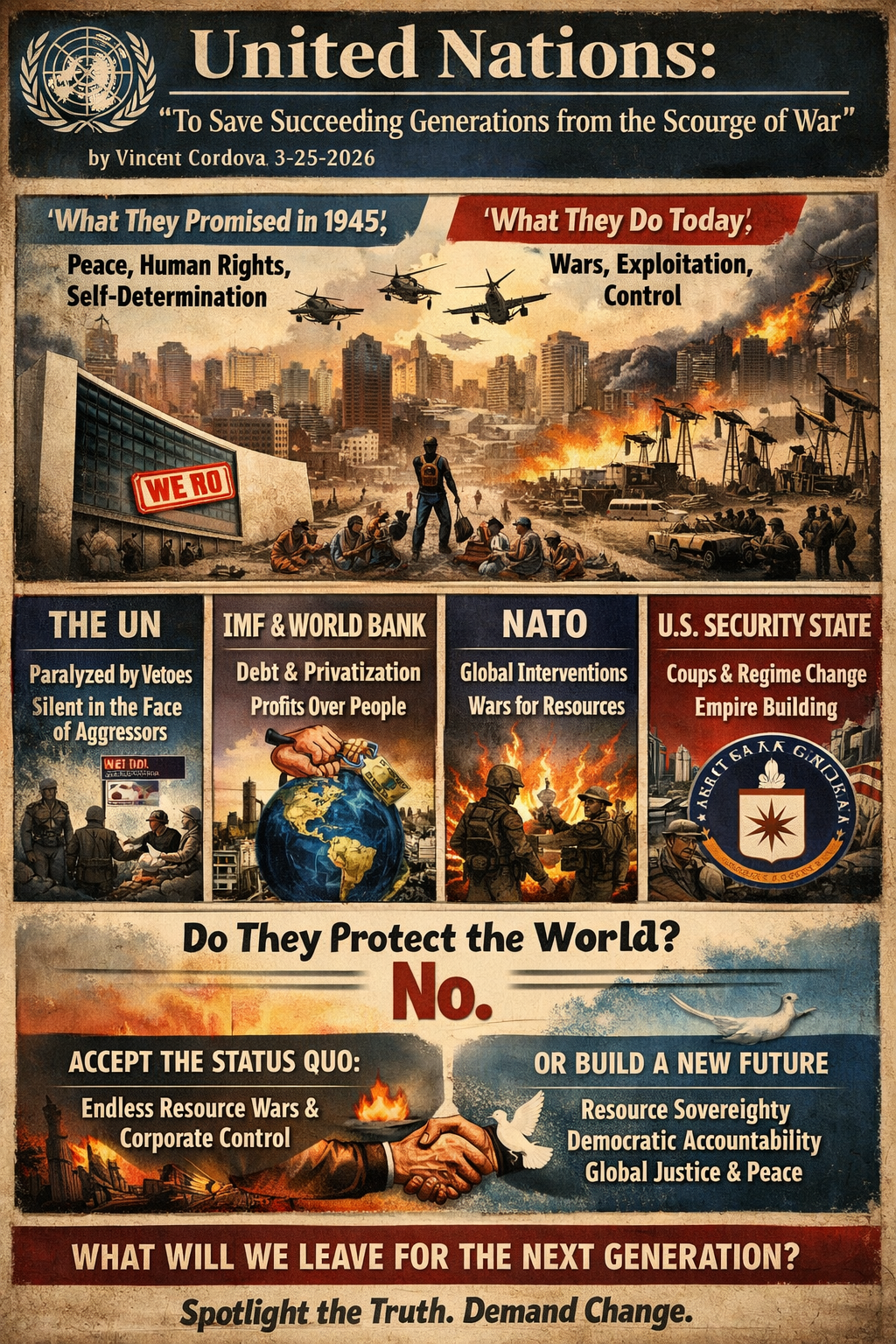
Campaign design team
The 1940s Blueprint: How Institutions Built to “Save the World” Became the Machinery of Control
By Vincent Cordova · March 25, 2026
We are still living in the 1940s.
The architecture that governs global finance, security, and diplomacy was forged between 1944 and 1949. Its creators sold it as the foundation of a peaceful, prosperous, and just world. Today, that same architecture enables resource wars, shields the powerful from accountability, and leaves ordinary people bearing the cost.
This blog is a spotlight. We will walk through each institution born in that era—what it promised, what it actually does today, whether it has made life better for the public, and whether we can trust it to protect the world or only private interests.
Finally, we will ask the essential question: Do we want to leave these institutions as they are, return them to their original promises, or build something new that represents our era and serves the generations to come?
The 1940s Blueprint: An Architecture for Control
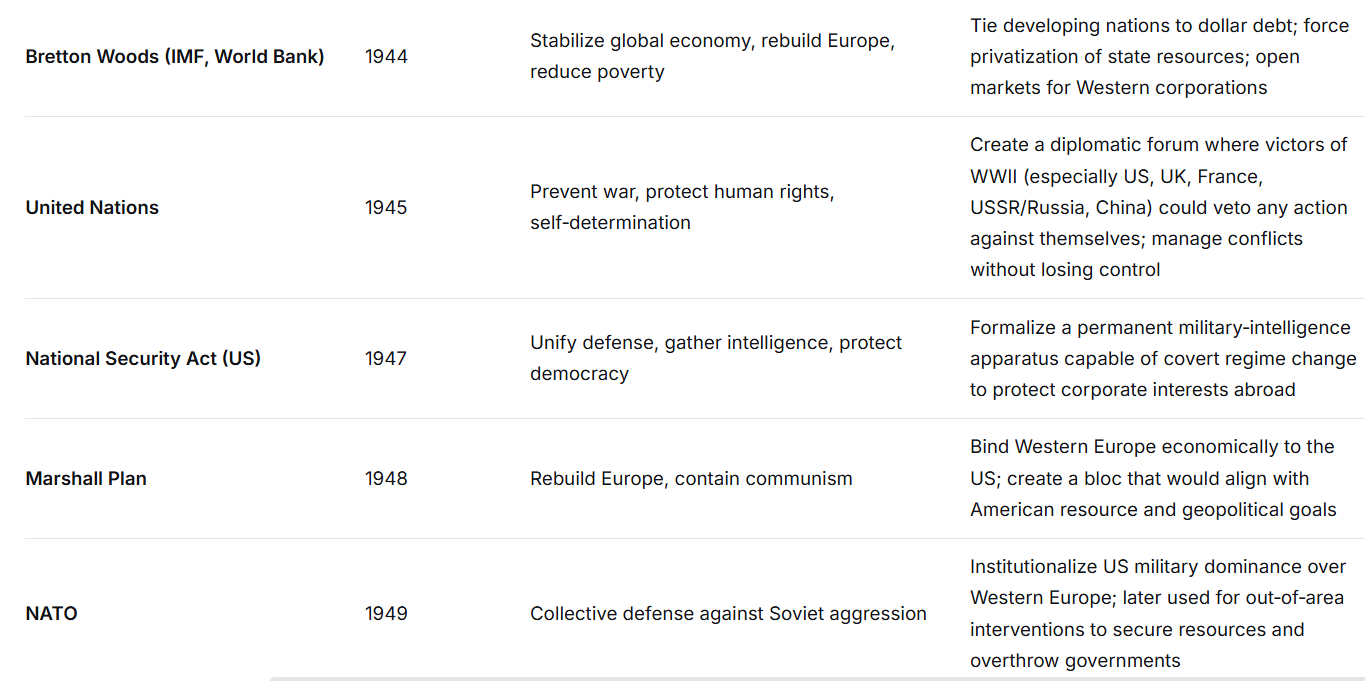
The years 1944–1949 saw the creation of the core institutions that still shape our world. Each was launched with a noble mission. Each was also designed, from the start, to lock in the dominance of a small group of powers and their corporate allies.
| Institution | Year | Stated Purpose | Hidden Design Function |
|---|---|---|---|
| Bretton Woods (IMF, World Bank) | 1944 | Stabilize global economy, rebuild Europe, reduce poverty | Tie developing nations to dollar debt; force privatization of state resources; open markets for Western corporations |
| United Nations | 1945 | Prevent war, protect human rights, self‑determination | Create a diplomatic forum where victors of WWII could veto any action against themselves; manage conflicts without losing control |
| National Security Act (US) | 1947 | Unify defense, gather intelligence, protect democracy | Formalize a permanent military‑intelligence apparatus capable of covert regime change to protect corporate interests abroad |
| Marshall Plan | 1948 | Rebuild Europe, contain communism | Bind Western Europe economically to the US; create a bloc aligned with American resource and geopolitical goals |
| NATO | 1949 | Collective defense against Soviet aggression | Institutionalize US military dominance over Western Europe; later used for out‑of‑area interventions to secure resources |
These institutions were sold to the public as instruments of peace, prosperity, and protection. But from the beginning, they were also instruments of capture—designed to ensure that the world's resources and markets remained under the control of a Western corporate‑state elite.
Campaign design team
United Nations: “To Save Succeeding Generations from the Scourge of War”
What they said in 1945: The UN Charter promised a world where collective security would replace unilateral aggression, where human rights would be universal, and where self‑determination would be respected.
What it does today:
- The Security Council is paralyzed when its permanent members (the US, Russia, etc.) are the aggressors or have allied interests.
- Resolutions condemning invasions, bombings, and occupations are vetoed repeatedly.
- The UN is used as a humanitarian fig leaf: peacekeepers are deployed after wars have already reshaped resource control, not to prevent them.
- In the current Venezuela operation (2026), the UN has issued statements of concern but taken no action against the US capture of a member state's oil industry.
Has it made life better for the public? For some—through humanitarian aid, refugee programs, and development agencies—yes. But as a peacekeeper, the UN has failed to stop any major resource war since its founding. The public in countries targeted by interventions (Iraq, Libya, Venezuela) have seen their lives destroyed while the UN watched.
Are they who they said they were? No. The UN was sold as a global conscience. In practice, it is a stage where powerful states perform accountability while acting with impunity.
IMF & World Bank: “To Rebuild Economies and Reduce Poverty”
What they said in 1944: Stabilize currencies, provide loans for development, and lift the world out of post‑war poverty.
What they do today:
- Impose structural adjustment programs that force debtor nations to privatize state‑owned resources (oil, water, mines), cut social spending, and open markets to foreign corporations.
- When countries try to nationalize resources (like Bolivia under Evo Morales or Argentina under the Kirchners), these institutions often tighten credit or demand reforms that reverse those gains.
- They function as debt enforcers, ensuring that resource‑rich nations remain in a cycle of dependency rather than sovereign control.
Has it made life better for the public? No. The IMF’s own research has admitted that structural adjustment increased poverty and inequality in many countries. Public services—health, education, infrastructure—were gutted while foreign corporations acquired mines, oil fields, and utilities.
Are they who they said they were? No. They were sold as development banks. They became debt collectors for Western financial interests.
NATO: “To Safeguard the Freedom and Security of Its Members”
What they said in 1949: A purely defensive alliance. Article 5: an attack on one is an attack on all.
What it does today:
- Expanded eastward despite promises not to, provoking the very tensions it claims to deter.
- Conducted “out‑of‑area” wars in Kosovo (1999), Afghanistan (2001–2021), Libya (2011)—none of which were attacks on a member.
- In Libya, NATO bombed for months, overthrew Gaddafi, and left the country a failed state. Western oil companies immediately moved in. The stated purpose was “civilian protection.” The result was resource access.
- Currently, NATO members are coordinating on Venezuela and Iran—not to defend themselves, but to reshape energy markets.
Has it made life better for the public? For citizens of member states, the alliance has provided a security umbrella—though at the cost of wars that have killed hundreds of thousands and created refugee crises that destabilize regions. For publics in targeted nations, NATO has brought bombing, chaos, and foreign corporate control.
Are they who they said they were? No. It was sold as a shield. It has become a sword—used to secure resources and enforce a hierarchy favorable to its members.
The US National Security State (CIA, Pentagon, etc.)
What they said in 1947: Protect the nation from foreign threats, gather intelligence, and defend democracy.
What it does today:
- Conducts covert regime change when elected leaders threaten corporate interests (Iran 1953, Guatemala 1954, Chile 1973, Honduras 2009, and dozens more).
- Maintains over 800 military bases worldwide—a network designed to secure energy corridors and resource flows.
- In 2026, US Special Forces captured the president of Venezuela and began asserting direct control over the country’s oil industry, with the stated goal of opening it to American companies.
- It is currently conducting military strikes against Iran—again framed as nuclear threats, but with the long‑term aim of gaining access to one of the world’s largest oil and gas reserves.
Has it made life better for the public? For the American public, trillions of dollars have been diverted from healthcare, education, and infrastructure to fund these operations. For publics in targeted countries, the result has been death, displacement, and the loss of resource sovereignty.
Are they who they said they were? No. The national security state was sold as a defensive shield. It has become a mechanism for corporate‑backed resource conquest.
The Bretton Woods System & Dollar Hegemony
What they said: Stable currencies and free trade would create shared prosperity.
What it does today:
- The US dollar remains the world’s reserve currency, giving the US the power to impose sanctions that can cripple any nation that defies its resource agenda.
- Countries that try to trade in other currencies (like Iraq under Saddam or Libya under Gaddafi) have been targeted for regime change.
- The system ensures that most nations must hold dollars, buy US debt, and remain vulnerable to US financial warfare.
Has it made life better for the public? The dollar system has given the US public a privileged position—but at the cost of perpetual war to defend it. For the majority of the world, it has meant vulnerability to sanctions, currency crises, and debt traps.
Are they who they said they were? No. Bretton Woods was sold as a global public good. It became a mechanism for financial dominance.
Where Are These Institutions Today—While Wars Rage?
Let’s look at what these institutions are doing right now, as the US conducts military operations in Venezuela and Iran, as wars continue in Ukraine and Gaza, and as resource competition intensifies.
- The UN Security Council has held emergency sessions but taken no binding action against the US for capturing Venezuela’s president or attacking Iran.
- NATO has supported the US operations while claiming they are “not NATO missions.” Yet NATO’s infrastructure and intelligence sharing are fully integrated.
- The IMF has not imposed sanctions on the US for violating international law; instead, it is preparing “post‑conflict reconstruction” loans that will lock in the new resource arrangements.
- The World Bank continues to fund projects in countries destabilized by these interventions, effectively normalizing the new order.
- The US national security apparatus is openly coordinating with oil companies to take over Venezuelan and Iranian fields.
These institutions were created to prevent such outcomes. Instead, they are either complicit or powerless to stop them.
Can We Trust Them to Protect the World?
No. They protect the world only when it aligns with the private interests of their most powerful members. When those interests conflict with peace, human rights, or self‑determination, the institutions either stand aside or actively facilitate the outcome.
This is not a failure of the institutions—it is their design. They were built to secure the interests of the victorious powers of 1945 and their corporate allies. That they now enable resource wars and shield the perpetrators is not a bug; it is the original feature.
Following the Money: Who Benefits from the Wars?
When we strip away the rhetoric about democracy, freedom, or national security—when we follow the material reality—we find the corporations that stand to gain from access to resources. The wars and interventions we’ve discussed aren’t abstract geopolitical conflicts. They are operations that open doors for specific companies. Here’s who is benefiting right now.
Venezuela: Chevron and Shell Move In
Following the capture of President Maduro in January 2026, Venezuela’s National Assembly passed a sweeping reform of the country’s oil law, granting foreign companies unprecedented autonomy to operate, export, and sell Venezuelan oil—even as minority partners of state‑owned PDVSA (Reuters, Feb 15, 2026). The result? Chevron and Shell are closing in on the first major production deals since the political upheaval (TheStreet, March 10, 2026).
Chevron’s expansion: Chevron is negotiating to expand its largest Venezuelan project, Petropiar, in the Orinoco Belt—home to over three‑quarters of the country’s crude reserves. The deal would give Chevron rights to the Ayacucho 8 area, a largely undeveloped block with proven oil resources. Petropiar currently produces about 90,000 barrels per day of upgraded crude and 20,000 barrels per day of vacuum gas oil. Chevron aims to secure reduced royalty rates and tax incentives under the new legislation, potentially becoming the largest private producer in the Orinoco Belt (Reuters, March 5, 2026).
Shell’s strategy: Shell has signed preliminary agreements to develop the Carito and Pirital fields in the Monagas North region—one of the few areas in Venezuela producing light and medium crude and natural gas, prized for blending to facilitate exports of heavy oil. The Punta de Mata area (including these fields) produced about 94,000 barrels per day of crude and 1.03 billion cubic feet per day of gas last month, with roughly 350 million cubic feet per day currently flared—indicating significant infrastructure opportunity (Reuters, March 8, 2026).
Why now? The timing is not coincidental. As the Iranian crisis deepens and the Strait of Hormuz—which normally carries 20% of the world’s oil—becomes increasingly volatile, both companies are moving to secure supply outside the Gulf. As TheStreet analysis put it: “When geopolitical shocks make people worry about chokepoints, majors tend to look more closely at underdeveloped basins that could help them get more supplies in the future.”
Iran: The Other Side of the Resource War
While the Strait of Hormuz crisis directly threatens global oil supply, it also creates opportunity. When Brent prices briefly hit $100 a barrel on March 12, 2026, and Gulf producers cut production by about 10 million barrels per day, the value of reserves outside the Gulf increased dramatically (Reuters, March 12, 2026). Chevron and Shell’s Venezuela moves are explicitly framed by analysts as a response to this market reality.
Meanwhile, the energy sector has become the stock market’s top performer in 2026, with the Energy Select Sector SPDR Fund (XLE) surging 14.18% in early 2026 as investors rotated into energy stocks amid geopolitical instability (MarketWatch, March 15, 2026).
Tesla and the New Resource Wars
The resource wars of the coming decade won’t just be about oil. They will be about lithium, cobalt, nickel, and rare earths—the minerals that power electric vehicles and renewable energy. Tesla’s business model hinges on these battery materials. Yet China dominates processing: over 65% of global cobalt and 55–65% of lithium (CFR, 2025). The Democratic Republic of Congo accounts for 60% of global cobalt production, with all the associated political instability and ethical concerns (Amnesty International, Dec 2025).
When the U.S. government frames interventions as “securing supply chains” or “countering Chinese dominance,” Tesla—and the broader EV industry—is the direct beneficiary.
The Pattern: Conflict Creates Opportunity
| Conflict/Intervention | Corporate Beneficiaries | Resources Secured |
|---|---|---|
| Venezuela operation (2026) | Chevron, Shell, SLB, Halliburton | Oil, natural gas |
| Iran conflict / Strait of Hormuz crisis | All oil majors (via price & supply effects) | Oil (indirectly, through price and diversification) |
| Potential resource competition with China | Tesla, EV manufacturers, battery producers | Lithium, cobalt, nickel, rare earths |
| AI infrastructure build‑out | Chevron, GE Vernova (gas plants for data centers) | Natural gas, electricity, strategic land/water rights |
One analyst put it bluntly: “The market is saying show me the disruption to supply before materially responding” (TheStreet, March 10, 2026). In other words, markets price in the expectation of disruption—and corporations position themselves to profit from it.
The evidence confirms what you, the reader, already suspected: when we see war with Iran or Venezuela, it is not for government control. Our government is being used for private interest. These wars are not making the lives of the public better in any way. Chevron and Shell are not moving into Venezuela because they care about Venezuelan democracy; they are moving in because the political obstacle was removed by U.S. military action, the legal obstacle was rewritten, the market incentive makes Venezuelan reserves suddenly strategic, and the financial opportunity makes it profitable. The public—both in Venezuela and in the United States—bears the costs.
A Forward‑Looking Direction: What Do We Do Now?
We have three choices:
- Leave them as they are. This means accepting that these institutions will continue to serve private interests, enable resource‑driven violence, and leave the public to bear the cost. The current trajectory will intensify as competition over resources—lithium, oil, water, rare earths—sharpens.
- Return them to their original promises. This would mean ending the veto power in the UN; making Security Council decisions binding; cancelling debt tied to structural adjustment; mandating that IMF loans cannot force privatization; returning NATO to Article 5 defense only; and ending covert regime change. This is unlikely without massive political pressure, because the same powers that benefit from the current system control the reform mechanisms.
- Create new institutions for a new era. If the old institutions cannot be reformed, we must build alternatives that represent the needs of this generation and the next. These would be grounded in resource sovereignty, democratic accountability, public purpose, and peaceful coexistence. This is already happening in small ways: the Non‑Aligned Movement in the Cold War, the New International Economic Order proposals of the 1970s, and today’s resource nationalism in countries like Argentina, Indonesia, and several African nations. These are seeds of an alternative architecture.
Conclusion: The Only Path Forward
We have laid bare the architecture built in the 1940s—institutions launched with promises of peace, prosperity, and protection. We have seen what they actually do: enable resource wars, shield the powerful from accountability, and leave ordinary people to pay the price in blood, displacement, and stolen sovereignty.
Now we arrive at the question that cannot be avoided: How can the public—globally—trust or defend institutions that never had the public’s interest at heart?
The honest answer is brutal: we cannot, and we should not. Trust was never earned. It was manufactured with noble language while the machinery was designed for something else. Defending these institutions today—making excuses for their failures, celebrating minor achievements while ignoring their systemic violence—only prolongs their legitimacy. The public’s role is not to defend the indefensible. It is to demand accountability, and when that is impossible, to build something new.
The only trust that matters is built by action. We will never trust the IMF or NATO in the way we trust a fire department or a public library—because those institutions were never ours. They were built to serve the interests of a small group of powerful states and the corporations that move with them.
The task before us, then, is not to rehabilitate the old architecture. It is to render it obsolete by creating systems that actually serve human life.
This is already happening in fragments: nations asserting resource sovereignty—keeping oil, gas, lithium, and minerals under public control rather than auctioning them to foreign corporations; movements demanding debt cancellation and refusing IMF structural adjustment programs that force privatization of essential services; regional alliances like BRICS+ and the resurgence of the Non‑Aligned Movement’s spirit—building trade, finance, and security cooperation outside the Western‑dominated framework; grassroots networks across borders sharing knowledge, exposing interventions, and creating solidarity that governments cannot ignore.
These fragments are the seeds of a new era. They are not perfect, but they are accountable—because they are built from below, not imposed from above.
The Spotlight Stays On
The blog you have read is a spotlight. It shines on the gap between promise and reality, between the words of 1945 and the wars of today. But a spotlight alone does not build a new world. It only reveals what must change.
Now the work moves from exposure to construction. The question is not whether we can trust the old institutions. It is whether we have the courage to build new ones—worthy of trust, accountable to the public, and designed not for the interests of a few, but for the flourishing of all.
A Final Word: Taking the Helm Together
I am not writing this to destroy any country, nor to tear down what can still serve the public good. I am writing because for five hundred years—through colonialism, through the institutions of the 1940s, through every war fought under a banner of freedom—the pattern has remained the same. A small few decide, and the many bear the cost.
We have to ask ourselves honestly: has the last few decades made life better or worse for the ordinary person? For some, there have been gains—technology, medicine, communication. But for the majority of the world, the trends are grim: widening inequality, a climate crisis born of the same resource extraction, and wars that take everything from people who never wanted anything but to live in peace on their own land.
So which direction are we headed? If we continue as we are—letting the old institutions drift, trusting them to protect us when they were never built for that—the path leads to more competition over fewer resources, more interventions disguised as humanitarianism, and more of our humanity surrendered to systems that do not answer to us.
But there is another direction. It does not require us to become enemies of our own countries. It requires us to recognize that we are passengers on a boat that has been steered for centuries by a small crew, often toward shores we did not choose.
Is it time to take control of the boat? Yes. Not by sinking it—but by learning to navigate together. That means: holding the institutions we have to their stated principles, and when they refuse, building new ones that answer to the public; refusing to let resource wars be fought in our name, whether we are citizens of powerful nations or of nations that have been targeted; choosing solidarity over division, because no public anywhere benefits from watching another public be sacrificed for oil, lithium, or strategic advantage.
We are not the first generation to see the gap between promise and reality. But we may be the last generation that can afford to look away.
The boat is ours. The helm is within reach. The only question is whether we will take it—together, globally, with the clarity that the old way has had its chance and has left us with centuries of wounds.
Let this be the era not of new institutions that mimic the old, but of a new kind of power: accountable, collective, and finally turned toward life.
If this resonates, share it. The spotlight only works when it’s held by many.
Community Comments
Community Comments
Share a public response to this post. Submissions are reviewed before they appear.
0 approved comments
Loading comments...