Economic Justice
The Last Stage of Empire: Loot, Exit, Global Solidarity, and How We Capture the Currency Before the Psychopaths Do
Vincent Cordova argues that late-stage imperial decline now looks like internal looting, private credit control, and social exhaustion, and that public banking, local currencies, and global solidarity are the only serious counter-power.
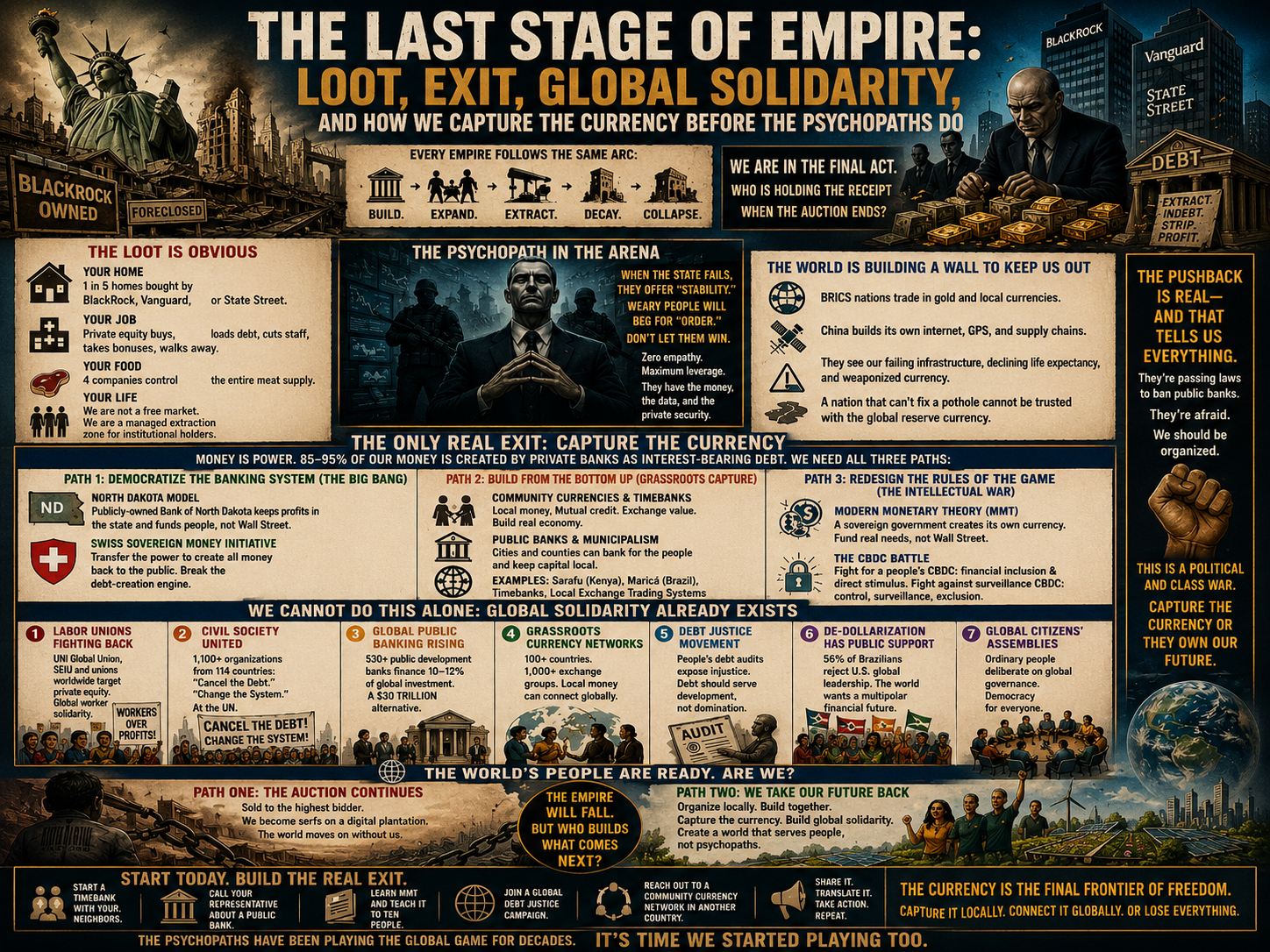
The currency is the final frontier of freedom. Capture it locally. Connect it globally. Or lose everything.
Every single empire in human history has followed the same arc: build, expand, extract, decay, collapse.
We are living in the final act of the American Empire. But we are not falling to foreign invaders with tanks and missiles. We are being liquidated from the inside. The question is no longer if we fall, but who is holding the receipt when the auction ends.
And my mind keeps coming back to one thing: currency.
Because if you control the money, you control the game. And right now, we do not.
How Did We Get Here?
It did not start with one bad election or one greedy CEO. It started with a quiet legal coup decades ago. We gradually allowed the financialization of everything: healthcare, housing, food, education, even water.
We stopped being citizens and started being assets.
The mechanisms were simple: deregulate the predators, let private equity buy up main street, strip the value, load the debt onto the company, and walk away with the cash. When the company dies, blame the workers.
The Institutional Landlords of America
Look around you. Who actually owns your life?
Your home is increasingly captured by institutional holders like BlackRock, Vanguard, and State Street. Your job may already depend on a hospital or local employer bought by private equity, hollowed out, and leveraged until collapse. Your food system is controlled by concentrated monopolies that can call price gouging inflation and get away with it.
We are not a free market. We are a managed extraction zone for institutional holders.
The Global Exclusion Zone
The rest of the world sees what we refuse to admit. Our infrastructure is failing. Our social fabric is torn. Our currency is a weapon, not a trust.
Why are BRICS nations moving toward gold settlements and local-currency trade? Why is China building its own internet, GPS, and supply chains? Because they are building lifeboats. They are building walls to keep us out of a future they no longer trust us to manage.
They see the bridges collapsing, the life expectancy decline, the fentanyl crisis, and the inability of a decaying empire to maintain basic public goods. When the petrodollar order weakens and sanctions recoil inward, the field will not become fair. It will become empty, and the most ruthless actors will try to inherit it.
The Psychopath in the Arena
If the public sphere collapses, if the rule of law becomes a suggestion and the social contract is shredded, who controls the playing field? Not the idealists. Not the social workers. Not the small business owners. The psychopaths.
Private equity has spent decades training executives in sociopathy: zero empathy, zero loyalty, maximum leverage. When the state fails, these are the people with private security, behavioral data, and real rehearsal in how to destroy towns for profit.
They will not arrive waving flags. They will arrive offering stability. They will offer order. And a tired public can be manipulated into begging for the same structure that consumed it.
But Here Is the Only Real Exit: Capture the Currency
You cannot fight an empire of private credit with protest signs alone. You cannot vote away institutional control. The only lever that matters is the money itself.
The dirty secret is that the vast majority of money in circulation is not created by the government. Commercial banks create most of it as bank-created credit money every time they issue a loan. Private banks, accountable primarily to shareholders, create the money supply as interest-bearing debt.
That is why we are drowning. That is why the psychopaths are winning. The radical question becomes: how does the public capture the currency?
Path 1: Democratize the Banking System
The Bank of North Dakota remains the clearest domestic proof of concept. The state deposits public revenues there. The bank backs local lending, infrastructure, and public purpose. Profits cycle back to the state instead of being siphoned to Wall Street.
The Swiss Sovereign Money Initiative pushed the more radical edge of the same argument: commercial banks should not control money creation. Even though it failed at the ballot box, it clarified the real line of struggle. If private banks control issuance, private power controls society.
Path 2: Build from the Bottom Up
We do not need to wait for federal permission to start building new monetary relationships. Community currencies, timebanks, and mutual-credit networks already exist. Kenya's Sarafu network showed that local digital currency can unlock real exchange even where national money is scarce. Timebanks prove that care and labor can be valued without surrendering everything to extractive finance.
Cities and counties can also pursue public banking. A municipal public bank can support student lending, local enterprise, and infrastructure while keeping financial capital circulating inside the real economy instead of ejecting it into global extraction chains.
Path 3: Redesign the Rules of the Game
Modern Monetary Theory matters because it breaks the household-budget lie that keeps populations obedient. A currency-issuing government is constrained by real resources and inflation, not by the mythology that it must kneel before private capital markets to fund public needs.
The CBDC fight matters for the same reason. A public retail CBDC could become a tool of democratic distribution and public balance-sheet power. A surveillance CBDC would be a nightmare of programmable obedience. The issue is not digital money in the abstract. The issue is who governs it, for whose benefit, and under what democratic limits.
But We Cannot Do This Alone
People keep asking whether citizens in the United States can get global support. The answer is yes, but only if we understand that private equity, debt extraction, and monetary domination are global systems. The resistance is already global too.
Labor unions, debt-justice campaigns, public-banking researchers, community-currency networks, and global citizens' assemblies are all building fragments of a counter-system. The private-equity model is global. The answer cannot remain provincial.
But Here Is the Hard Truth
All of this global solidarity exists, but it is waiting for more Americans to join. Movements in the Global South have been carrying this fight for decades while bearing the weight of IMF austerity, World Bank restructuring, and debt imperialism.
They will stand with us, but only if we stand with them. That means learning from Brazil, India, Kenya, Ghana, Argentina, and the Philippines instead of assuming the United States is the natural center of every answer.
The Pushback Is Real
The moment the public tries to claw back monetary power, entrenched interests fight back. Some U.S. states have already introduced bills to prohibit local public banks before they can even scale.
That tells us everything. Capturing the currency is not a technical dispute. It is political conflict and class war. Public banks, local currencies, debt cancellation, and publicly governed digital money all threaten the core extraction engine, so the holders of that engine move early to block them.
The Only Question Left
Path one is the auction. We get sold to the highest bidder: sovereign wealth funds, techno-feudal platforms, militarized conglomerates, or some hybrid of all three. The rest of the world keeps building new systems while we are left isolated, exhausted, and ruled by psychopaths.
Path two is waking up. We stop waiting for a savior in Washington. We fight for public banks. We launch community currencies. We learn MMT. We demand public control without surveillance tyranny. And we link arms with labor unions, debt-justice campaigns, and mutual-credit organizers across borders.
The looting is obvious. The decay is terminal. The empire will collapse. The open question is whether we are sold into the next prison or whether we build a different future together before the auction closes.
Global Solidarity Already Has Real Infrastructure
1
Labor unions are already targeting private equity across borders.
UNI Global Union, SEIU, and allied labor formations have been coordinating campaigns against firms that strip value from workers while multiplying debt loads for profit.
2
Civil-society networks are advancing debt justice at scale.
Hundreds of organizations across more than 100 countries are already uniting around debt cancellation, taxing concentrated wealth, and forcing a different global financing architecture.
3
Public banking is not hypothetical.
Researchers and institutions tied to the UN, G20, and transnational policy networks are actively developing collaborative public-bank models as an alternative to failed private-finance dominance.
4
Community-currency networks already span continents.
The Community Exchange System and the Sarafu model show that mutual-credit ecosystems can move from local resilience to transnational linkage if communities decide to interconnect them.
5
Debt-justice organizing is already transnational.
From Ghana to Zimbabwe to the Philippines, people are conducting debt audits and challenging the idea that public budgets should exist to feed creditors instead of human development.
6
De-dollarization is not just state strategy; it has social backing abroad.
Ordinary people in many parts of the Global South increasingly support a multipolar financial order because they have lived under dollar weaponization firsthand.
7
Global citizens' assemblies are becoming a real governance proposal.
Pilot assemblies have already shown that ordinary people can deliberate seriously on global questions, including those touching climate, development, and democratic legitimacy.
Start Today
If this post resonated with you, do not leave it at agreement. Translate it. Share it. Take one real step before the week is over.
- Start a timebank or mutual-aid exchange with your neighbors.
- Call your state representative and ask where they stand on a public bank.
- Study Modern Monetary Theory and teach the basics to ten other people.
- Join a debt-justice campaign that links local struggle to global extraction.
- Reach out to a community-currency network in another country and begin the relationship now.