Innovation Infrastructure
America's Innovation Crisis Isn't About Ideas—It's About Infrastructure
Vincent Cordova argues that America's innovation crisis isn't a shortage of ideas — it's a shortage of the manufacturing, financing, mentorship, and time ordinary Americans need to turn ideas into real products.
Campaign design team
The Tools, The Time, The Space
A few days ago, I watched a video showcasing Huawei and Google Pixel's collaborative technology for vehicle light projection systems. It was impressive engineering. Genuinely impressive.
That's when it hit me: we're not losing the innovation race because we lack creative people. We're losing it because we've built a system that makes it nearly impossible for ordinary Americans to take ideas from conception to reality.
And that should terrify us.
Here's what I believe with absolute certainty: if we don't give the American people the tools to create, the time to innovate, and the opportunity to build without constant financial stress, the United States will fall behind nations that do.
This isn't ideology. It's basic economics.
Innovation doesn't begin with government. It doesn't begin with venture capitalists or corporate R&D departments. It begins with people. But people can't invent, manufacture, or compete when they're overwhelmed by the cost of living, stagnant wages, and declining opportunities.
Look at what's happened to American manufacturing. Families that once could build middle-class lives through factory work now struggle to find stable employment. Farms are being hollowed out and consolidated into corporate operations. Wages have stagnated while productivity has soared. Small manufacturers can't compete with supply chains built overseas. Young people with talent and ambition leave communities where there's no path forward.
This isn't accidental. This is what happens when policy choices—from trade deals to labor law to corporate tax structure to healthcare financing—are optimized for extracting value in the next quarter rather than building capacity for the next generation.
The Real Question We Should Be Asking
We have to ask whether too many corporations and politicians are planning for America's long-term future—or simply the next quarter or the next election.
The evidence is visible everywhere if you're willing to look at it.
Our manufacturing base has been hollowed out. In industry after industry, we're falling behind in innovation while products become increasingly difficult for consumers and independent repair shops to service. Companies design devices that can't be fixed. They lobby for laws that prohibit independent repair. They outsource production and then complain about supply chain vulnerabilities.
Some of this behavior looks less like building a durable national future and more like extracting value while the system still holds.
When companies restrict repair, outsource production, suppress wages, and prioritize financial engineering over product leadership, it signals something troubling: they are managing decline rather than trying to reverse it.
I don't think most corporate leaders consciously expect the United States to fail. But many of their incentives clearly do not require the country to succeed long term. They only require profits, market control, and political access in the near term.
That is the real danger.
What America Actually Has
Here's what I want you to hear, because I genuinely believe this:
The United States has everything it needs to lead the world again.
We don't need better people. We need to empower the people we already have.
This nation has millions of talented people with ideas, skills, and the determination to build incredible things. Teachers who could be engineers. Mechanics who could be manufacturers. Parents who could be entrepreneurs. But too many never get the chance because they're consumed by financial stress, rising costs, long work hours, and simply trying to survive.
Imagine what America could become if people had the time to innovate, the tools to create, the opportunity to manufacture, and the security to take risks.
National strength comes from maximizing the potential of ordinary people. When people have the freedom and stability to invent, start businesses, build products, and raise families without constant financial strain, innovation becomes widespread instead of being concentrated in a handful of large organizations.
That is the real competitive advantage.
The Revolution We're Witnessing—And Missing
There's something extraordinary happening right now that most people don't fully appreciate.
Artificial intelligence has fundamentally changed what's possible for ordinary people. Today, almost anyone can take an idea and turn it into a design, a business plan, a prototype, or a solution in a matter of hours. Technology that once required years of specialized training and thousands of dollars in software is now accessible to anyone with a laptop.
The barrier to turning an idea into a plan has collapsed.
But here's the problem: the barrier to turning that plan into a real product has not.
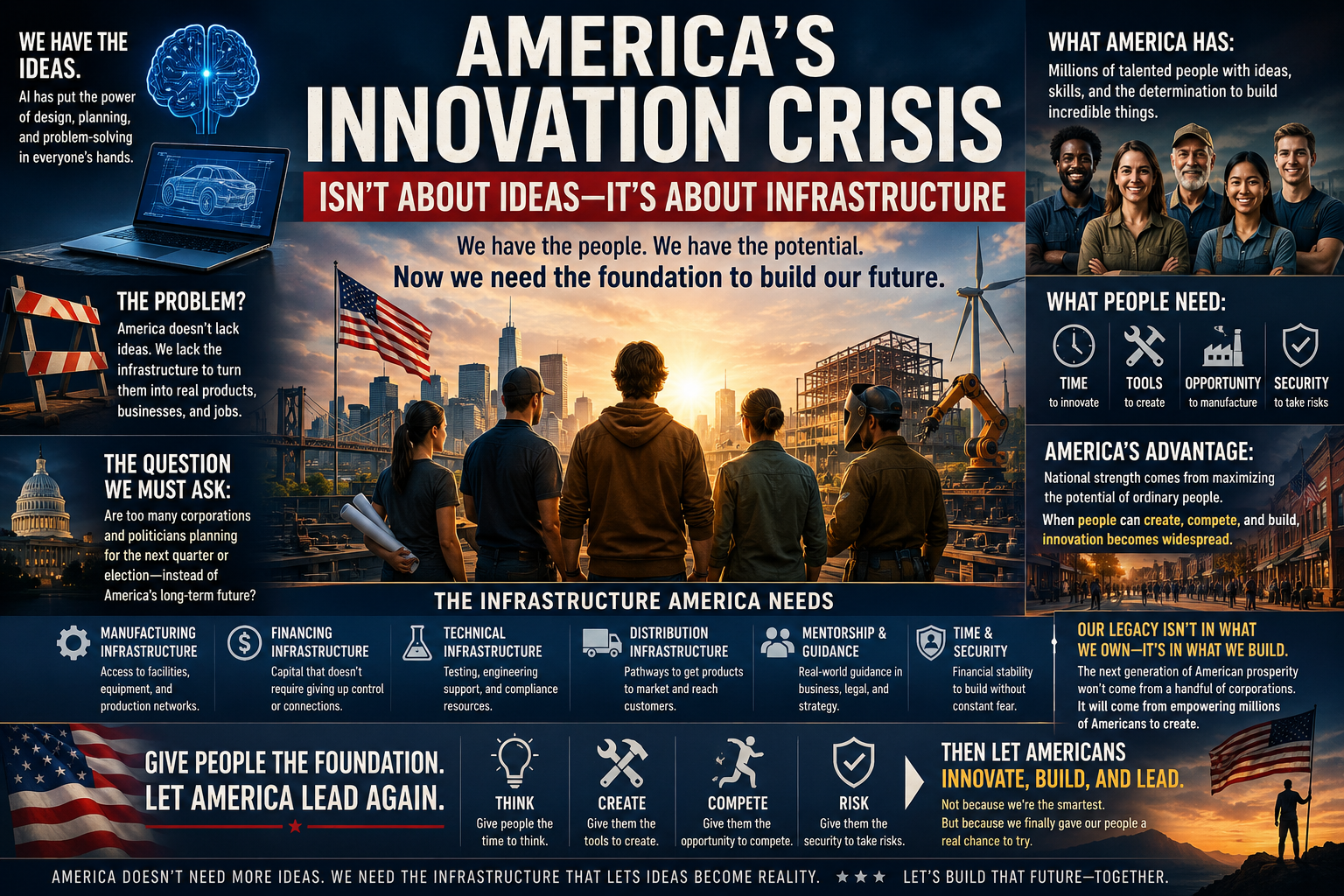
America doesn't have an innovation shortage. It has an innovation infrastructure shortage.
There are still major barriers preventing brilliant ideas from becoming actual businesses and products: manufacturing infrastructure—where do you make something, who do you call, how do you find affordable, reliable production; financing infrastructure—how do you fund development without giving away your company; technical infrastructure—where do you test, who provides engineering expertise, how do you meet standards; distribution infrastructure—how do you get your product to market; mentorship and guidance—legal, accounting, business strategy, where does that come from for someone without a network; and time and security—even with access to tools, how do you sustain yourself while building.
AI has democratized the thinking. But we're still gatekeeping the doing.
Reframing What Government Should Actually Do
I believe the purpose of government should be to maximize the potential of every American.
Not to solve every problem directly. Not to pick winners. Not to protect incumbent interests.
But to create the conditions where people can solve problems themselves.
This principle ties together everything—manufacturing, agriculture, healthcare, education, housing, wages, and innovation. It gives us a North Star for evaluating policy: does this help ordinary Americans create, invent, and build? Or does this make it harder?
Manufacturing revival isn't about nostalgia. It's about creating pathways for people to make things and build skills. It means building cooperative networks, prototyping centers, and regional manufacturing ecosystems. It means making small-scale production economically viable.
Agricultural sovereignty means protecting family farms from financial squeeze and corporate consolidation. It means giving farmers the tools to stay on the land and compete fairly.
Education reform means teaching people to build—not just to pass tests. It means connecting learning to creation. It means Guardian Curriculum principles: teaching people to think for themselves and understand how systems work.
Healthcare and housing can't be luxury goods. When people spend half their income on housing and are one illness away from bankruptcy, they can't take risks or pursue innovation.
Wage policy matters because time is the scarcest resource. People working two jobs can't become inventors.
Access to capital matters because financing structures shouldn't require existing wealth or connections.
This isn't about replacing market competition. It's about removing artificial barriers so that competition is actually based on merit and innovation rather than access and privilege.
From Tools to Execution: Connecting the Dots
If we build the foundation that connects inventors, engineers, manufacturers, investors, and skilled trades, we won't just create more businesses. We'll unlock millions of innovators who have never had the opportunity to build.
Regional innovation hubs that provide access to manufacturing, testing, and prototyping facilities. Maker spaces exist, but they're fragmented and underfunded. Imagine a network of facilities in every region where someone could go from sketch to prototype to small-batch production.
Cooperative manufacturing networks where independent makers and small manufacturers can share equipment, expertise, and distribution channels. Economies of scale don't have to mean giant corporations.
Mentorship pipelines that connect experienced builders with people just starting out. Not venture capitalist mentorship focused on explosive growth and exit strategies. Real mentorship from people who know how to build things sustainably.
Financing structures beyond venture capital that don't require giving up control or aiming for billion-dollar valuations. Small businesses, regional manufacturers, and social enterprises need capital too. Community investment funds, public banking, cooperative investment models—these should be viable pathways.
Apprenticeship and skills training that's connected to actual job pathways, not disconnected from employment. We need to rebuild the skilled trades while simultaneously preparing people for advanced manufacturing and technical roles.
Antitrust enforcement that prevents dominant platforms from using their power to exclude competitors and control repair. A company shouldn't be able to make it illegal to fix something you own.
The next generation of American prosperity won't come from a handful of corporations. It will come from empowering millions of Americans to create.
Using AI as a Multiplier, Not a Replacement
Here's where the AI opportunity becomes crucial.
In the past, turning an idea into reality required years of specialized knowledge just to create drawings, business plans, software, or marketing materials. You needed to be able to code, or design, or write well. Only people with those skills could move forward.
AI has dramatically lowered that barrier. It's now a thinking tool available to everyone.
But this is only valuable if we simultaneously build the physical infrastructure that allows ideas to become real. Otherwise, we're creating a world where millions of people can imagine things they can never actually make.
The real question isn't whether AI will replace human workers. The real question is whether we'll use AI to help more people become inventors, entrepreneurs, and builders—or whether we'll use it to concentrate power and eliminate jobs.
That depends on the choices we make about infrastructure, access, and policy.
What This Means Politically
I want to be clear: this isn't a left-right issue, though both sides will claim it.
Some on the left will see infrastructure investment and automatically think we need centralized government solutions. Some on the right will see government involvement and automatically oppose it. But the real question isn't the size of government. It's whether government is removing barriers or creating them.
Conservative principle: let people compete freely and build according to their values.
Liberal principle: make sure everyone has a genuine chance to participate.
Both principles point toward the same infrastructure. A thriving private sector doesn't require monopolies or gatekeeping. It requires competition, access, and opportunity. Those things are only possible when government removes barriers rather than protecting incumbent interests.
The Vision
Give people the time to think. Give them the tools to create. Give them the opportunity to compete. Give them the security to take risks.
Then let the American people do what they've always done—innovate, build, and lead.
That's an optimistic message. It's one that can resonate across political lines because it focuses on expanding opportunity rather than limiting it. It's not about taking from the strong to give to the weak. It's about unleashing potential that's been artificially constrained.
The proof? Look at every moment when America led the world. It wasn't because we had a more educated elite than other countries. It was because we had systems that let ordinary people become extraordinary.
The Wright brothers were bicycle mechanics. Henry Ford was an engineer in a rapidly growing industry. Steve Jobs and Steve Wozniak were tinkerers who had access to parts, workshops, and a culture that valued building. The internet was built by people who had access to computers and communication networks and the freedom to experiment.
Every major innovation in American history came from people with an idea, access to tools, and the security to take a chance.
We can recreate those conditions. We're not reinventing the wheel. We're recovering a capability that built this nation.
The Work Ahead
This isn't a policy speech. This is a call to think differently about what government is actually for.
We've spent decades optimizing for the wrong things. We've protected incumbent industries instead of enabling new ones. We've treated entrepreneurship as a luxury for the well-connected instead of a pathway for the ambitious. We've let financial engineering and market manipulation replace actual innovation as the path to wealth.
We can change that. Not overnight. Not through a single policy. But through a coherent vision that asks one question about every decision: does this expand the opportunity for ordinary Americans to create, build, invent, and compete?
If yes, we should do it. If no, we should reconsider it.
America's greatest asset has never been Wall Street. It's never been our military. It's never been our natural resources.
It's the ingenuity of the American people.
Our policies should make it easier to build, invent, manufacture, and compete—not harder.
And if we get that right, the video I watched of Huawei and Pixel won't impress me because a foreign company is leading. It will impress me because I'll recognize it as the kind of work Americans could and should be doing.
Not because we're smarter than everyone else. But because we've finally given our people a real chance to try.