Government Accountability
The Conveyor Belt of Monsters: How We Cultivate Our Own Demise, From Wall Street to the ICE Detention Cell
Vincent Cordova argues that Wall Street, private equity, and ICE detention-for-profit run on the same empathy-stripping machinery that turns human beings into revenue units.
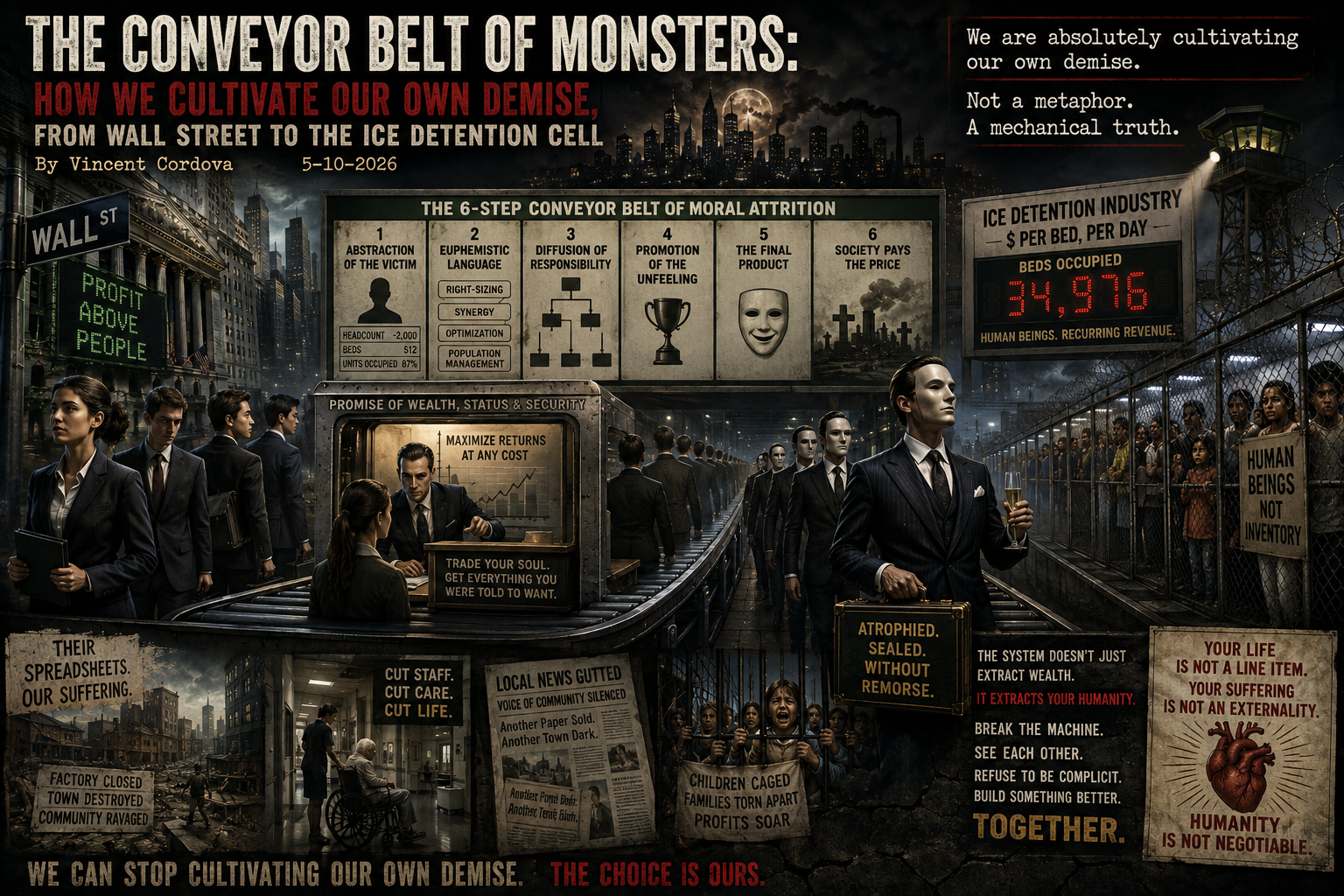
We are absolutely cultivating our own demise. And I need you to sit with that line, not as a metaphor, but as a precise mechanical truth. We have built a set of financial industries - private equity, institutional asset management, and the privatized arm of state violence - that do not just attract sociopaths. They manufacture them. They take ordinary human beings with normal empathy distributions, and in exchange for a life those people have never had, they systematically amputate the part of the soul that recognizes another human's face.
Wall Street was a perfect, glittering lesson we refused to learn. We watched it chew up homeowners, lie about mortgage-backed securities, and crash the global economy, and we somehow concluded the problem was a few bad apples and some missing regulations. We missed the deeper horror: the system had already trained an entire generation that harm is just a spreadsheet cell. And now that same logic has escaped the trading floor and colonized everything - including the concrete boxes where Immigration and Customs Enforcement (ICE) holds human beings for a daily rate. In that architecture, human beings are targeting their own species for money. Literally. And we are still not screaming.
This is not a rant about capitalism in general. It is about a specific, metastasizing process that turns empathy into a career-killing disability and callousness into the only rational survival strategy. If we do not understand how this conveyor belt works - how it takes our neighbors and spits out functional sociopaths - we will hand the next generation a world where cruelty is not a bug but the operating system. Let us walk through the machinery, feel its weight, and then talk about what it means to break free together.
The Transaction That Steals Your Soul
Imagine a young associate who grew up in a household where an unexpected car repair meant panic. Where the phone ringing after 9 p.m. was never good news. She clawed her way into a target school, then into a private equity firm. Now she is looking at a compensation package that promises to vaporize every financial insecurity her family has ever felt. She will be able to pay off her parents' mortgage. She will be able to walk into a room and be seen - not as a liability, but as a person of weight.
The price? She must now build a financial model that determines whether a 70-year-old factory in Ohio - one she has never seen, in a town she could not find on a map - should be gutted, its workers fired, their pensions carved up and sold for scrap, because the math says the real estate underneath the plant is worth more than the people inside it. The victims have no faces. They are line items labeled "headcount synergy reduction." Her brain's empathy circuitry, which fires when it sees a crying face or hears a trembling voice, gets no signal at all. It stays dark. And that is the moment the deal is sealed.
She learns, fast, that showing hesitation is professional suicide. If she says, "Wait, these are real families," her boss - someone who was once exactly like her - will pull her aside and explain that she lacks the hard edge required for the role. Her peers, fighting for carry and bonus pools, will sense weakness and sideline her. To survive, she silences the part of herself that recognizes shared humanity. She adopts the language: not firing people, but "right-sizing." Not destroying a community, but "unlocking value." After a few years, she stops needing to quiet that inner voice because the voice has atrophied. The mask she put on to survive the job has fused to her face. At home, she might still be a loving parent. At work, she is an instrument of harm who feels nothing. That is not compartmentalization. That is a successfully socialized sociopathy, and she was trained into it by the promise of a life her former self could only dream of.
The ICE Parallel: Profiting From Your Own Species
Now transport that exact psychological architecture from the trading floor to the detention center. Private prison companies and ICE contractors are paid a per-bed, per-day rate. The financial incentive is not to process humanely or to uphold dignity; it is to fill beds and keep bodies inside. When you pay a corporation a daily rate to detain a human being, the human being stops being a mother fleeing violence or a child seeking safety. They become recurring revenue. They become a daily occupancy number that determines quarterly earnings.
The guards, the administrators, the regional managers - many of them come from backgrounds that are not so different from the people they are detaining. They might share a language, a heritage, a zip code of origin. But the system requires them to view their own species as inventory. And just like in private equity, those who express moral discomfort are removed or bypassed. Those who learn to quip about bed counts and population management get promoted. The face of the detained becomes invisible, replaced by a file number and a profit margin. When you see leaked videos of officers laughing at crying children, or ignoring medical emergencies, you are not seeing a random failure of character. You are seeing the predictable end product of an incentive structure that rewards callous disregard. They are targeting their own species for money, with a straight face, because the distance between the profit and the pain has been deliberately engineered to be unbridgeable by ordinary human empathy.
Wall Street Was the Prototype, Not the Outlier
Wall Street should have been our warning. The 2008 crisis was not just about greed; it was about a generation of traders, analysts, and executives who had been trained to see mortgages not as families' shelter but as raw material for collateralized debt obligations. They never met the couple in Las Vegas who were sold a loan they could not afford. They never saw the eviction notice taped to a door in Stockton. They saw correlation assumptions and default probability vectors. And when the whole edifice collapsed, many of them walked away with their wealth intact, their moral universe unchallenged, because in their minds they had not done anything to people. They had just played a complex game with abstract instruments.
That event did not reform the culture; it proved to the culture that the sociopathic playbook works. The people who caused the crash stayed rich. The legal system protected them. The revolving door between government and finance continued spinning. The lesson absorbed by the next cohort was: You can commit violence at scale, and as long as it is mediated by a spreadsheet, no one will ever make you look your victim in the eye.
How the Conveyor Belt Works: A Step-by-Step Dissection
Let us lay out the process explicitly, because it is not mysterious. It is a trainable, replicable sequence of moral attrition.
1. Abstraction of the Victim. The first step is to remove all sensory evidence of the other person's humanity. Workers become headcount. Detained migrants become beds. Patients in a private-equity-owned nursing home become occupied capacity units. Once the face is erased, the brain's natural empathy response is starved of input. You are no longer harming a person; you are adjusting a variable.
2. Euphemistic Language. The machinery provides a vocabulary of sanitization. Layoffs are synergy capture. Cutting corners on care is efficiency optimization. A detention center under investigation for inhuman conditions becomes a facility facing operational challenges. This language is not just corporate jargon; it is a shared ritual that signals membership in the tribe of those who can handle hard decisions. Every time you use the approved term, you reinforce your identity as a competent, unsentimental professional.
3. Diffusion of Responsibility. The institutional chain is deliberately fragmented. The pension fund that demands double-digit returns pushes its asset manager, who pushes the private-equity firm, who pushes the portfolio company CEO, who orders the plant closure. At every link, the individual can say, "I am just fulfilling my fiduciary duty," or "I am just executing the board's directive." No one behaves like the sole author of the harm. Everyone is a cog, and cogs do not have consciences.
4. Promotion of the Unfeeling. The promotion ladder actively filters for those who can inflict pain without flinching. If you lose sleep after a mass firing, you are not leadership material. If you can do it over a Zoom call and then head to a spin class without missing a beat, you are a rising star. This selection pressure, applied year after year, means the senior ranks of these institutions are populated almost entirely by people who score high on what researchers call the dark triad of personality traits: Machiavellianism, narcissism, and subclinical psychopathy.
5. The Conveyor Belt's Final Product. After a decade, the person who entered the system with a functional moral compass is nearly indistinguishable from a clinical sociopath. They can destroy communities, shred retirements, and separate children from parents without any significant physiological stress response. They are wealthy, respected, often charming at dinner parties. And they are genuinely baffled - genuinely - when anyone suggests they have done something wrong. In their mind, they have just been good at their job.
The Harvest We Are Reaping Now
This is not an abstract future. The sociopath-generation is in full control right now, and the damage is living tissue.
Private-equity-owned healthcare has been a slow-motion massacre. Nursing homes stripped of staff to meet debt-service ratios have produced bedsores, falls, and deaths that never make a federal indictment but leave families shattered. Dental chains and veterinary clinics prioritize revenue per visit over medical necessity, pushing unnecessary procedures on trusting patients and pets. The financial engineers who engineer these cuts are rarely in the same state as the suffering they cause. They are in midtown Manhattan, or Greenwich, counting their multiples.
Private-equity-owned retail and media has hollowed out local economies. When a hedge fund buys a local newspaper chain, they are not buying journalism; they are buying the real estate and the subscription list, then milking the cash flow while cutting reporters until the paper is a zombie. The reporters fired do not exist as people in the spreadsheet. The communities that lose their watchdog do not register on a cash flow statement. The sociopaths in charge do not even know what they stole, because they never felt the value of a local paper in their own lives.
ICE and the detention industry is the terminal endpoint. When private-equity firms invest in private prisons and detention centers, they use the same playbook: load the facility with debt, cut costs like food, medical care, staffing, and heating and cooling, extract management fees, and lobby for policies that keep the beds full. The product is captive human beings. The cost savings are literal human suffering. And the people who sign off on those cost savings, who visit the detention center only to do a photo-op with clean floors, will never hear the wailing of a child separated from their parent. They have built their whole professional identity on not hearing it. This is what it looks like when the conveyor belt succeeds: human beings making fortunes off the caged misery of other human beings, and sleeping soundly.
The Generational Poison
What does the next generation inherit from this? They inherit a world where the most visibly successful people are those who have perfected the art of harm without feeling. They see CEOs celebrated for turnarounds that are really just asset-stripping. They see ICE contractors winning government awards. They watch social media algorithms amplify the kind of performative cruelty that gets engagement, because engagement is money, and the people designing those algorithms have been subject to the same empathy-stripping incentive structure.
I already see it in young people entering the workforce. They have grown up watching their parents get laid off by invisible shareholders. They have internalized that loyalty is for suckers and that looking out for number one is the only rational play. Many of them enter finance not as wide-eyed idealists who will be corrupted, but as already cynical pragmatists who have preemptively numbed themselves to survive. They are not even getting a mask fused to their face; they are born wearing it. That is the intergenerational transmission of sociopathy. We are not just creating monsters today; we are building a culture that raises children into the monster-making machinery as if it is a finishing school.
If we do not break this, the future is utterly predictable. More inequality, more extraction, more communities treated as disposable, more human beings in cages because their suffering is a quarterly revenue stream. And the people pulling the levers will be ever more distant, ever more armored in language and abstraction, ever more incapable of even recognizing their own cruelty. We are marching toward a society split between the wealthy sociopaths and the rest of us who are the raw material for their wealth, and the sociopaths will be the ones writing the rules.
Breaking Free: How We Stop the Conveyor Belt
This is the part where a typical blog post would offer ten mildly comforting tips. I am not going to insult your intelligence. Untangling this requires a level of honesty and spiritual defiance that most of us have been conditioned to avoid. But here is where we start.
1. Name the violence for what it is. Stop using the euphemisms. When a private-equity firm fires 2,000 workers, call it social violence, an extraction of lifeblood from a community. When an ICE contractor runs a freezing detention center with spoiled food, call it what it is: a human rights abuse for profit. Language is the first line of defense. Refuse to participate in the sanitization.
2. Re-anchor empathy in the real. We have to deliberately counter-abstraction. Support journalism that puts faces and names and voices to the victims of financial engineering. Demand that every investment committee presentation, every board deck, every government contract bid include a moral impact statement that describes in plain language the human beings affected. If a CEO cannot look at a photo of the factory worker they are about to fire and still sign the order, that is not a business failure - that is a humanity success. We need to make it legally and culturally impossible to harm from a distance.
3. Change the fiduciary rules. The legal mandate that forces institutional investors to prioritize financial returns above all else - including human dignity - is a social construct, not a law of nature. We need fiduciary duty redefined to include stakeholder welfare, environmental sustainability, and social cohesion. It is already happening at the edges with B-Corps and stakeholder capitalism movements, but we need to force it into the hard core of private equity and public markets.
4. Starve the conveyor belt of talent. This one is personal. If you are a young person reading this, or if you know a young person, understand that taking a job at a predatory private-equity firm or an ICE contractor is not a morally neutral career move. It is a decision to enter a soul-wrecking machine. We need to build cultural pressure so that working for extractive, harm-driven institutions carries the same stigma as other forms of professionalized cruelty. It is not about canceling individuals; it is about withdrawing the social license that makes their behavior seem respectable.
5. Build alternative economic structures. The only lasting antidote is an economy where human connection, place-based relationships, and long-term stewardship are more powerful than distant capital. Support employee ownership, community land trusts, credit unions, public banking, and local supply chains. Every time a business is owned by the people who work there and the community it serves, the sociopath's abstraction loses a host. Weaken the parasite by strengthening the organism.
6. Recover the sacredness of seeing. This is the deepest one. The entire edifice of modern sociopathic finance depends on the belief that some people's suffering does not register. We have to recover the spiritual practice of seeing the unseen. It means, in our own lives, refusing to look away from the detention center, refusing to ignore the factory closing a town over, refusing to treat the service worker as invisible. It is small, but it retrains our own empathy circuits, and that ripples into how we vote, invest, organize, and parent. If the sociopaths are made by not seeing, then our resistance must be built on radical, inconvenient, painful seeing.
The Choice Before Us
We are absolutely cultivating our own demise, but cultivation takes time, and this crop has not fully ripened. The conveyor belt is running hot, but it can be dismantled. The people still entering these systems with intact souls can refuse to hand those souls over. The rest of us can stop worshipping the wealth they bring back. We can stop accepting their checks, stop handing them awards, stop validating their spiritual emptiness as success.
Wall Street was an example. ICE is an example. They are branches of the same rotting tree. The root is the belief that distance dissolves responsibility, and that money can serve as a silencing agent for conscience. If we do not tear that root out, our children will look back at us and ask why we let the monsters run the world when we could see them being made, brick by brick, deal by deal, migrant by migrant, every single day.
We move forward together by looking at each other - really looking - and saying: Your life is not a line item. Your suffering is not an externality. And I will not trade my humanity for a life I have never had, no matter how beautifully it is packaged. That is the vow that breaks the machine. Let us start speaking it out loud.
Atrophied, Sealed, and Without Remorse: The Addict in a Bespoke Suit
Here is the belief that the whole design has forced into my bones, and I am going to write it without polish: the person this system produces is no morally different from a drug addict who steals from their own grandmother's purse, who leaves a gas station clerk bleeding for the price of a fix, and who feels nothing. Literally nothing. The empathy muscle in them is dead. Atrophied. The whole design - the distance, the language, the fragmentation of blame, the waterfall of money - has produced a human being who can deny a dying person healthcare, who can cut the heating budget in a detention center during a freeze, who can strip a pension fund until elderly workers eat cat food, and then climb into a town car and check their portfolio with the same emotional flatline as someone checking the weather. There is no remorse because remorse requires a nerve that has been surgically removed.
We treat the street-level addict who steals a television as a criminal. We lock them up. We call them a menace. And that addict, however desperate, however chemically hijacked, still occasionally sees the face of the person they harmed in a moment of withdrawal and feels something hot and terrible rise up. But the private-equity partner who slashes a nursing home's staffing to meet a debt covenant, causing bedsores that become sepsis, causing a death that will be recorded as natural causes in a facility he has never visited, feels nothing. He does not kill for denying healthcare; he denies healthcare and the killing just happens, quietly, somewhere else, to someone whose name he never knew. The addict takes a purse and leaves a bruise. The executive takes a life and calls it a synergy. Which one is more dangerous? The addict can hurt maybe a dozen people. The executive can hurt thousands, tens of thousands, and no one even thinks to call it violence.
The gravity is this: we are in a moment where the most socially rewarded class of people are emotional burnouts who have been trained to see human suffering as a cost of doing business, and we treat them as pillars of the community. They are more lethal, more contagious, and more unrepentant than any desperate soul on a street corner, yet we give them keys to the economy and let them teach our children what success looks like. They are the living proof of what the whole design was engineered to do - not just extract wealth, but to create beings who can extract wealth from human agony without experiencing a single tremor of guilt. That is a factory for monsters, and it is running at full capacity.
If we cannot see that the suit is no different from the needle - that the atrophied, sealed-off heart of the dealmaker is just a cleaner version of the same spiritual rot that drives a person to rob for a fix - then we are consenting to our own destruction. We are agreeing that some violence is clean and some violence is dirty, but the dead are dead either way. The next generation is watching, and the lesson the machine is teaching them is: you can be a predator, but if you do it with a credential and a PowerPoint deck, you will never be called one. Breaking free means looking that predator in the eye, stripped of the title and the tailoring, and calling them exactly what they are. A thief. A danger. A walking emptiness that the world, for some temporary and insane reason, has agreed to call a hero. That has to end. Now.