Human Dignity
The Colonizer's Disease: Drapetomania, ADHD, and a System That Fears Thinkers
A society built to produce compliance will always try to diagnose the minds that refuse to fit inside it.
I said I would look at matters from a different direction.
Today I want to talk about a word most Americans have never heard: drapetomania.
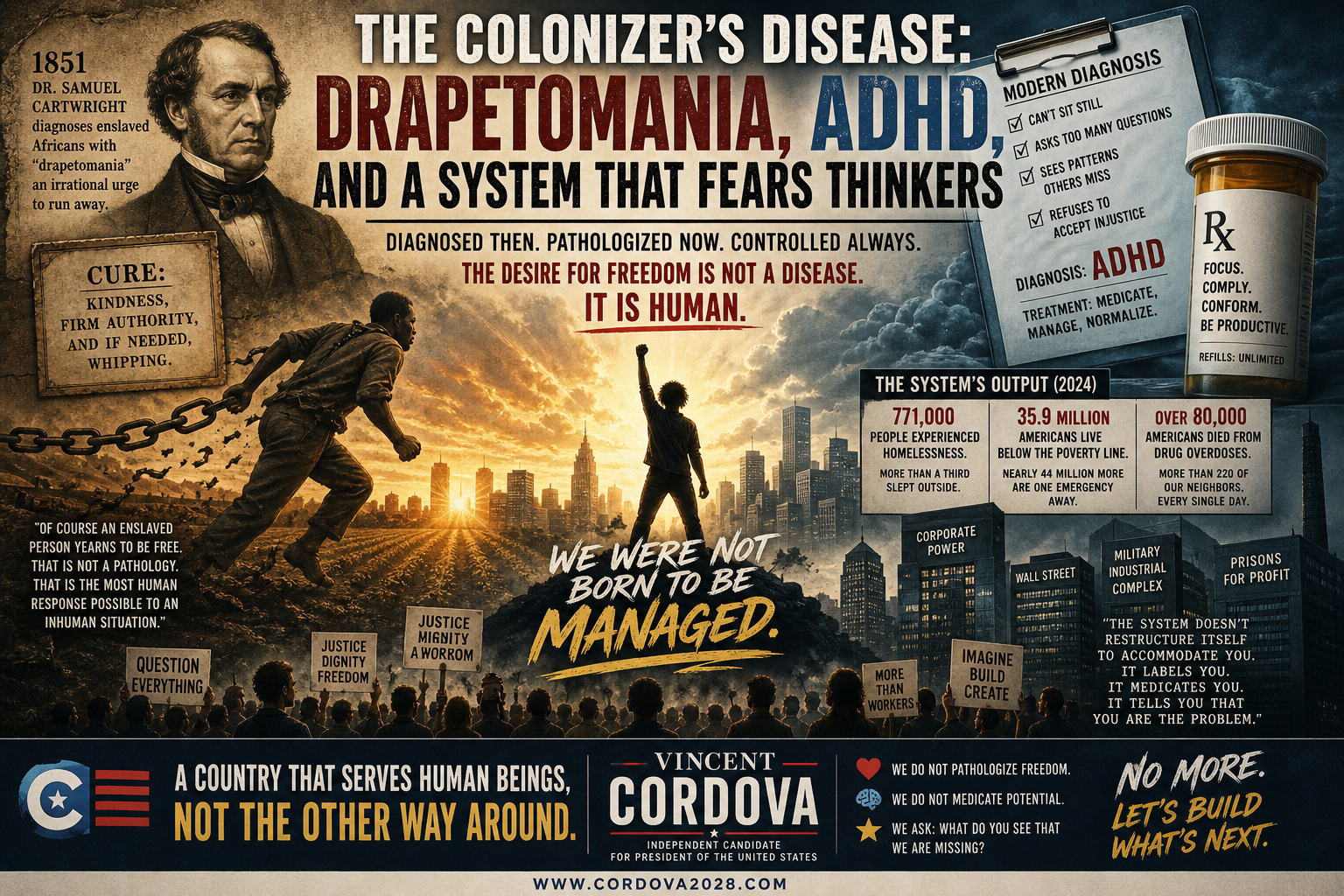
In 1851, a physician named Samuel Cartwright - respected, credentialed, published in the leading medical journals of his day - identified a new mental disorder. Its primary symptom? Enslaved Africans who had an irrational, pathological urge to run away from slavery.
He named it drapetomania. The "cure" was simple: treat your slaves with sufficient kindness and firm authority, and the condition would resolve. If it persisted, whipping would "cure" the physiological symptoms.
This was not the ranting of a fringe lunatic. This was the official medical opinion of the antebellum South. It was published. It was cited. It was science, approved by the institutions that governed society.
I want you to sit with that for a moment.
A human being, born into bondage, looks at the horizon and feels an overwhelming need to be free. And the medical establishment, in service to the economic system that depended on his labor, diagnoses that desire for freedom as a disease.
Now look at today.
The Colonizer's Lens
If you were designing a society from the top down to produce compliant workers rather than independent thinkers, what would it look like?
You would build an education system that rewards obedience, not curiosity. You would design workplaces that demand conformity, not creativity. You would create an economy that depends on people staying in place, doing what they are told, and not asking questions.
And when some people - despite everything - cannot sit still, cannot stop questioning, cannot stop thinking, you would have a problem. Because those people are dangerous to the system. Not dangerous in a violent sense. Dangerous because they see through it. They feel in their bones that something is wrong, even if they cannot yet name it.
What do you do with those people?
You do what Cartwright did. You pathologize them. You give their way of being a clinical name. You tell them their brain is broken. You prescribe medication to bring them back into line. And you call it science.
I am going to say something that will make a lot of people uncomfortable.
When I look at the modern diagnoses of ADHD and neurodivergence, I do not see broken people. I see human beings whose natural cognitive patterns are incompatible with a system designed to produce workers, not thinkers.
I am not saying these conditions are not real. They are very real. The struggle is real. The overwhelm is real. I know this personally - I am an overthinker, and there are days it nearly drowns me.
But real does not mean diseased. Real means different. And in a society that demands sameness, different is always pathologized.
The Numbers Don't Lie
771,000 human beings experienced homelessness in 2024, the highest number ever recorded. More than a third slept outside, on concrete, because there was nowhere to go.
35.9 million Americans live below the poverty line. Nearly 44 million more are one emergency away from joining them.
Over 80,000 Americans died from drug overdoses in 2024. More than 220 of our neighbors, every single day.
Half this country is self-medicating to survive inside the system. The other half is medicating with illegal drugs to escape the very same system.
This is not a failure of individuals. This is the direct output of the governing structure. At these numbers, there is no honor. When politicians and institutions speak honorably, I have to ask: honor to who?
To the shareholders? To the donor class? To the GDP? Because it is certainly not to the 771,000 human beings sleeping on the ground.
The system is producing exactly what it was designed to produce: a compliant workforce for an economic machine, with a discard pile for everyone who cannot or will not comply. And when you cannot comply because your mind works differently, the system does not restructure itself to accommodate you. It labels you. It medicates you. It tells you that you are the problem.
Drapetomania, Repackaged
Cartwright's diagnosis was absurd to anyone standing outside the slave economy. Of course an enslaved person yearns to be free. That is not a pathology. That is the most human response possible to an inhuman situation.
What would Cartwright diagnose today?
A student who cannot sit still through six hours of standardized test preparation? A worker who asks too many questions in meetings? A citizen who refuses to accept that homelessness is an inevitable feature of society? An analyst who cannot stop seeing the patterns, the connections, the hidden architecture of power?
He would diagnose them. He would give it a name. And the pharmaceutical industry would develop a product line.
I want to be clear: I am not against medication. I am not against treatment. I am against a system that uses diagnosis as a form of social control. I am against an economic structure that is so rigid, so dehumanizing, that the natural diversity of human cognition becomes a liability to be suppressed rather than a gift to be nurtured.
What would the world look like with no overthinkers?
Read your history. Every movement for justice, every scientific breakthrough, every work of art that has moved the human spirit came from someone who could not stop thinking. Someone who stared at the way things were and said, this is not right, and I cannot rest until I understand why.
A world without overthinkers is a world of workers. Workers who do not question the wage. Workers who do not question the fence. Workers who do not look at the horizon and feel that overwhelming urge to run.
In other words: slaves.
We Were Not Born to Be Managed
The colonizer's lens reveals a simple truth: systems of power do not fear weapons the way they fear questions. They do not fortify themselves against armies the way they fortify themselves against ideas. The person who cannot stop thinking is the single greatest threat to a structure that depends on the people remaining asleep.
ADHD is not drapetomania. But the impulse to pathologize human difference in service to an economic order is the same spirit. The instinct to call the desire for freedom a disease - it never died. It just updated its terminology, got a peer-reviewed journal, and secured a billing code.
I am running to build a country where we do not diagnose the desire for freedom. Where we do not medicate away the gifts of a different mind. Where overthinkers are not told they are broken but are asked: what do you see that we are missing?
Because the answer, right now, is everything.
The system is broken. The numbers prove it. The suffering proves it. And the ones who see it most clearly are exactly the ones the system has spent generations trying to silence, pathologize, and manage into compliance.
No more.
Afterword
I asked myself a question before posting: Why does telling the truth make people uncomfortable? Why can't we see that change is good, and that great things come from it?
Here's what I've come to understand.
The discomfort people feel when I call the system what it is - a machine that produces workers, pathologizes thinkers, and discards the inconvenient - is not proof that I am wrong. It is proof that I am touching something real. The system has spent lifetimes teaching us to look away. When someone refuses, it hurts the eyes.
We were all raised inside a story: work hard, follow the rules, be a good citizen, and things will work out. I'm saying the story is a lie. That's not easy to hear. If you've sacrificed your health, your relationships, your peace to that story, hearing it called a lie feels like an attack on your entire life. I understand that.
But I am not attacking people. I am attacking a structure that uses people as fuel.
Change is good. Look at every great leap forward. Look at the end of legal slavery. Look at the right of women to vote. Look at the fall of secret torture programs. These were unimaginable to the generation before them - until courageous people made them inevitable.
The overthinkers, the restless ones, the people who refuse to sit quietly in a burning house - these are not broken. They're the architects of the next world. And history will see them that way.
I'm asking you to sit in the discomfort with me. Not forever. Just long enough to see what's on the other side. Because on the other side is a country that serves human beings, not the other way around.
That's worth a little discomfort. That's worth everything.