Campaign design team
They Don't Know What They're Doing. And We Are the Ones Paying the Price.
By Vincent Cordova | Candidate for U.S. President 2028
April 25, 2026
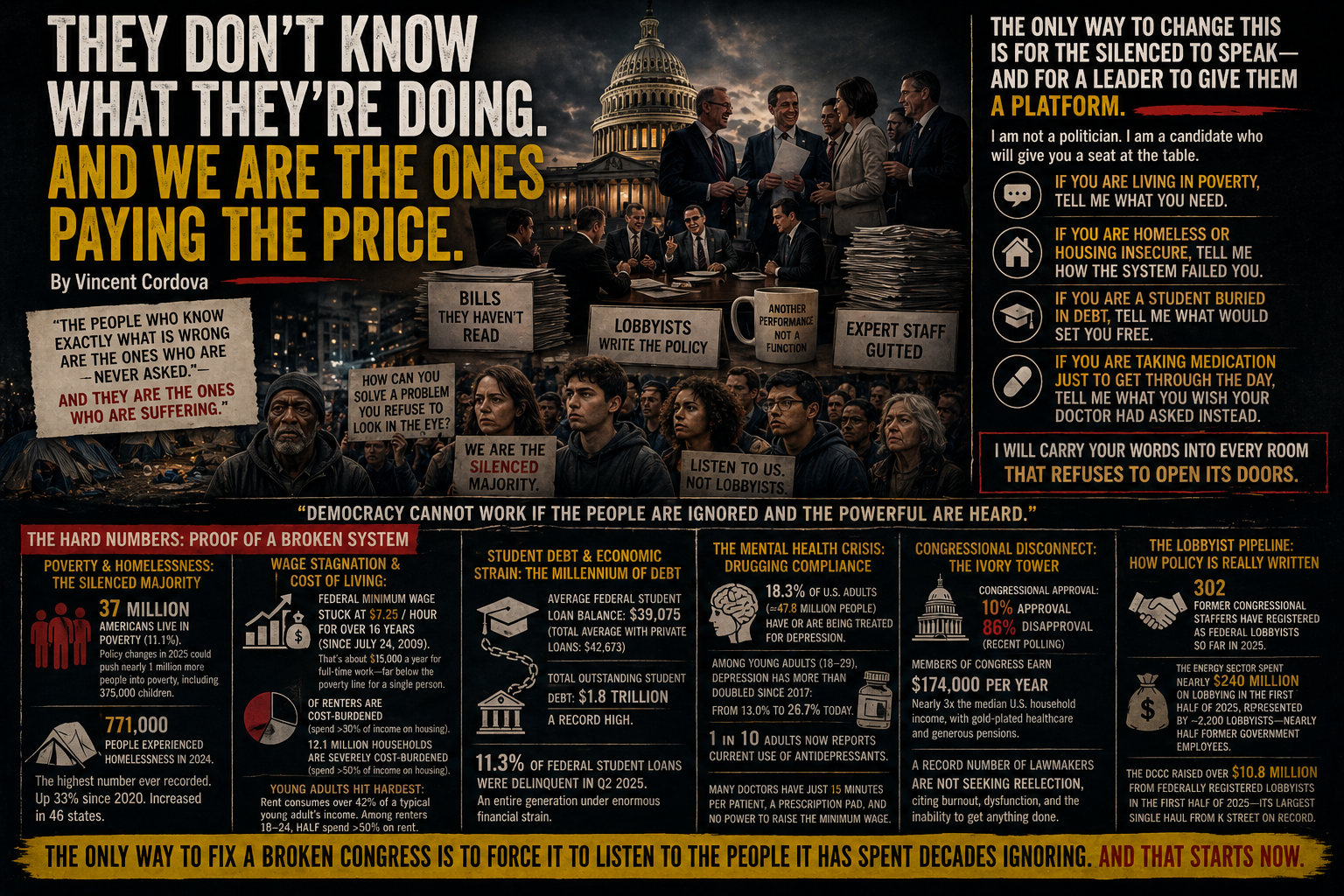
We asked a simple question: Do members of Congress actually know what they are doing? The honest answer is that most of them do not. They vote on bills they have not read. They rely on lobbyists to explain policy. They have gutted their own expert staff. And they have turned legislating into a performance, not a function.
But here is the deeper truth: Their ignorance would be merely embarrassing if it did not cause real, measurable harm to real human beings.
The people who know exactly what is wrong are the ones who are never asked. And they are the ones who are suffering.
Let us name some of the silenced.
The 37 million Americans living in poverty. Congress does not ask them how to fix welfare. It debates them as if they are a budget line, not neighbors. The result? The federal minimum wage has been $7.25 for over 15 years, the longest stretch without an increase in history. Meanwhile, the real cost of living has soared. But no one in power has to live on $7.25 an hour. So they do not know. And they do not ask.
The 771,000 Americans who are homeless. That is the highest number ever recorded. These are not statistics. They are veterans, families, children sleeping in cars, people who work full-time jobs but cannot afford a deposit. Congress holds hearings about homelessness. It rarely invites a homeless person to testify. How can you solve a problem you refuse to look in the eye?
The one in four young adults who are clinically depressed. We have the data. Depression among people under 30 has more than doubled since 2017. Student debt averages $40,000. Rent consumes half a paycheck. Wages do not move. And then we call them lazy, or we hand them a prescription, or both. But when was the last time a member of Congress sat down with a classroom of students and just listened without cameras, without a speech, without a check to write?
The 43% of adults taking mental health medication. Many of them are not broken. They are exhausted. They are working two jobs. They are watching their parents age without care. They are drowning in medical bills. And the system says: here is a pill. Go back to work. Be quiet.
Congress does not know any of this because the structure of Congress is designed to insulate members from the consequences of their votes. They have gold-plated healthcare. They have guaranteed pensions. They do not worry about rent. They do not worry about student loans. Their children do not go to failing schools. Their neighborhoods are not poisoned by pollution.
And then they wonder why we are angry.
The only way to change this is for the silenced to speak and for a leader to give them a platform.
I am not a politician. I am a candidate who is running because I have seen the other side of the curtain. I know that Congress, as it is currently built, cannot hear you. It was not designed to. It was designed to hear money, to hear lobbyists, to hear the powerful.
But I hear you. And I am asking you to speak.
If you are living in poverty, tell me what you need.
If you are homeless or housing insecure, tell me how the system failed you.
If you are a student buried in debt, tell me what would set you free.
If you are taking medication just to get through the day, tell me what you wish your doctor had asked instead.
I will give you a seat at the table. I will not filter your voice. I will not dress up your pain as a talking point. I will carry your words into every room that refuses to open its doors.
Because the only way to fix a broken Congress is to force it to listen to the people it has spent decades ignoring.
And that starts now.
The Hard Numbers: Proof of a Broken System
Poverty and Homelessness: The Silenced Majority.
37 million Americans officially live in poverty, which is about 11.1% of the population. An additional policy change in 2025 is projected to push nearly another million people into poverty, including roughly 375,000 children.
771,000 people experienced homelessness in 2024, the highest number ever recorded. The population has surged by 33% since 2020 and increased in 46 states.
Wage Stagnation and Cost of Living: The Mathematical Trap.
The federal minimum wage has been frozen at $7.25 an hour for over 16 years since July 24, 2009. This amounts to just about $15,000 a year for full-time work, far below the poverty line for a single person.
59% of renters are now cost-burdened, spending more than 30% of their income on housing. Of those, 12.1 million households are severely cost-burdened, paying over half their income just for a roof.
Young people are hit hardest: Rent consumes over 42% of a typical young adult's gross income, and among renters aged 18-24, half spend more than 50% of their income on rent.
Student Debt and Economic Strain: The Millennium of Debt.
The average federal student loan balance stands at $39,075, with total debt averaging $42,673 when private loans are included. Total outstanding student debt has climbed to a record $1.8 trillion.
11.3% of federal student loans were delinquent in Q2 2025, underscoring the fragile financial state of an entire generation.
The Mental Health Crisis: Drugging Compliance.
Depression among adults has surged by roughly 60% in a decade, rising from 7% in 2015 to over 11% in 2025. Currently, an estimated 18.3% of U.S. adults, roughly 47.8 million people, have or are being treated for depression.
The crisis in young adults is even more stark: among those aged 18 to 29, depression has more than doubled since 2017, climbing from 13.0% to 26.7% today. Over one in four young people are now suffering.
One in ten adults now reports current use of antidepressants.
Many doctors are trapped by the system: They have an average of just fifteen minutes per patient, a prescription pad, and no power to raise the minimum wage.
Congressional Disconnect: The Ivory Tower in Washington.
Congressional approval has been in freefall, with disapproval hitting a record 86% and approval falling to just 10% in recent polling.
Members of Congress earn $174,000 per year, nearly three times the median U.S. household income, with gold-plated healthcare and generous pensions. Their last raise was in 2009, the same year the minimum wage was frozen.
A record number of lawmakers are not seeking reelection, citing burnout, dysfunction, and the sheer inability to get anything done in a system that feels impossible.
The Lobbyist Pipeline: How Policy is Really Written.
The revolving door between Capitol Hill and K Street spins fast: 302 former congressional staffers have registered as federal lobbyists so far in 2025 alone.
The energy sector spent nearly $240 million on lobbying in just the first half of 2025, represented by about 2,200 lobbyists, nearly half former government employees themselves.
The Democratic Congressional Campaign Committee raised over $10.8 million from federally registered lobbyists in the first half of 2025, its largest single haul from K Street on record.
Community Comments
Community Comments
Share a public response to this post. Submissions are reviewed before they appear.
0 approved comments
Loading comments...