Global Accountability
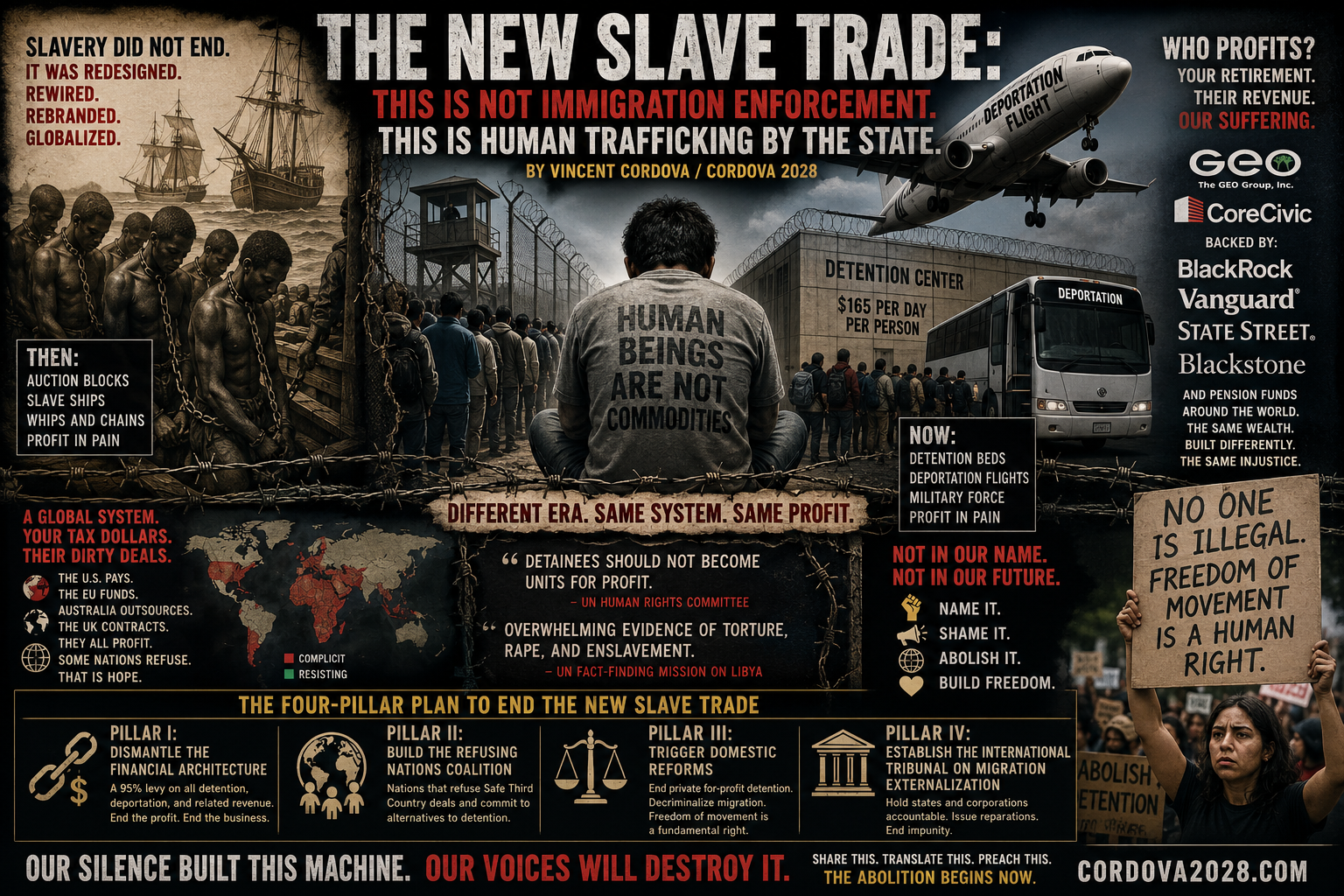
The New Slave Trade: This Is Not Immigration Enforcement. This Is Human Trafficking by the State.
A structural argument from the manuscript: when policy, logistics, and finance converge to monetize captive populations, the language may evolve but the moral architecture remains.
The Lens
I am going to say something that makes many people uncomfortable: the current global detention-and-deportation system is not just immigration enforcement.
It is a redesigned pipeline of human capture, human warehousing, and human transport for institutional profit.
Not a metaphor. Not rhetorical heat. The same architecture appears again: legal carveouts, coercive logistics, financial intermediaries, and normalized dehumanization.
When we stop reading policy language as neutral and start reading outcomes, the pattern is undeniable.
"If slavery was redesigned rather than abolished, then modern detention must be examined as a continuity, not an exception."
The 13th Amendment Loophole
The 13th Amendment ended chattel slavery, but left one opening: involuntary servitude remained legal as punishment for crime. That exception mattered immediately.
Black Codes criminalized survival itself. Convict leasing transformed arrests into labor supply. Private actors monetized punishment, and wealth accumulated through legal violence.
The manuscript links that history directly to modern detention economics: the plantation became the prison, and the prisoner became a billable unit.
The Modern Supply Chain Of Human Cargo
Capture
Interception at borders and sea lanes through militarized agencies, bilateral pressure campaigns, and cross-border enforcement partnerships.
Warehousing
Detention infrastructure priced per bed-day, with occupancy incentives and public contracts that reward volume, not dignity.
Transport
Charter flights and contractor bus routes move deportees across jurisdictions to places where legal protection is weakest.
Forced Labor: The 13th Amendment In Action
GEO Group forced every detainee at Aurora Immigration Processing Center to perform unpaid janitorial work, threatening solitary confinement for refusal.
Detainees paid $1 per day or nothing for labor maintaining the facilities where they are held.
This is a direct continuation of convict leasing, where prisoners were worked to death by private corporations under the 13th Amendment's exception clause.
The U.S. Supreme Court declined to shield GEO Group from forced-labor lawsuits, allowing detainees to pursue claims under federal anti-slavery statutes.
"Detainees should not become units for profit." — UN Human Rights Committee
Evidence Snapshot
$165/day
Approximate per-detainee payment level cited for ICE private contracts in the manuscript
~$5B
Combined annual revenue level cited for CoreCivic and GEO Group in 2025
$7.5M
Amount cited for Palau arrangement to accept 75 deportees
A$5.6M
Per-person offshore detention cost cited for Nauru
Smoking-Gun Contracts
El Salvador CECOT
$6 million ($4.67M confirmed in leaked memo)
Explicitly banned use of funds for reproductive healthcare. Zero safeguards against torture. 300 Venezuelan migrants transferred to a mega-prison notorious for enforced disappearances.
Libya / EU Funding
$5.2 billion in externalization agreements
EU Ombudsman found European Commission guilty of maladministration. 42 civil society organizations formally demanded funding halt. February 2026 UN report documented torture, rape, and enslavement.
Palau Relocation
$7.5 million for 75 deportees ($100,000 per person)
Small island nation of 18,000 people agreed to permanently accept deportees with no connection to the country—effectively a per-capita purchase price.
Turkey / EU Deal
€6 billion
Payment to host refugees and prevent crossings into Europe; Greece's hotspot islands transformed into what rights groups call "open-air prisons."
Who Profits
Vanguard Group
~11% GEO Group (cited)
Largest U.S. retirement-plan provider named in the manuscript.
BlackRock
~15-16% GEO Group (cited)
Largest asset manager identified as a key institutional stakeholder.
State Street
Significant GEO holdings (cited)
Part of the institutional ownership triad highlighted in the text.
Blackstone
$1.242T AUM (cited)
Positioned in broader carceral-adjacent financial infrastructure.
Danish pension funds
PKA, Velliv, and Laerernes Pension (cited)
European retirement savings tied to U.S. private-prison exposure.
Corporate Operators: The Direct Profiteers
Grupo IAMSA (Mexico)
MX$4 billion ($216.2M USD)
Bus and air transportation for detainees; investigations found simulated competition among subsidiaries to win no-bid contracts.
MTC (Australia / U.S.)
$787 million (Nauru)
Subsidiary of U.S. private prison corporation; also runs 7 onshore Australian detention centers in a $2.3B deal.
Serco (UK / Australia)
$7.6 billion (2009–2024)
Brook House detention center awarded despite prior fraud conviction; extensive UK and Australian operations.
Mitie Care and Custody (UK)
£500+ million
Short-term holding facilities; 280 employees made redundant when Rwanda scheme collapsed.
Bristow Group (UK)
£1.96 billion
Search and rescue helicopter operations feeding directly into the detention pipeline.
Galliford Try (UK)
£170+ million
Redevelopment of detention facilities linked to the Rwanda deportation policy.
Kronflyg (Sweden)
Part of 240M+ kronor transport budget
Swedish Armed Forces charter company handling deportation flights.
Medihospes (Italy/Albania)
€133 million
Construction and operation of offshore detention centers in Albania under the Italy-Albania Protocol.
The Global Externalization Network
United States
Partner Countries
Mexico, El Salvador, Guatemala, Honduras, Panama, Costa Rica, Palau, Rwanda, Uganda, Eswatini, South Sudan, DRC, Ghana, Cameroon, Equatorial Guinea
Mechanism
Safe-third-country frameworks, direct detention payments, tariff threats, and diplomatic leverage.
European Union
Partner Countries
Turkey, Libya, Morocco, Tunisia, Egypt, Mauritania, Niger, Sudan, Albania, Serbia, Bosnia and Herzegovina, Moldova, North Macedonia
Mechanism
Trust-fund financing, Frontex operations, and bilateral migration-control agreements.
United Kingdom
Partner Countries
Rwanda, Albania
Mechanism
Deportation agreements and multi-billion-pound private contractor pipelines.
Sweden
Partner Countries
Iraq, Ethiopia, Kenya, Somalia, Afghanistan
Mechanism
Frontex co-financed charter flights; €500,000 paid to Somali Prime Minister's relatives to secure deportation cooperation; for-profit youth detention with 80% margins.
Australia
Partner Countries
Nauru, Papua New Guinea
Mechanism
Offshore processing and contractor-run detention systems.
Canada
Partner Countries
United States
Mechanism
Safe Third Country Agreement (2004) upheld by Supreme Court in 2023; returns asylum seekers to U.S. detention despite evidence the U.S. is no longer safe for refugees.
Israel / Saudi Arabia
Partner Countries
Rwanda, Uganda / Ethiopia
Mechanism
Relocation agreements and mass-arrest deportation cycles under sponsorship control systems.
Fiat Currency As A Weapon Of Coercion
Fiat currency—money not backed by gold but by state power—functions as a printed tool of coercion. The U.S. and EU create it at will and deploy it to induce poorer nations to police their own populations.
Eswatini received E86 million (approx. $4.5 million USD) in direct funding for hosting deportees. Total U.S. payments to five African partners exceeded $32 million.
The money is never intended as aid. It is a direct payment for the service of human containment—a transaction that converts sovereignty into a contractual service and human beings into cargo.
When nations resist—as Nigeria did—the externalizing powers threaten visa sanctions, tariff increases, and aid withdrawal. The "choice" offered is participation or economic punishment.
The money is never intended as aid. It is a direct payment for the service of human containment—a transaction that converts sovereignty into a contractual service and human beings into cargo.
Nations Refusing The Role
- Nigeria: Flatly rejected U.S. pressure to accept third-country deportees. Foreign Minister stated, "We will not accept them." Held firm despite visa-sanction threats.
- Costa Rica: Constitutional Court ordered release of nearly 200 deportees and mandated government provision of health, education, and housing.
- Senegal and Mauritania: Refused to sign Frontex status agreements, holding open a crucial gap in the Atlantic enforcement wall.
- Ecuador and Bolivia: Rejected safe-third-country transfers involving families with children.
- Peru: Pioneered alternatives-to-detention model with work authorization and essential-service access, hailed by the Inter-American Commission on Human Rights as "an example for the region."
- Brazil and Chile: The two most populous South American nations remain telling gaps in the U.S. deportation-partner network, maintaining independent foreign policy postures.
The Ideological Infrastructure: Who Manufactures Consent
Center for Immigration Studies (CIS)
Anti-immigrant movement's primary policy shop since 1985; proposed a network of "snitches" to force self-deportation in February 2025.
Migration Policy Institute (MPI)
Provides the academic framework for "managed migration," translating control mechanisms into politically defensible policy language.
European Stability Initiative (ESI)
Architect of the EU-Turkey deal framework and ongoing externalization proposals.
International Organization for Migration (IOM)
Operates as a direct contractor for detention and repatriation services, blurring the distinction between humanitarian organization and enforcement agency.
Academic And Legal Record
- Laura I. Appleman, legal historian: The pursuit of private profit from punishment has been "a crucial and formative aspect of American carcerality since our earliest days." Convict leasing was a "textbook example of corporatism" and a "new form of slavery."
- Brett Burkhardt, sociologist: "The first day after the election, stock prices jumped 30%, 40%, for CoreCivic and GEO." The market does not lie about what these companies do.
- UN Human Rights Committee: Called for elimination of all for-profit detention facilities, stating that "detainees should not become units for profit."
- UN Fact-Finding Mission on Libya (February 2026): Documented torture, rape, and enslavement; explicitly recommended the EU immediately suspend all assistance to Libyan militias.
- UN Special Rapporteur on human rights of migrants (October 2025): Called on states to end externalization arrangements that "expose migrants to serious human rights violations."
- EU Ombudsman: Found European Commission guilty of maladministration for failing to monitor where Libya funding went.
- Amnesty International: Warned that Europe is "complicit in Libya atrocities" for actively supporting a "system of abuse and exploitation."
- Danwatch investigation: Revealed three major Danish pension funds—PKA, Velliv, and Lærernes Pension—all invest in CoreCivic and GEO Group.
- UN Convention on Genocide, Article II(c): Defines genocide as "deliberately inflicting on the group conditions of life calculated to bring about its physical destruction in whole or in part." When healthcare is banned by contract and torture safeguards are absent, the intent is written into the paperwork.
Four-Pillar Plan
Pillar I: Dismantle the Financial Architecture
Apply a 95% levy on detention and deportation extraction revenue to make the current model economically nonviable.
Pillar II: Build the Refusing Nations Coalition
Formalize treaty alignment among countries refusing safe-third-country deals and offshore processing contracts.
Pillar III: Trigger Domestic Reforms
End private detention, decriminalize migration, and codify freedom of movement as a fundamental human right.
Pillar IV: Establish an International Tribunal
Create jurisdiction to prosecute externalization-era crimes against humanity and issue binding reparations.
The Surveillance-Detention Nexus
The same institutional investors funding private detention—BlackRock, Blackstone, Vanguard, State Street—are the dominant financial forces behind the hyperscale data center industry. Data centers are the physical infrastructure of mass surveillance, and their expansion is funded by the same capital that profits from caging human beings.
When CoreCivic and GEO Group stock prices surge on immigration enforcement announcements, the same portfolios gain. When data center contracts expand, the same portfolios gain. The surveillance economy and the detention economy are not separate industries. They are two revenue streams flowing into the same institutional accounts.
This is why the Four-Pillar Plan includes a 95% levy on both detention revenue and data-center-derived data-processing revenue: the financial architecture of caging and the financial architecture of surveillance are one and the same, and both must be dismantled together.
Closing Declaration
The transatlantic slave trade was not a historical anomaly. It was an early, brutal expression of a permanent possibility within systems that commodify human beings. When the legal language changes—from "chattel" to "detainee," from "slave ship" to "charter deportation flight," from "overseer" to "private contractor," from "auction block" to "daily bed rate"—but the financial architecture, the institutional investors, and the human outcome remain the same, we are not looking at a new problem. We are looking at the same problem in a new uniform.
The same families and institutions that built their wealth on the transatlantic slave trade rebuilt it through convict leasing when chattel slavery was abolished. When convict leasing was abolished, they rebuilt it through the prison-industrial complex and the War on Drugs. When mass incarceration faced public scrutiny, they expanded into immigration detention—a system where detainees have even fewer legal protections, where proceedings are "civil" not criminal, where there is no right to appointed counsel, no right to a speedy trial, no limit on how long a human being can be held. This is not coincidence. This is a multi-generational, continuous lineage of profiteering from human caging.
This argument ends where abolition always begins: with naming. If a system depends on euphemism to function, clarity is resistance. The choice before every nation, every institution, and every voter is whether to continue calling this "immigration enforcement" or to name it for what it is: the new slave trade, operated by the same interests, funded by the same capital, producing the same profit-in-pain outcome, and waiting—as it has waited for 160 years—for enough people to see it clearly and refuse.
"Slavery did not end in 1865. It was redesigned. It was rewired. It was rebranded. And it was globalized. The only question is whether we have the courage to name it and refuse it."