Campaign design team
The Shareholding System: How the Plantation Ledger Became the American Data Apparatus
By Vincent Cordova | Candidate for U.S. President 2028
April 26, 2026
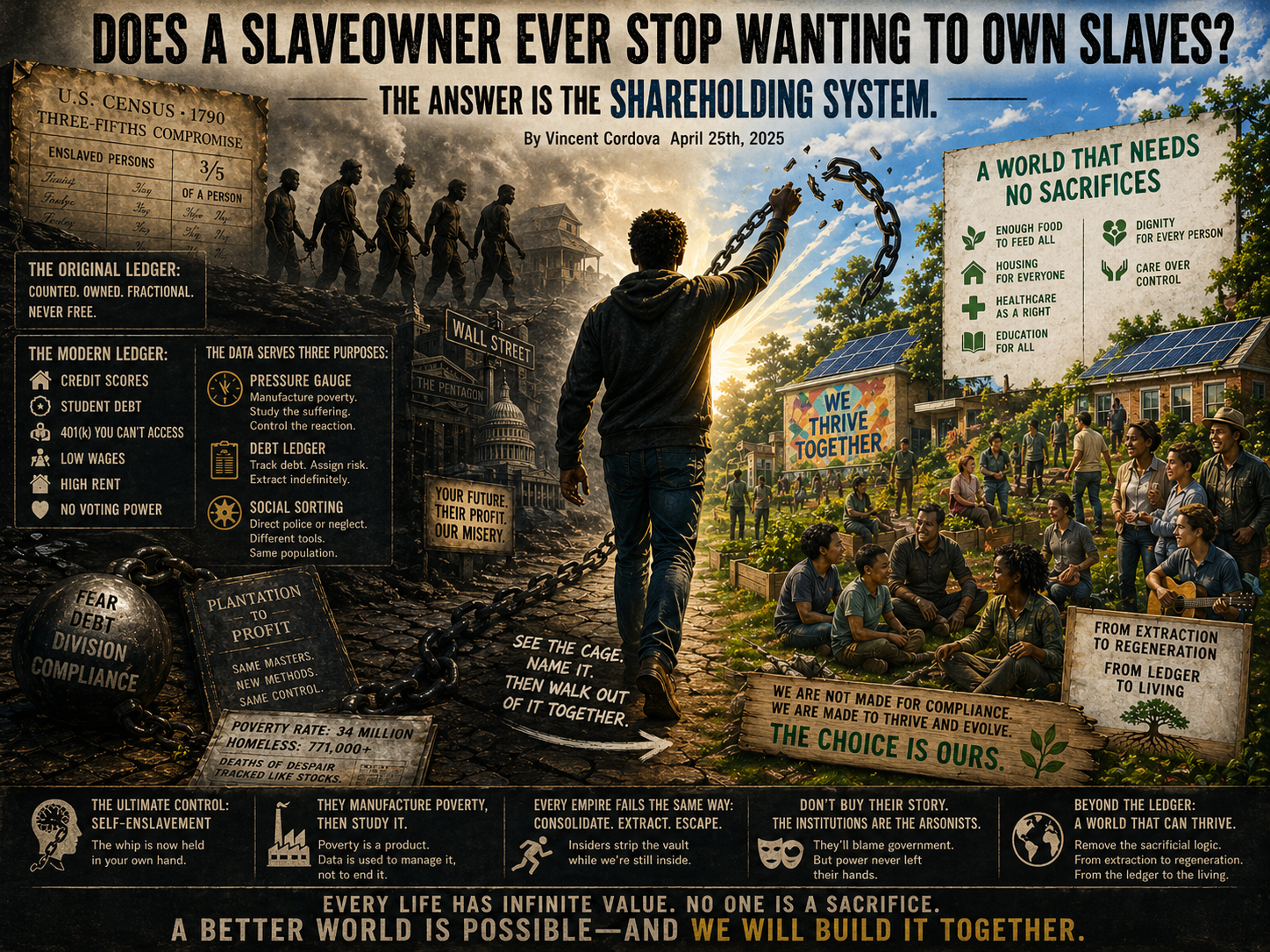
Does a slaveowner ever stop wanting to own slaves? The answer is the Shareholding System.
Note to the reader: If you have ever felt like something about this system does not add up, like you are working harder but getting less, you are not alone. And you are not broken.
Before we go any further, understand this: nothing you are about to read is meant to take your footing away. It is meant to help you find it again.
And whatever we are facing, we are not facing it individually. The same people who keep this world running, you, me, everyone doing their best to survive it, are the ones who will get through it.
Introduction: The Numbers Are Not Neutral
The United States government publishes a staggering volume of data about its population. Every month, agencies release statistics on employment, poverty, homelessness, incarceration, and deaths of despair. We are told this information exists to serve the public, to guide policy, allocate funds, and measure our collective well-being. It sounds benevolent. It sounds democratic.
It is neither.
The American data apparatus was not born in a public health laboratory or a progressive-era reform movement. It was born on the plantation. Its original purpose was not to uplift the vulnerable but to count human assets for the benefit of a slaveholding class. That mentality did not die with emancipation. It shape-shifted, modernized, and embedded itself into the very institutions that now claim to measure suffering in order to alleviate it.
Today, I propose a name for this evolved system: the Shareholding System. It is an arrangement in which a permanent owning class maintains control over labor, land, credit, and law, not through chattel ownership of bodies, but through ownership of the shares of the entire social enterprise. The rest of us are granted fractional, non-voting stakes just large enough to feel invested, while the real dividends flow upward. And the data that purports to help us is, in fact, the modern plantation ledger: a tool for measuring, managing, and maintaining manufactured suffering.
I. The Original American Data Project
The United States Census is mandated in Article I, Section 2 of the Constitution. Its first job was to count the population in order to allocate political power and tax burdens among the states. Embedded in that mandate was the most infamous compromise in American history: an enslaved Black person would be counted as three-fifths of a human being.
This was not ignorance. It was not a scientific error. It was a cold, deliberate political calculation designed to preserve the power of slaveholding states in Congress. The Census, from its first breath, was a ledger for counting human beings as fractional assets. The categories it created, free, slave, later "negro," "colored," "urban," were not neutral demographic labels. They were tools of social sorting, designed to map populations for the convenience of those who held power.
When the 13th Amendment formally abolished slavery in 1865, it left a gaping exception: slavery was prohibited "except as a punishment for crime whereof the party shall have been duly convicted." This clause was not a loophole. It was an invitation. Southern states immediately enacted Black Codes that criminalized Black life, vagrancy, unemployment, "insulting gestures," and fed a new system of convict leasing. Black men and women were arrested in mass numbers, convicted in sham trials, and leased to plantations, mines, and railroads, often the very same enterprises that had previously owned them. The state became the body-broker, and the data system adapted to count the new captive labor force.
The logic did not change. The category labels softened, but the underlying function remained: to identify, track, and manage a population that the state and capital viewed as a problem to be controlled, not as citizens to be served.
II. From Chattel to Contract: Building the Shareholding System
When physical ownership of human beings was outlawed, the owning class faced a structural problem: how to maintain the same extraction of labor, the same guarantee of a controllable workforce, without the legal instrument of the deed. They answered with three interlocking innovations that together form the blueprint of the modern Shareholding System.
Convict Leasing and the Carceral State. As historian Douglas Blackmon documents in Slavery by Another Name, convict leasing became a vast system of state-sanctioned forced labor. By the 1880s, in some Southern states, 90% of prisoners were Black, and the revenue from leasing them out constituted up to 10% of the state's total budget. The state had a direct financial incentive to arrest, convict, and lease Black bodies. The carceral system was not a response to crime; it was a labor recruitment apparatus dressed in legal robes.
Sharecropping and Debt Peonage. For those not swept into the convict system, sharecropping became the mechanism of control. Freed people were allowed to work the land in exchange for a share of the crop, but the landowner supplied the seeds, tools, housing, and food on credit, at usurious interest rates, recorded in a ledger that the sharecropper could not see or dispute. At harvest, the crop was sold by the landowner, who deducted the debts and announced that the sharecropper had broken even, or more often, fallen further behind. The sharecropper was legally free but economically captive. The ledger was the chain.
Company Towns and Wage Slavery. Industrial capital refined the model. In company towns, the employer owned the housing, the store, the school, the church. Workers were paid in scrip, not U.S. currency, redeemable only at the company store, where prices were inflated. The worker could not accumulate savings, could not leave, and could not organize. The contract that ostensibly made them a free laborer was a cage with invisible bars.
These three mechanisms shared a common DNA: the owning class no longer held title to the body, but held title to everything the body needed to survive, land, credit, law, and the means of subsistence. The "free" individual was free to starve, free to be arrested, free to accept the terms offered, or free to suffer the consequences. The system was not a departure from chattel slavery. It was its administrative modernization.
III. The Modern Shareholding System
The 20th century brought reforms: the New Deal, the Great Society, the Civil Rights Act. But the owning class did not surrender its project. It absorbed those reforms and captured them. The modern Shareholding System operates through a set of financial and legal instruments that appear race-neutral and meritocratic but reproduce the same stratified outcomes the plantation required.
The Credit Score as Plantation Ledger. The FICO score, introduced in 1989, is a numerical representation of a person's creditworthiness. It determines access to housing, employment, insurance, and even utilities. The algorithms that generate these scores are proprietary and opaque. The data that feeds them, debt history, payment records, length of credit, is not neutral. Generations of redlining, predatory lending, and discriminatory housing policy have ensured that Black and brown communities have lower credit scores on average, a gap that lenders then cite to justify higher interest rates, perpetuating the cycle. As scholar Virginia Eubanks demonstrates in Automating Inequality, the data systems that purport to assess risk are, in practice, tools for sorting populations into deserving and undeserving, insuring and uninsurable, free and indebted. The credit score is the modern sharecropper's ledger: it tells the landlord how much debt the tenant can carry while still producing enough labor to service it.
The 401(k) and the Illusion of Ownership. The shift from defined-benefit pensions to defined-contribution 401(k) plans, which accelerated in the 1980s, was sold as empowerment: workers would now be "investors," with control over their retirement savings. In practice, it transferred risk from employers to employees, while funneling trillions of dollars of workers' deferred wages into the stock market. According to the Federal Reserve's 2022 Survey of Consumer Finances, the top 10% of households owned 89% of corporate equities and mutual fund shares. The bottom 50% owned just 1%. The vast majority of workers hold tiny, fragmented stakes that tie their future security to the very corporations that suppress their wages and lobby against their interests. They are "shareholders" in name only, with no voting rights, no dividends of consequence, and a liability clause that guarantees their own precarity. As political economist Jacob Hacker has argued, this "great risk shift" has left American workers bearing the costs of unemployment, illness, and old age alone, while the financial sector extracts fees at every turn.
Public Money as Private Insurance. When the financial system teeters, the state intervenes, not to rescue the vulnerable, but to backstop the shareholders. The 2008 Troubled Asset Relief Program authorized $700 billion in public funds to purchase toxic assets from banks. The Federal Reserve's quantitative easing programs pumped trillions more into financial markets, inflating asset prices and enriching those who already held stocks and real estate. The public's money, taxes, the dollar's status as the global reserve currency, the deferred wages of workers, is used to guarantee the solvency of the owning class while leaving the underlying poverty-producing structures intact. The state acts as the ultimate owner, ensuring that those who hold the controlling shares never face the full consequences of their extraction.
IV. The Data Is the Modern Ledger
If the Shareholding System is a machine for manufacturing and managing inequality, the data apparatus is its dashboard. Every statistic the government publishes serves a dual function: a public-facing narrative of concern, and a managerial function of control.
Poverty and Homelessness as Managed Metrics. In 2023, the U.S. Census Bureau reported that 36.8 million Americans lived in poverty. The Department of Housing and Urban Development's 2024 point-in-time count identified 771,480 people experiencing homelessness on a single night. These numbers are not emergencies that trigger redistribution. They are thresholds that trigger management. Policymakers use poverty data to calibrate work requirements, eligibility cutoffs, and benefit levels, not to eliminate poverty, but to contain it within politically tolerable boundaries. The data tells the system exactly how much suffering is being administered and whether the population is approaching a breaking point. The 771,000 houseless are not just uncounted; they are meticulously counted, their numbers studied to determine whether sweeps, temporary shelters, or municipal ordinances are needed to keep them out of sight.
The Carceral System as Data-Driven Social Sorting. The United States incarcerates approximately 1.9 million people, a rate higher than any other nation. The data that maps crime, arrests, and incarceration is used to justify budgets, build prisons, and deploy police. Predictive policing algorithms, fed with historical arrest data that reflects decades of racialized enforcement, generate "heat maps" that send officers into the same communities again and again, producing more arrests and feeding the algorithm a self-reinforcing loop. As sociologist Ruha Benjamin argues in Race After Technology, these systems are not neutral tools; they are "the new Jim Code," encoding racial hierarchy into seemingly objective technological systems. The same zip code data that identifies a "high-risk" neighborhood for saturation policing is used to deny mortgage applications and insurance coverage. The data does not just describe inequality. It enforces it.
Health Disparities and Deaths of Despair. The Centers for Disease Control and Prevention meticulously tracks opioid deaths, suicides, and alcohol-related fatalities, the so-called deaths of despair that economists Anne Case and Angus Deaton have linked to decades of economic decline, wage stagnation, and social disintegration. Over 100,000 Americans die annually from drug overdoses alone. These statistics are published, analyzed, and lamented, yet the economic policies that generate despair, the destruction of unions, the offshoring of jobs, the gutting of community institutions, remain untouched. The data is the autopsy report, not the treatment plan. It is collected to understand how much despair the system can generate before the human asset breaks down.
V. Manufacturing Suffering, Then Studying It
The most cynical dimension of the data apparatus is not that it fails to solve poverty, homelessness, or mass incarceration. It is that the system actively manufactures these conditions and then funds agencies to study them, creating a self-perpetuating industry of suffering management. The poverty-research complex, the homelessness-industrial complex, and the criminal justice reform industry offer careers, grants, and conferences to those who measure misery without challenging the distribution of wealth and power that produces it. The doctor has a financial interest in the patient's continued sickness.
This is not a conspiracy of individuals. It is the structural logic of a system that needs a permanent underclass to function. Wages must be low enough to maintain profit margins. A portion of the population must be desperate enough to accept any job under any conditions. The threat of homelessness must be real enough to discourage organizing. The carceral system must be large enough to absorb those who cannot or will not comply. The data is the diagnostic tool for a disease the system requires.
VI. The Internalization of Control
The final victory of the Shareholding System is that it makes the violence administrative and, increasingly, self-inflicted. The chain is replaced by the algorithm. The overseer is replaced by the credit report. The slaveowner's demand that the enslaved person know their place becomes the internalized demand that the modern worker "invest in themselves," "build their brand," and "manage their risk."
You check your credit score like a moral report card. You police your own Facebook posts for fear of HR. You accept student debt that will take decades to repay because the alternative is a lifetime of even worse precarity. You stay in a job that destroys your body because your health insurance is tied to your employer. You are the CEO of a micro-enterprise called "You, Inc.," and you are running it into the ground because the game was rigged before you were born.
The data system intensifies this self-surveillance. It tells you your risk score, your life expectancy by zip code, your child's school's test scores compared to wealthier districts. It makes you feel personally responsible for outcomes that are structurally determined. You are a minority shareholder in a company whose board you will never meet, holding a few valueless shares while the controlling class extracts your life force and calls it a transaction.
VII. The Arc of Empire
Every empire built on this logic has eventually collapsed. The Roman latifundia gave way to the manorial system, which gave way to industrial capitalism, which produced its own crises. The British Empire extracted wealth from colonies until the colonies revolted and the center could no longer sustain itself. The Soviet nomenklatura looted the state until there was nothing left to steal. The pattern is invariant: consolidation of power, extraction of value, creation of a managerial class, and then a period of frantic looting by insiders who know the end is near.
The United States is in that final stage now. The owning class is not redistributing. It is converting public trust into private escape pods, offshore accounts, bunkers, citizenship-by-investment programs, assets untouchable by the fire they lit. They are stripping the copper from the walls while the rest of us are still inside.
And when the collapse comes, the institutions that built this machinery will point to the government and call it a failure. They will say democracy could not handle it. They will never mention that the government was their shield, the presidency their mask, and the public data their ledger. They will demand that the responsible adults take over, meaning themselves, meaning a more open form of the same extraction.
VIII. Conclusion: The Ledger Is Not the Whole World
The Shareholding System is not eternal. It is a human construct, maintained by human compliance, and it can be dismantled by human refusal. The data that has been used to sort, manage, and extract can be repurposed to distribute care and measure justice. The money that has been channeled into weapons, prisons, and surveillance can be redirected into housing, healing, and regeneration.
But first, we must see the cage. We must recognize that the numbers on the news are not neutral information. They are the quarterly reports of a plantation we were born onto, read aloud not to set us free, but to confirm that the system is generating the correct amount of desperation.
The slaveowner's ledger never disappeared. It just went digital. The question is whether we will remain its subjects or become its authors.
This analysis draws on the work of Douglas Blackmon, Virginia Eubanks, Ruha Benjamin, Anne Case and Angus Deaton, Jacob Hacker, and the datasets of the U.S. Census Bureau, Bureau of Labor Statistics, Federal Reserve, Department of Housing and Urban Development, and Centers for Disease Control and Prevention.
Community Comments
Community Comments
Share a public response to this post. Submissions are reviewed before they appear.
0 approved comments
Loading comments...