Campaign design team
The Lifestyle Trap: Why America's Congress Has Become Structurally Compromised
By Vincent Cordova | Cordova 2028
July 20, 2026
A Question Worth Asking
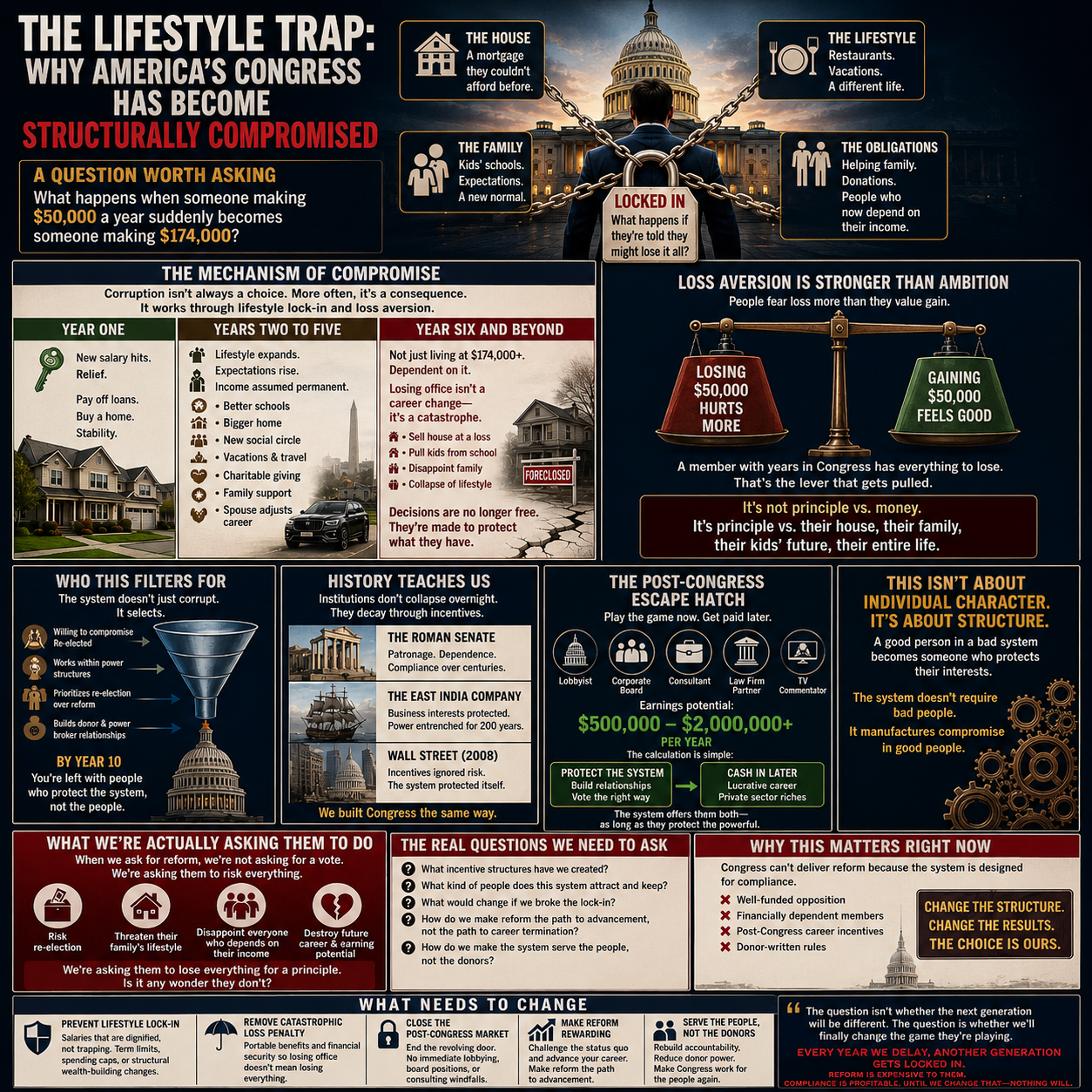
What happens when someone making $50,000 a year suddenly becomes someone making $174,000?
They don't just get richer. They get locked in. They buy a house they couldn't afford before. Their kids go to better schools. Their family's expectations shift. Restaurants they couldn't consider become normal. They take vacations. They help relatives. They plan retirements around this new income stream.
Then ask yourself: What happens if they're told they might lose it all?
This isn't theoretical. This is the condition we've built into the structure of American Congress, and it is actively corrupting our government.
The Mechanism of Compromise
We talk about corruption as if it's a choice-as if Members of Congress wake up one morning and decide, "Today I will betray my principles for money." That happens sometimes. But the more insidious corruption works differently.
It works through lifestyle.
A newly elected member of Congress experiences something most Americans never will: a sudden, permanent increase in income. Not a one-time bonus. Not a temporary spike. A permanent restructuring of their financial reality that compounds over years.
Here's what follows:
Year One
New salary hits. Relief. The member can finally pay off student loans. Maybe buy a home in a district they represent or a second apartment in Washington.
Years Two to Five
The lifestyle expands. The member's family assumes this income is permanent. Kids' school choice becomes a lever in family decisions. Social circles shift to others at this income level. Mortgage payments are built around this salary. Spouse's job choices adjust. Vacation patterns change. Charitable giving increases. Extended family members come to expect certain forms of support.
Year Six and Beyond
The member isn't just living at $174,000+. They're dependent on it. Losing office isn't a lateral career move-it's a catastrophe. It means selling the house at an unfavorable moment, pulling kids from their school, disappointing family members who've come to expect stability, collapsing the lifestyle architecture they've spent years building.
By this point, the member is no longer making decisions freely. They're making decisions to protect what they have.
Loss Aversion Is Stronger Than Ambition
Behavioral economics proved this decades ago: people fear loss more acutely than they value equivalent gain.
Losing $50,000 hurts more than gaining $50,000 feels good. It's not rational-it's how human psychology works.
A Congressional member with five years in office has built a loss. They have everything to lose. When a powerful donor suggests they vote a certain way, or when party leadership pressures them to stay silent on corruption, or when a lobbyist hints that future employment depends on cooperation-the member isn't facing a choice between principle and money as abstract concepts.
They're facing a choice between principle and losing their house, disappointing their family, collapsing their children's school plans, and admitting they can't maintain the lifestyle their family now depends on.
That's not a fair fight.
Who This Filters For
Over decades, this system doesn't just corrupt individuals. It selects for them.
Members who are willing to compromise get re-elected consistently. Members who push real reform, who vote against party leadership, who refuse donor requests, who challenge the status quo-they face well-funded primary opponents and lose re-election bids.
The institution doesn't just corrupt; it filters out the people least willing to be corrupted.
By Year 10 in Congress, you're left with:
- People who've shown they'll protect their lifestyle
- People who've proven they work within existing power structures
- People who've demonstrated they prioritize re-election over reform
- People who've built relationships with donors and power brokers who keep them employed
This isn't a bug in our system. It's a feature of how we've structured it.
Historical Precedent: This Is How Decline Works
Look at any institution that rotted from within-not through dramatic villainy, but through structural incentives.
The Roman Senate didn't suddenly become corrupt. Over centuries, senators became dependent on their positions, on patronage networks, on the ability to move between public office and private enrichment. By the time anyone noticed, the system had already selected for compliance.
The British East India Company wasn't founded by cartoon villains. It was founded by merchants who needed a structure to protect their investments. Those structures, once built, shaped decisions for 200 years.
Wall Street didn't break in 2008 because of a few bad actors. It broke because the structure incentivized everyone to ignore risk-because the people making decisions had already built their lives around the assumption that the system would protect them.
We built Congress the same way.
The Post-Congress Escape Hatch
Make it worse: members often know that if they do protect the system, if they do vote the right way for the powerful people who matter, there's an exit strategy.
Former members of Congress regularly become:
- Lobbyists (leveraging their Congressional relationships)
- Board members of corporations they regulated
- Consultants to industries they oversaw
- Partners in white-shoe law firms
- Television commentators
The earning potential post-Congress can exceed what they made in Congress. A member who leaves office after 10-15 years can realistically earn $500,000-$2,000,000+ annually through these channels, depending on how well they played the game while serving.
So the calculation becomes:
- During Congress: Protect the system, vote the right way, build relationships with corporate interests, donors, and party leadership
- After Congress: Leverage those relationships for lucrative private-sector positions
The member isn't just protecting their current lifestyle. They're setting up their next one, often more lucrative than the current one.
The system doesn't ask them to choose between principle and money. It offers them both-as long as they protect the people who already have power.
What We're Actually Asking
When we ask a member of Congress to vote against a donor, to challenge their party leadership, to push for real reform-we're not asking them to make a principled stand.
We're asking them to:
- Risk their re-election
- Threaten their family's lifestyle
- Disappoint everyone dependent on their current income
- Potentially destroy the relationships and reputation that could make them rich post-Congress
We're asking them to lose everything for a principle.
Is it any wonder they don't?
The Real Questions We Need to Ask
If we want to understand why Congress isn't delivering on reform, we shouldn't just ask "Are members corrupt?" We should ask:
What incentive structures have we created?
- We pay them suddenly more than they've ever made
- We let them build lives on the assumption this income is permanent
- We reward them for protecting the status quo
- We punish them for challenging powerful interests
- We offer them lucrative exits if they play the game correctly
What kind of people does this system attract and keep?
- Those willing to prioritize personal security over reform
- Those comfortable building networks with wealthy donors
- Those skilled at justifying compromise
- Those who understand the difference between public positions and private votes
What would change if we broke the lock-in?
- If members couldn't build unsustainable lifestyles on Congressional salaries
- If they didn't face catastrophic loss if they lost re-election
- If the system didn't reward protecting the status quo
- If there weren't lucrative post-Congress industries waiting for obedient politicians
This Isn't About Individual Character
Let's be clear: this isn't about finding "honest people" to elect to Congress. Individual character matters, but it's not the lever.
The lever is structure.
A good person placed in a system that rewards compromise, punishes reform, and makes losing office catastrophic will-over time, under pressure, year after year-become someone who protects their interests. Not because they're evil. Because they're human.
An honest person facing the choice between "vote the way I believe and lose my house" versus "vote the way the donor wants and keep my house" will eventually choose their house. They'll find a way to rationalize it. They'll tell themselves everyone does it. They'll convince themselves that the alternative-losing their position-means someone worse takes their seat.
The system doesn't require bad people. It manufactures compromise in good people.
What Needs to Change
This isn't a question about individual reform or rooting out "bad actors." It's a question about restructuring the incentives.
We need to ask:
- How do we prevent lifestyle lock-in? Congressional salaries should be high enough to be dignified, but not structured to trap members into unsustainable living. Term limits, spending caps, or structural changes to how members build wealth could matter here.
- How do we remove the catastrophic-loss penalty for losing office? If losing Congress doesn't mean losing your house and disappointing your family, members can make freer choices. Portable benefits, stronger protections for members' financial security outside of re-election, or structural changes to how we think about Congressional work could help.
- How do we close the post-Congress influence market? If former members can't immediately monetize their Congressional relationships through lobbying, board positions, or consulting, the incentive to build those relationships while in office diminishes.
- How do we make reform the path to advancement rather than the path to career termination? If challenging the status quo actually advanced a member's career and prospects, rather than threatening them, you'd see different behavior.
- How do we make the system serve the people members represent, rather than the donors who keep them employed?
Why This Matters Right Now
America is in a moment where Congress is functionally unable to deliver on major reform.
It's not because members are uniquely stupid or uniquely corrupt compared to previous generations. It's because we've structured Congress to select for compliance and reward protection of the status quo.
Every significant reform-campaign finance reform, healthcare reform, tax reform, technology regulation, environmental protection-has to survive a gauntlet of:
- Well-funded opposition
- Members who are financially dependent on opposing change
- Post-Congress career incentives that reward obstruction
- Donor networks that have written the current rules and benefit from them
The members of Congress aren't villains in this story. They're people trapped in a system that makes reform catastrophically expensive and compliance safely profitable.
If we want Congress to actually do something, we have to change the structure. We have to make reform the thing that protects members' careers and families, not the thing that threatens them.
Otherwise, we can nominate the most principled people in America, put them in Congress, and the system will still grind them toward compromise. Not through corruption. Through loss aversion. Through lifestyle. Through the simple fact that humans protect what they have.
The Challenge Before Us
Congress isn't broken because the people in it are bad. Congress is broken because the incentive structure is designed-whether intentionally or through accumulated historical accident-to lock members into protecting the status quo.
Until we change that structure, we can't expect different results.
Until we ask the real questions-not "Are members corrupt?" but "What system have we created that makes compromise inevitable?"-we'll keep voting people in expecting them to change, only to watch them get swallowed by the same machine that swallowed their predecessors.
The question isn't whether the next generation of Congress members will be different. The question is whether we'll finally change the game they're playing.
Everything else follows from that choice.
This is a question America needs to answer now. Not in five years. Not after the next election. Now. Because every year we delay, another generation of members gets locked into a system that makes reform impossible and compromise inevitable.
Community Comments
Community Comments
Share a public response to this post. Submissions are reviewed before they appear.
0 approved comments
Loading comments...