Build protections against extractive systems—so the next generation doesn’t have to live under them.
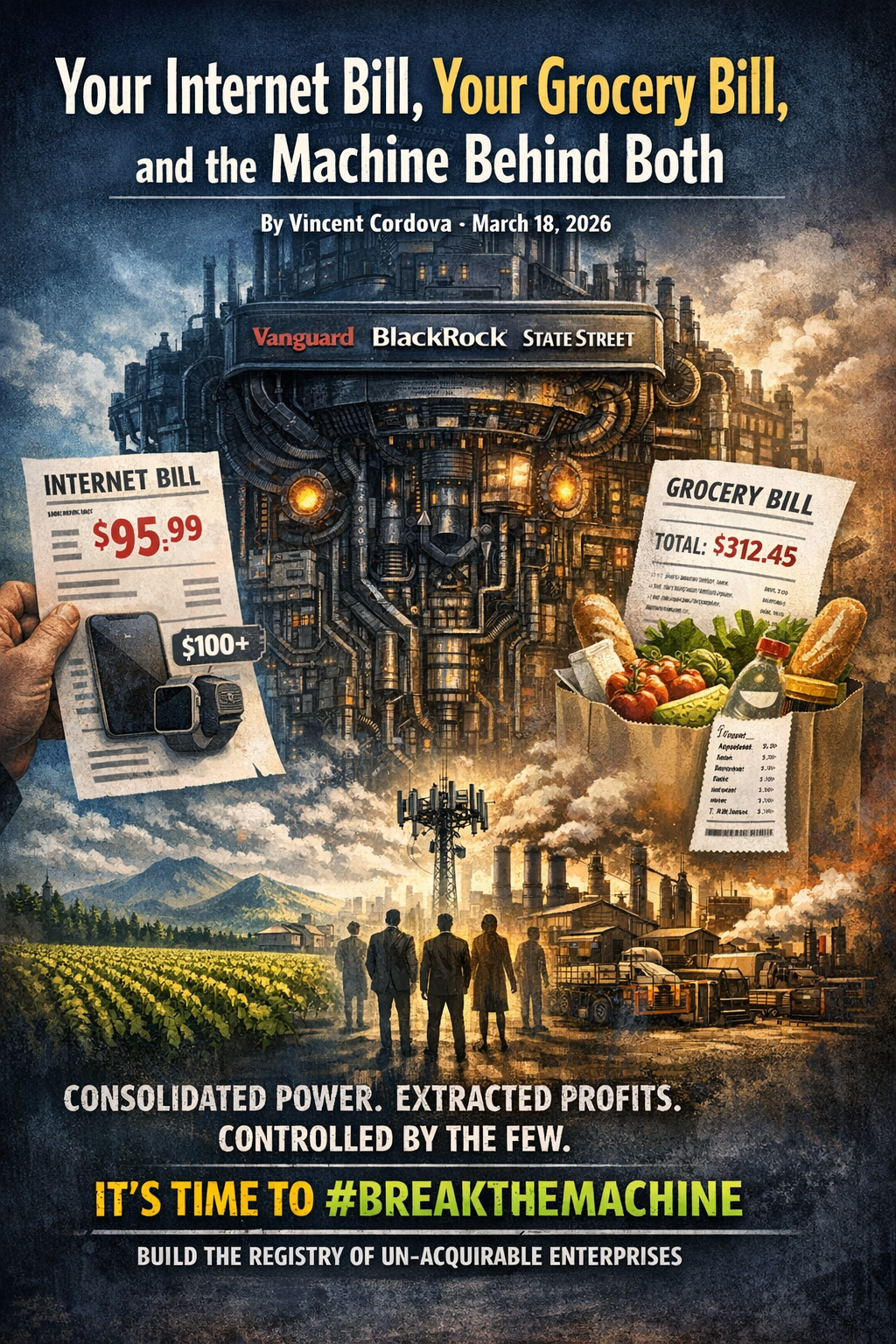
After Verizon bought Frontier, my internet bill went up again. No warning. No explanation. Just deal with.
But that wasn't the first time.
We paid off all our corporate phones in a One Talk Solution. Signed up with terms we understood. Then the price went up anyway.
My personal devices: one phone, one smart watch, one second number. Over $100 a month. For devices I already own.
Most people get over it. Most of the time, I do too. It's just how things work now, huh?
But here's what I finally realized: it's not separate problems. It's the same problem, showing up in different places. I should expect that in an extractive system, correct?
Why and how come? - Only if wages matched that.
Internet goes up. Phones go up. The terms you agreed to change. The devices you own keep costing you. And every time, the explanation is the same—which is to say, there isn't one.
That's not a coincidence. That's a system.
Thanks, Verizon, for taking the value out of working hard. I wonder how many children will eat less because of it, especially knowing wages barely meet the cost of life already.
I expect more from you. You're our "one solution" now, and I'd like to keep it that way. But you know what happens if I move on? I get the same “consolidated power,” controlling my "competitive" prices from another value extractor company.
Is it a lose-lose situation?
Please be or do better because I don’t want to change providers.
A machine.
They say that they are not run by conspirators meeting in secret room. Run by incentives so perfectly aligned that the outcomes look coordinated even when no one's coordinating. Run by ownership so concentrated that competition becomes a memory. Run by a system designed to extract from the builders, not to build. How was slavery coordinated? (See Part 17: How Slavery Was Coordinated)
Three firms sit at the center of this machine: Vanguard, BlackRock, and State Street. Together, they are the largest shareholders in 88% of all S&P 500 companies [Harvard's John Coates]. They own roughly 20% of both Verizon and AT&T—your two strong "choices" for internet service [SEC filings]. They vote 91% of the time in shareholder elections. Individual investors like you? We vote 28% [Harvard Law School Forum].
They don't set prices, they say. They don't manage operations. They don't need to. When you own 20% of every option, when you vote 91% of the time, when every CEO knows what you expect—the machine runs itself.
In markets with no real competition—internet service, food production, raw materials—that machine produces one outcome consistently: prices rise, across every sector, at the same time.
If you run a small business, you've felt this. Internet goes up. Supplies go up. Logistics go up. Your competitor down the street gets the same increases on the same day. It doesn't feel like competition. It feels like structure.
That's because it is.
The Machine Runs on Raw Materials
This pattern doesn't stop at your internet bill. It runs through everything.
On February 18, 2026, President Trump signed an executive order declaring elemental phosphorus and glyphosate-based herbicides critical to U.S. national security [White House]. The order invoked the Defense Production Act of 1950, a law designed to mobilize American industry for war.
Why? Because elemental phosphorus is in your food (fertilizer), your phone (semiconductors), your car's battery, and your military's smoke screens and incendiary devices. China controls 84% of global production. The U.S. controls 5% [essentialchemicalindustry.com]. We import over 6 million kilograms annually.
Glyphosate is the world's most widely used herbicide. Without it, a family of four would pay 48% more for groceries. Crop yields would drop 50-90% for fruits and vegetables. Farmers would need an additional 800 million acres to maintain current production—an area equivalent to 42% of the lower 48 states [Bayer].
The order states plainly: any interruption of supply "could leave our defense industrial base and food supply vulnerable to hostile foreign actors."
But here's what the order doesn't say. The same machine that owns your internet provider also owns the companies that mine phosphorus, manufacture glyphosate, and distribute food. Vanguard, BlackRock, and State Street are among the largest shareholders in every link of that chain.
The threat isn't just foreign. It's structural. When ownership concentrates, prices rise. When prices rise everywhere, it's not a market—it's a toll road.
Two Visions of Security
Not everyone accepts this.
Will Harris, a regenerative farmer at White Oak Pastures in Georgia, issued a statement opposing the executive order. He wrote:
"We firmly believe moving away from these inputs in mass is not optional—it's necessary, and it's beyond time... We believe a more appropriate executive order would have declared the PROTECTION of our soils, water, and rural communities to be national security issues" [White Oak Pastures].
Harris points to the long-term damage from chemical drift, contaminated land, and poisoned waterways. He argues that true security lies in healthy soil and clean water, not in guaranteeing supply for extractive industries.
He's right. But here's the problem: even regenerative farmers need to buy supplies. Even organic farms need inputs. And those inputs come from companies owned by the same machine.
The question isn't whether we use these substances—it's who controls them and what they're incentivized to do with that control.
When private equity and extractive capital control critical materials, their incentives are:
• Minimize costs (including safety)
• Maximize price
• Fight transparency
• Externalize harm
When mission-locked enterprises control them, their incentives are:
• Protect workers (who are owners)
• Serve the public (locked mission)
• Be transparent (public trust)
• Invest in safer alternatives (long-term horizon)
The harm is not in the substance. It's in who controls it and what they're allowed to do with that control.
The Structures Already Exist
Here's what surprised me most. The alternative models already exist. They're just not visible.
Perpetual Purpose Trusts hold businesses in perpetuity to fulfill a specific mission. Patagonia transferred ownership to a Perpetual Purpose Trust in 2022. All voting stock went into the trust, created to protect the company's mission and values. The remaining non-voting stock went to a nonprofit that receives Patagonia's profits to fight climate change. The company continues operating as a for-profit B Corp, but now all profits serve the planet [Patagonia].
The Guardian has been owned by the Scott Trust since 1936. The trust exists for one reason: "to secure the financial and editorial independence of The Guardian in perpetuity." It has no shareholders. It cannot be bought [Scott Trust].
Employee Ownership Trusts benefit employees by holding shares on their behalf. Research shows employee-owned firms have 50% lower bankruptcy rates and over 90% higher employee net wealth [NCEO].
Mainscape, a commercial landscape company with 950 employees across 11 states, is transitioning into the Mainscape Jubilee Trust—a perpetual purpose trust created to protect the company's purpose, invest in its people, and ensure shared prosperity for generations. Founder Dave Mazanowski acknowledges he's leaving money on the table by not selling to private equity. "This is my way of testing whether I believe any of that is true," he says. "Am I going to really make a decision that reflects my beliefs?" [Mainscape].
These models exist. They work. They just need visibility and scale.
What We're Building: The Registry of Un-Acquirable Enterprises
Right now, there's no way to find these businesses. No directory. No certification. No way for a consumer to know, at a glance, which enterprises are legally locked and which are designed to be sold.
That absence matters. What people can't see, they can't support.
We're building a Registry of Un-Acquirable Enterprises—a public, verifiable directory of businesses legally incapable of being sold to extractive capital. Certified. Searchable. Free.
The registry will include:
• Perpetual purpose trusts
• Worker-owned cooperatives
• Steward-owned enterprises
• Employee ownership trusts
• Nonprofit industrial operators
For consumers: a way to choose businesses that can never be sold.
For founders: a roadmap for building differently.
For policymakers: a tool for supporting structural diversity.
For investors: a signal that these enterprises exist and need capital.
How We Build It
The tools already exist. Open-source, government-grade platforms are available today.
OpenG2P is an open-source platform enabling governments to build secure, inclusive registries for social benefit delivery. It's a Digital Public Good recognized by the Digital Public Goods Alliance, designed for creating functional registries of individuals, non-human entities, and groups. The platform handles change management, audit trails, and interoperability—everything a registry needs [OpenG2P].
Similar platforms include:
• Diia.Engine
• Sovrium
• NocoBase
• Liquio
• Jet Admin
We can have a working registry in weeks. For free. On infrastructure we own. With data we control.
The registry itself must be un-acquirable. That means legal structures—perpetual purpose trust, steward-ownership, or similar—that lock the mission forever, prevent any sale or transfer of control, and ensure the registry serves the public in perpetuity.
Partnering With Global Leaders: The Conversion Strategy
The machine controls production today. But production doesn't have to stay in extractive hands.
We can partner with global chemical manufacturers to transition their operations—or parts of them—into mission-locked structures. This isn't about nationalization or seizure. It's about conversion.
Why Manufacturers Might Partner
• Regulatory pressure
• ESG credibility
• Talent retention
• Succession planning
• Risk management
• Supply chain security
The Model: Hybrid Structures
A global chemical manufacturer could:
• Spin off a division into a separate entity
• Structure that entity as a perpetual purpose trust or steward-owned enterprise
• Retain a minority economic interest while ceding control
• License technology to the new entity at fair rates
• Become a preferred supplier to the un-acquirable ecosystem
The Defense Production Act Precedent
On February 19, 2026, the Defense Department announced an $11.8 million Defense Production Act award to Umicore Optical Materials to establish new processing capability in Oklahoma [Defense Department].
Section 303 of the Defense Production Act authorizes the President to support purchases, production capability, and substitutes for strategic and critical materials [50 U.S.C. § 4533].
The precedent exists. The legal authority exists. The question is whether we use it to incubate mission-locked enterprises alongside extractive ones.
Why This Becomes a Global Project
This isn't just about internet bills. It's about building infrastructure for a different kind of economy—one where enterprises can be structured to endure, not to be extracted from.
Once the registry exists, it can spread globally. Every country facing concentrated ownership, rising costs, and extractive capital needs this tool. Every community trying to build something lasting needs a way to be seen.
The registry becomes a map. The map becomes a movement. The movement becomes a global infrastructure for enterprises built to last.
The Ask
I don't have money to pay anyone. The machine has trillions. It has decades of momentum. It has lawyers and lobbyists and a system built to extract.
What I have is a phone number. A problem that needs solving. And an invitation.
If you're an attorney who can structure the registry itself to be un-acquirable—not for a fee, but for a legacy—call me: 350-229-1046.
When you call, say: "I don't need money. Tell me about the problem."
If you're a chemical manufacturer facing the choice between selling to private equity or locking your mission forever—call me.
If you're a founder: Ask not just "how do I grow?" but "how do I structure this so it can never be taken?"
If you know an un-acquirable business: Add it to the public spreadsheet. Link in bio. Visibility is leverage.
If you're none of those things: Share this post. One person. That's all it takes.
The Closing
I started with an internet bill. I found a machine.
The machine has trillions. It has a 50-year head start. It has every incentive to keep extracting.
But it doesn't have meaning.
That's what we're offering.
There are so many intelligent people out there. I know you're reading this. I know you've been waiting for something that matters.
This is it.
My internet bill went up. If we build this—really build it, lock it forever, make it global—our kids won't have to accept that as normal.
They'll have something better.
And that's worth building.
Vincent Cordova is going to “attempt” to build the Registry of Un-Acquirable Enterprises. If you are a developer, please build it—this can change the world, let’s do it together. :)
For attorneys, founders, and chemical manufacturers: 350-229-1046
#UnAcquirableRegistry #BreakTheMachine #ProtectTheNextGeneration #ConvertDontSell