Campaign design team
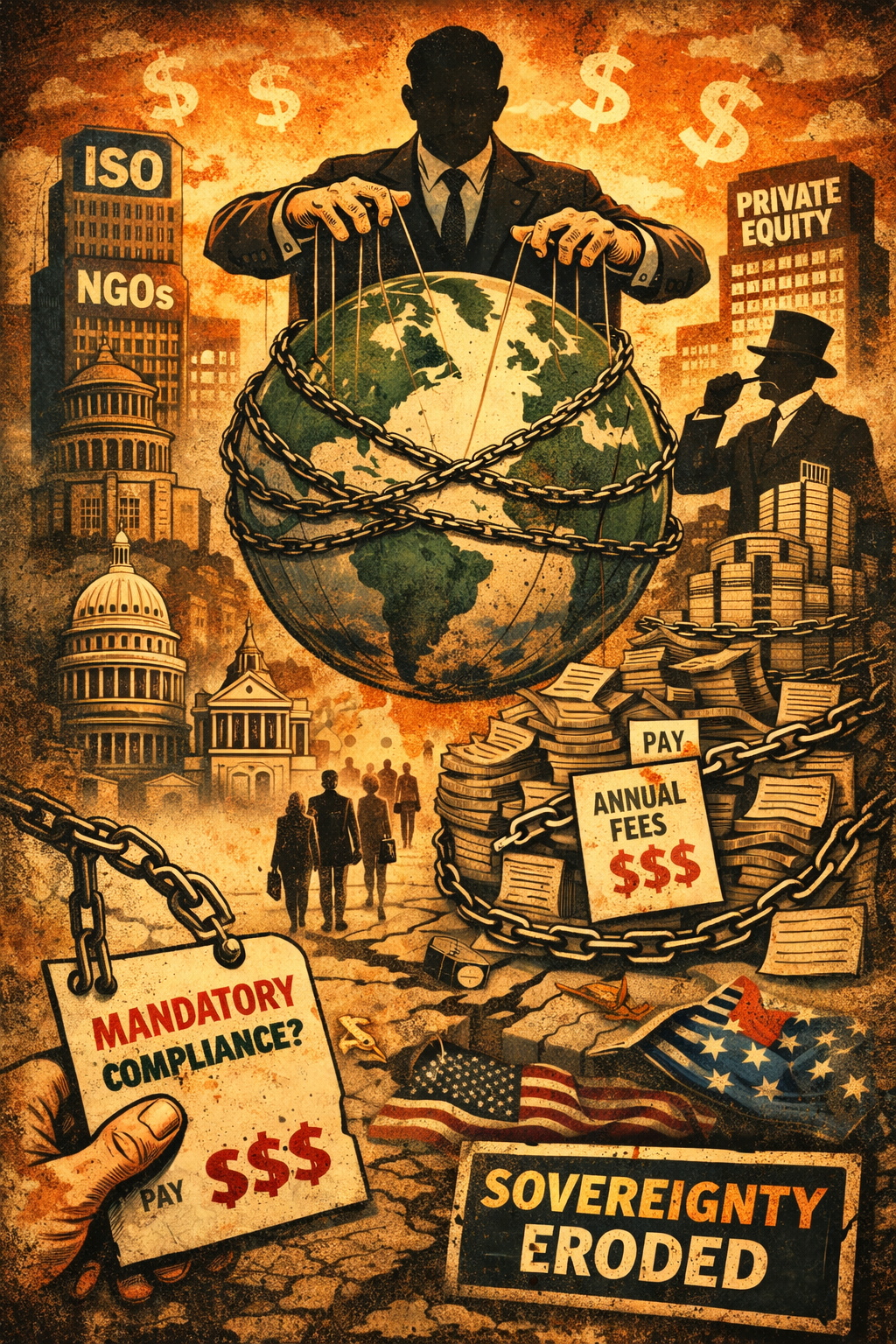
When Private Standards Become Public Power
By Vincent Cordova | January 21, 2026
Why Capitalist Societies Are Especially Vulnerable to Compliance Colonization
Capitalism is often defended as a system of freedom, choice, and competition. In its healthiest form, that defense is justified. But capitalism also has a shadow—one that emerges when profit incentives are allowed to replace democratic consent and when private authority quietly substitutes itself for law.
We are now deep into that shadow.
Across industries and borders, businesses are increasingly required to comply with rules that were never legislated, enforced by entities no one voted for, and maintained through ongoing fees that function as economic tolls. These requirements are framed as “standards,” “best practices,” or “risk controls,” but their effects are unmistakably political.
They govern who may participate.
They govern under what conditions.
And they govern at a price.
The Structural Risk to Capitalism Itself
Capitalism depends on clear boundaries between:
- Private enterprise
- Public law
- Voluntary coordination
When those boundaries collapse, capitalism does not become freer—it becomes extractive.
The danger is not regulation. The danger is regulation without legislation.
When compliance obligations are created by international bodies, NGOs, or nonprofits—and enforced through market access rather than law—capitalism begins to resemble something else entirely: a managed economy governed by private rule-makers whose incentives are not aligned with public welfare.
How Private Equity Learned to Rule Without Governing
Private equity firms did not need to capture governments to gain power. They discovered something more efficient.
They acquired:
- Infrastructure companies
- Service providers
- Compliance vendors
- Data platforms
- “Risk” and “trust” intermediaries
Through consolidation, PE firms now sit behind:
- Logistics
- Healthcare
- Housing
- Insurance
- Food systems
- Payment rails
- Compliance tooling
Their mandate is not public good. Their mandate is return on investment.
And when profit is the mandate, complexity becomes a revenue strategy.
The Pattern: Profit Through Compliance Expansion
The pattern is now unmistakable:
- A private or international body defines a “standard.”
- The standard is framed as neutral or technical.
- Regulators reference it instead of legislating.
- NGOs or nonprofits are positioned as administrators.
- Compliance becomes required to participate.
- Annual fees are imposed to remain “in good standing.”
- Businesses pay because exit is impractical.
This is not accidental.
It is a business model.
Each new compliance layer:
- Increases dependency
- Reduces competition
- Favors scale
- Penalizes small operators
- Creates recurring revenue
This is not capitalism functioning. This is capitalism being exploited.
NGOs and Nonprofits as Enforcement Proxies
One of the most dangerous myths in modern governance is that nonprofits are inherently benign.
In reality:
- Nonprofits are not democratically accountable.
- Boards are self-selecting.
- Funding shapes priorities.
- Oversight is minimal.
- Capture is easy.
When NGOs or nonprofits are used to administer compliance, they become enforcement proxies—able to impose rules, collect fees, and restrict participation without ever passing a law.
This structure provides perfect insulation:
- Governments deny responsibility.
- Corporations claim neutrality.
- Nonprofits claim moral authority.
- Businesses absorb the cost.
No one is accountable. Everyone profits—except the public.
International Standards and the Erosion of Sovereignty
The sovereignty risk is not theoretical.
When international agencies or private standard-setters create requirements that domestic businesses must follow—without domestic legislative approval—sovereignty is already compromised.
Over time, this leads to:
- Foreign rule-making by reference.
- Economic coercion without treaties.
- Compliance regimes immune to local challenge.
- Domestic policy overridden by “global norms.”
A country does not lose sovereignty all at once. It loses it incrementally, through convenience, delegation, and silence.
Why This Is Especially Dangerous in Capitalist Systems
Capitalist systems amplify power.
Capital flows toward:
- Scale
- Leverage
- Control points
- Dependency nodes
When compliance itself becomes a control point, it will be monetized.
When identity becomes a control point, it will be rented.
When participation becomes conditional, it will be priced.
That is not corruption. That is incentive alignment.
And unless constrained by law, those incentives will always drift away from the public interest.
Compliance Without Law Is Not Neutral — It Is Coercive
There is a fundamental principle being violated here:
If a rule is mandatory, it must be legislated.
Anything else is coercion disguised as coordination.
When businesses are told:
- “This is not law, but you must comply.”
- “This is voluntary, but you cannot operate without it.”
- “This is a standard, but you must pay yearly.”
What they are experiencing is governance without consent.
The Cost Is More Than Money
The real cost is not the annual fee. The real cost is:
- Loss of autonomy
- Loss of local control
- Loss of innovation
- Loss of trust
- Normalization of unaccountable power
Once businesses accept non-legislative compliance as normal, the door is open for endless expansion.
More rules. More fees. More intermediaries. More dependency.
Less freedom.
We Have to Be Done With This
This is not a call for deregulation. It is a call for re-legitimation.
Rules that govern participation must:
- Be written in law.
- Be debated publicly.
- Be funded transparently.
- Be accountable democratically.
- Expire or be renewed through consent.
Anything else is unacceptable in a society that claims to value freedom, markets, and self-determination.
A Line Must Be Drawn
Standards should enable. They should not rule.
Nonprofits should serve. They should not govern.
International coordination should assist. It should not override sovereignty.
And compliance should never be a private toll road into economic life.
If capitalism is to survive as anything other than managed extraction, this pattern must end.
Not someday. Not incrementally.
Now.
Community Comments
Community Comments
Share a public response to this post. Submissions are reviewed before they appear.
0 approved comments
Loading comments...