This site is under construction - will be ready soon.

Campaign design team
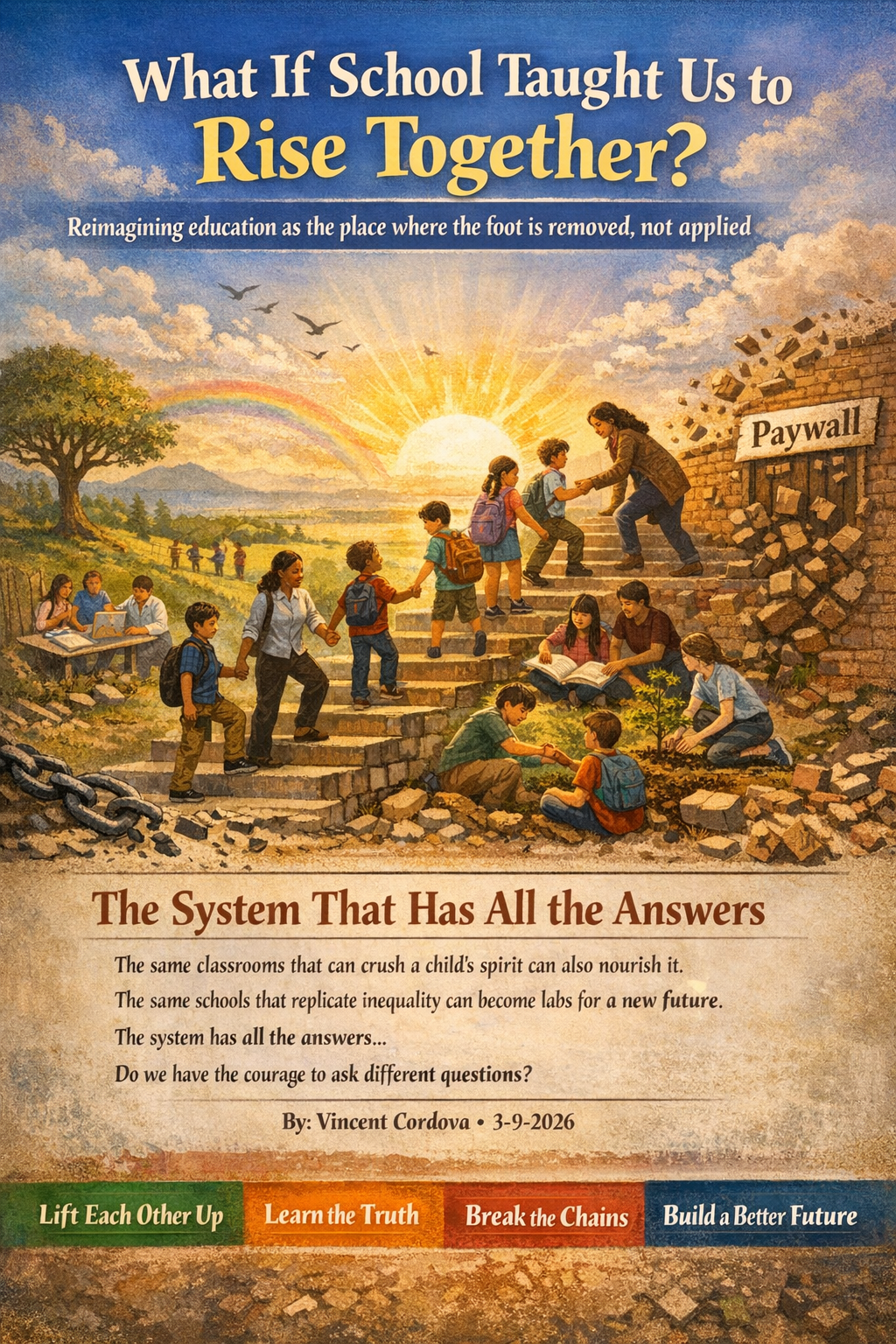
What If School Taught Us to Rise Together?
By Vincent Cordova · 3/9/2026
Reimagining education as the place where the foot is removed, not applied
The System That Has All the Answers
There is a strange and powerful truth hiding in plain sight: the very education system that is aimed at our children—that sorts them, ranks them, and too often prepares them for a life of extraction—also holds within it all the answers we need to change course.
Think about that for a moment.
The same classrooms that can crush a child's spirit can also nourish it. The same teachers who are forced to teach to tests can also spark lifelong curiosity. The same schools that replicate the inequalities of the outside world can also become laboratories for a new one. The system has all the answers. The question is whether we have the courage to ask different questions.
Right now, too many children sit in classrooms where they are being prepared for a world that does not yet exist—or worse, for a world that exists only to consume them. They learn to compete, to rank, to measure themselves against others. They learn that their value is tied to their performance. They learn that some people are winners and some are losers, and that this is simply how the world works. They absorb, without anyone ever saying it directly, that their success may require someone else's failure.
This is not accidental. This is design. The extractive system needs workers who believe they are lucky to be chosen, consumers who believe they are defined by what they own, and citizens who believe that the way things are is the way things must always be. Schools, as they currently function, too often serve this machine.
But they do not have to.
What We Are Really Teaching
Let us be honest about what the current system teaches, whether we intend it or not.
It teaches that time is an enemy to be raced against, not a gift to be inhabited. It teaches that some subjects matter more than others, and by extension, that some kinds of minds matter more than others. It teaches that there is a limited amount of success to go around, and that kindness, collaboration, and deep understanding are nice ideas but not what the test measures.
For children in underfunded schools, it teaches something even crueler: that they are worth less. The crumbling building, the outdated textbooks, the overcrowded classrooms—these are not just inconveniences. They are daily lessons in where society believes these children belong.
And for the children who "succeed" in this system? They learn that their success is earned, that they deserve their advantages, and that those who struggle must somehow be less capable or less deserving. They learn to see the world through a lens of meritocracy that obscures the foot that was never on their neck.
We are not just failing to teach. We are actively teaching the wrong things.
Removing the Target
A transformed education system would do one thing above all else: it would remove the target from the backs of children.
It would stop treating children as future workers to be trained and start treating them as whole humans to be nurtured. It would fund schools equally, because a child's zip code should not determine their destiny. It would feed children, because hungry brains cannot learn. It would counsel them, because wounded hearts cannot focus. It would see them—really see them—not as data points but as sacred beings.
This is not radical. This is simply paying attention to what children actually need.
The research is clear on what works. Smaller class sizes. Well-supported teachers. Nutritious meals. Access to books. Time for play and art and movement. Wraparound services that address the whole child. None of this is mysterious. We know what children need to thrive. The only question is whether we are willing to provide it to all children, not just some.
Teaching the Truth
A transformed education system would also tell the truth.
It would tell the honest story of how we got here—the five hundred years of extraction, the creation of the underclass, the systems that persist. Not to shame children, but to equip them. Not to burden them with guilt, but to arm them with understanding so they do not unknowingly become tools of the same machine.
Imagine a history curriculum that does not sanitize the past but illuminates it. Imagine students learning about the extractive economies of the past and recognizing their echoes in the present. Imagine them studying the rise and fall of empires and asking: What are we building? Where is it leading?
Imagine a civics class that does not just teach how a bill becomes a law, but teaches how power actually works—who has it, who doesn't, and how ordinary people have fought to shift the balance. Imagine students leaving school not just knowing their rights, but knowing how to use them.
Imagine a literature class where children read stories that reflect their own lives and stories that open windows into lives completely different from their own. Where empathy is not a buzzword but a practiced skill. Where they learn that the deepest truths are often found not in data but in poetry, not in formulas but in fiction.
This is not indoctrination. This is liberation. This is giving children the tools to understand the world so they can change it.
Modeling the World We Want
Most importantly, a transformed education system would model the world we want to live in.
Schools themselves would become places of abundance, not scarcity. Collaboration would replace competition. Curiosity would replace compliance. Children would learn that their success does not require someone else's failure—that the pie can grow, that there is enough, that we rise together or not at all.
This means rethinking assessment. Not abandoning standards, but asking what we are really trying to measure. Do we need to know who is "ahead" and who is "behind," or do we need to know what each child needs to flourish? Do we need to rank, or do we need to understand?
This means rethinking the structure of the day. More time for deep engagement, less for frantic transition. More time for questions, less for answers that are already known. More time for silence, for wonder, for the slow work of becoming.
This means rethinking the relationship between schools and communities. Schools as centers of community life, not isolated fortresses. Schools as places where parents come to learn alongside their children, where elders share their wisdom, where the boundaries between "school" and "life" dissolve.
And this means rethinking who teaches and how they are supported. Teachers as professionals trusted to use their judgment, not as technicians following scripts. Teachers as mentors, guides, co-learners. Teachers who are paid what they are worth, supported in their growth, and freed from the impossible demands of a system that asks them to do more with less.
Why Education Is Not Free
You know what I just realized? Something so simple and so devastating that I have to say it out loud.
Education is not free because if it were, the underclass would be free from their chains within a single generation.
Think about it. A child with a fully funded school. A child with nutritious meals every day. A child with teachers who are valued and supported. A child with books and computers and art supplies and time to play. A child with counselors who help them heal and mentors who believe in them. A child who learns the truth about the world and their place in it.
That child cannot be kept down.
That child grows up knowing they are worthy. That child asks questions the system does not want answered. That child becomes an adult who cannot be controlled, who cannot be exploited, who cannot be convinced that their suffering is normal or deserved.
The foot requires ignorance to stay in place. The foot requires exhausted parents who cannot advocate because they are working three jobs. The foot requires overcrowded classrooms where children disappear into the noise. The foot requires the myth that some children are just "better" or "smarter" or "more deserving." The foot requires that the child who ages out of foster care at eighteen has nowhere to go and no one to call.
Every single resource that could lift someone up is locked behind a paywall. Not because we cannot afford to provide it. The wealth exists. The resources exist. The knowledge of how to do it exists. The only thing missing is the will. And the will is missing because the system knows exactly what would happen if every child was truly free to become who they were meant to be.
They would become unstoppable.
Unfortunately, most parents today have a foot on their own necks, letting them know, one wrong move and your child will be houseless and hungry. So how is change supposed to occur? That foot is preventing your own true growth or dreams; you need that foot off your neck. So how do we remove that foot, that chain, off of everyone's neck - as it is an essence killer. if that foot/boot was removed, what would you create?
The Paywall Is the Chain
We need to be honest about what a paywall really is.
When a child cannot afford tutoring, that is a chain.
When a family cannot afford healthcare, that is a chain.
When a young person ages out of foster care with nothing, that is a chain.
When education requires debt that takes decades to repay, that is a chain.
When the schools in poor neighborhoods crumble while schools in wealthy neighborhoods flourish, that is a chain.
The chains today are not made of iron. They are made of dollars and cents. They are made of policies that ensure the child born into poverty stays there because every door has a price. They are made of a system that says, "You can rise, but only if you can pay" — knowing full well that the ones who need to rise the most are the ones with the least to pay.
This is not neglect. This is design. This is the modern version of what has existed for five hundred years. The underclass is enslaved not by visible bonds, but by invisible paywalls. And the cruelest part is that we have been taught to blame ourselves for not being able to afford the keys to our own freedom.
The Double Painful Truth
Remember the child we spoke about in the first blog? The one who ages out of foster care at eighteen with nothing but a trash bag and a bus pass?
That child faces a double painful truth.
The first pain is the original wound—the abandonment, the loss, the years without the love of a family.
The second pain is the discovery that every door they knock on has a price. Education has a price. Housing has a price. Healthcare has a price. Hope has a price. And they have nothing to pay with.
That is not a free society. That is a cage with a turnstile. And... Don't let your child be a free thinker, the systems know who they are before you do and has plans for them to keep the status quo. I was that free thinking child.
What Free Education Would Actually Mean
Free education is not just about saving money. It is about removing the foot.
Imagine a world where every child, regardless of background, had access to the same quality of education. Where no school was underfunded. Where no teacher was undervalued. Where no student went hungry. Where no young person was told, "You cannot afford to dream."
In that world, the underclass would dissolve within a generation. Not because everyone would be rich, but because everyone would know their worth. Everyone would have the tools to question, to create, to build. Everyone would understand that they were never meant to be fuel for someone else's fire.
That is why education is not free.
Because the system knows. It has always known. And it has spent five hundred years building walls—paywalls—to keep the underclass exactly where they are, while targeting you for the rest or your life.
But Here Is What the System Forgets
The system forgets that we are waking up.
It forgets that the child who was kept down grows up and finds their voice. (Actually, the system doesn't forget, it plans to silent you - especially by the foot or whatever mechanism that has kept this system going for 500 years.) It forgets that the mother who could not afford healthcare finds others who also could not, and together they start to ask why. It forgets that the young person aging out alone might one day write words that reach thousands, millions, and those words might be the ones that finally break through.
The paywall is real. The chains are real. The foot is real. What is also real, how they system silence the abused children of an underclass when they become adults.
But so is the human spirit. And the human spirit, when it finally understands what has been done to it, becomes the most dangerous thing in the world to a system built on keeping people down.
We are that spirit. We are waking up. And we are going to build something new.
The Inheritance We Owe
When I think about what we owe the next generation, I do not think first about skills or knowledge or college readiness. I think about something simpler and more profound.
I think about a child waking up in the morning and wanting to go to school. Not because they are afraid of what happens if they don't, but because school is a place where they feel seen, where they feel safe, where they feel curious about what they might discover.
I think about a child who struggles with something—reading, math, making friends—and finds not judgment but patience. Not labeling but help. Not shame but hope.
I think about a child who graduates not with a transcript of achievements, but with a sense of who they are and what they love and how they might contribute to something larger than themselves.
I think about a child who can say, with honesty and gratitude: "I did not learn at the expense of others. I learned alongside them. And now I am ready to help the world become a better place."
That is the inheritance we owe every child. That is what becomes possible when we stop aiming at our children and start lifting them.
A Question for All of Us
So here is the question I leave with you, whether you are a parent, a teacher, a student, or simply someone who remembers what it was like to be young:
What would it take to build schools like this?
step by step, classroom by classroom, community by community- standing up together. Simple in terms.
What would it take to demand that our schools stop serving the machine and start serving the children?
What would it take to believe that another way is possible?
Because it is. The answers are already there, waiting in the hearts of good teachers, in the eyes of curious children, in the accumulated wisdom of centuries of people who dreamed of something better.
The education system has all the answers. The only question is whether we are ready to ask.
A Prayer for the Children Behind the Paywall
For every child who cannot afford a tutor, may they find a mentor.
For every family choosing between food and medicine, may they find abundance.
For every young person aging out alone, may they find community.
For every door with a price, may it swing open.
For the teachers who pour themselves out with too little support, may they be upheld.
For the schools that crumble from neglect, may they be rebuilt.
For the systems that sort and rank and label, may they be transformed.
For the Underclass, may you be freed from the chains of other growth and build your own.
For the rest of, may we find and change all the frameworks and mechanism that target us (all of us), to change this world for a better and prosperous future. It is in our hands.