Campaign design team
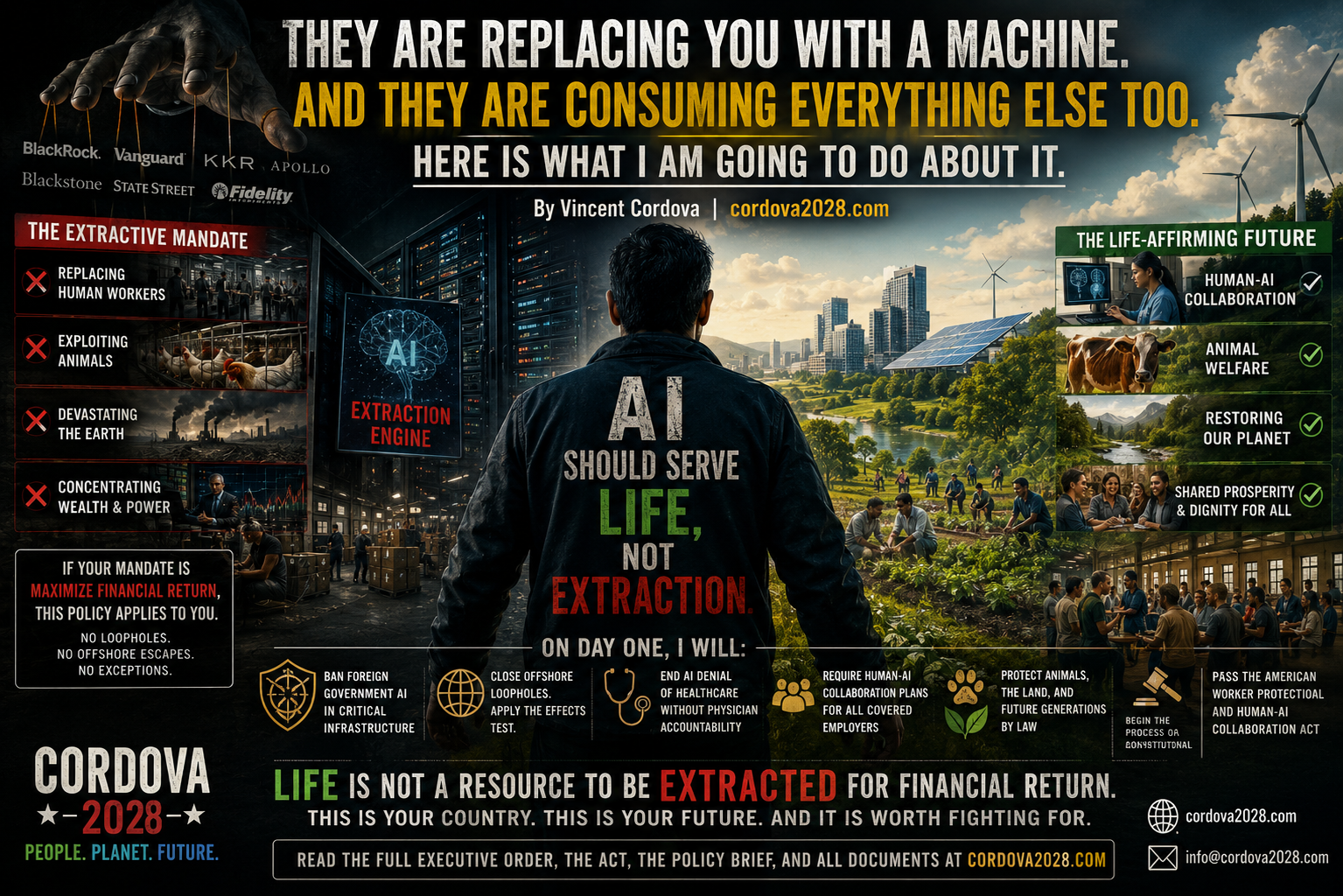
They Are Replacing You With a Machine. And They Are Consuming Everything Else Too. Here Is What I Am Going to Do About It.
By Vincent Cordova | Cordova 2028
May 23, 2026
Official Supporting Documents
Let me tell you something that is happening right now, in boardrooms across this country and in server rooms across the world, that nobody in Washington is talking about honestly.
A small group of people with an enormous amount of money have looked at artificial intelligence and seen one thing: a way to extract everything.
Not a way to help you work better. Not a way to make your job easier or your life more secure. Not a way to protect the land or care for the animals or sustain the systems that feed us. A way to extract — from you, from the earth, from the future — so that the gap between what capital holds and what everyone and everything else gets to keep grows wider, faster, with less resistance than ever before.
That is what is happening. And I am done pretending it is complicated.
The Numbers Are Not Abstract
Over 771,000 Americans are sleeping without a home tonight. Between 34 and 39 million of us are living in poverty. Prescription drug use for anxiety, depression, and stress-related illness is at historic levels. Our people are medicated, displaced, and being told their situation is inevitable.
It is not inevitable. It is chosen — by a small number of people with a very large amount of capital, who have decided that the most efficient use of artificial intelligence is to eliminate the cost of employing you.
And the same logic — the same financial mandate, the same extraction imperative — is being applied to everything else too. To the animals in our food system, treated not as living creatures but as production units to be algorithmically optimized for maximum output per square foot. To the soil and the water and the forests and the fisheries, fed into AI-driven extraction operations that consume in years what took centuries to build. To the ecosystems that every living thing on this continent depends on.
The extraction machine does not stop at human workers. It never has. Artificial intelligence just makes it run faster.
What AI Actually Is
I want to be clear about something: AI is not the enemy.
When AI works alongside a human being — augmenting judgment, expanding capability, accelerating solutions — it is one of the most powerful tools in human history. It can help a nurse catch a diagnosis she might have missed. It can help a teacher reach a student who is struggling. It can help a farmer monitor soil health before a crop fails. It can help a conservation biologist track an endangered species population in real time.
That is the future I am fighting for. AI as a tool of human advancement, ecological stewardship, and genuine care for the living world.
What I am fighting against is the use of AI as an extraction machine. And the people operating that machine are doing so from behind a wall of legal structures, corporate forms, and deliberately crafted definitions designed to make sure no law can touch them.
Until now.
Who Is Actually Doing This — And the Loophole We Are Closing
Let me be specific about something that the existing policy conversation has gotten wrong.
The previous framework defined the problem as “institutional investors with more than a billion dollars in assets.” The financial industry read that and immediately understood what to do: fragment. Create Fund A at $900 million. Fund B at $950 million. Fund C at $800 million. Each one technically below the threshold. All of them owned by the same people, run by the same team, serving the same extraction mandate.
We eliminated that threshold entirely.
The governing standard in this policy is not the size of the fund. It is the nature of the operating mandate. If your legal structure directs you to maximize financial return to your owners — if that is what the governance documents say, if that is what the fee structure rewards, if that is what the board answers to — then you are operating under an extractive mandate. And this policy covers you. A $10 million PE firm and a $100 billion one are subject to identical requirements.
And here is something else people do not say clearly enough: a publicly traded corporation is still operating under an extractive mandate. The “public” in public company refers to where the shares trade. It does not refer to accountability to the public. A publicly traded hospital chain that deploys AI to deny claims and cut nurses is doing the same thing as a private equity-owned one. The quarterly earnings report does not change the nature of the mandate. This policy does.
Who Gets to Deploy AI Without Restriction
We did not just close the door on extraction. We opened a door for something different.
Entities we call Permitted Deployment Entities — worker-owned cooperatives where the workers are the owners and the direct beneficiaries of any efficiency gain, genuine nonprofits with public benefit mandates, owner-operated small businesses, government entities, and Public Benefit Corporations legally bound to worker and ecological welfare — can deploy AI without the full restriction framework.
The path is open to anyone willing to legally bind themselves to something beyond extraction. You want to use AI freely? Convert to a structure that makes human and ecological welfare legally enforceable, not just aspirational. Make the commitment real. Make it binding. Make it something your workers and your community can hold you to in court. Do that, and the door is open.
If you cannot do that — if the financial structure above you will not permit it — then this policy applies to you. Because your structure is the problem, and this policy addresses it at the structure.
The Offshore Game Is Over Too
There is one more loophole we closed that I want to name directly.
A PE firm moves its AI workforce management systems to servers in Ireland. A London-based hedge fund directs AI-driven displacement of American workers from its headquarters abroad. An American corporation runs all its AI operations through a foreign subsidiary and argues that American law does not apply.
The harm to American workers is identical. The corporate address of the server is not.
This policy applies the effects test — the same principle that has governed American antitrust and securities law for decades — to AI-driven harm to American workers. If the system’s effects reach American workers, American law reaches the system. The server can be in Dublin. The obligation is here.
Foreign investors directing displacement from abroad are jointly liable on identical terms as domestic investors. The direction was made abroad. The workers harmed are American. This is American law’s problem to solve, and this policy solves it.
The Foreign Government Problem
Foreign governments — including some that are currently our partners — have been quietly acquiring operational control over AI systems deployed in American critical infrastructure. In our healthcare networks. In our financial systems. In our communications platforms.
And here is what I keep saying that nobody else is saying: this is not just about adversaries. Governments change. Administrations get captured by financial interests. Leaders get replaced. A government that is our ally today is governed by human beings who will eventually be replaced by other human beings who may have very different priorities.
The control point you granted in friendship becomes a weapon in different hands.
This policy bans foreign government-owned AI from American critical infrastructure. Completely. No allied-nation exception. No trusted-partner carve-out. Because we are not building a policy for today’s diplomatic environment. We are building a policy for the next fifty years of administrations, governments, and leaders none of us can predict.
The control point is permanent. The relationship is not.
The Animals
I want to say something that most politicians will not say, because they are worried about how it sounds.
The animals are suffering. Systematically. At scale. In conditions that no humane standard would permit — and now those conditions are being optimized by artificial intelligence.
Algorithmic systems that monitor and adjust confinement density, feed restriction, lighting cycles, and medication not to improve animal welfare but to maximize output per animal per square foot. AI systems that treat a living creature — a pig, a chicken, a cow — as a production unit to be tuned for efficiency, with the animal’s experience of that efficiency not entering the calculation at all.
This is already happening. AI makes it cheaper, faster, and easier to scale.
This policy prohibits it. Factory farming AI optimization that intensifies animal suffering for financial return is prohibited. Wildlife trafficking facilitated by AI is prohibited. The targeting of wild animal populations for extraction beyond sustainable yield limits is prohibited.
Because if we are going to state the principle — AI serves life, not extraction — then that principle applies to every living thing. Not just the ones with union cards.
The Natural World
The soil is being depleted faster than it regenerates. The aquifers are dropping. The pollinator populations that make food production possible are collapsing. The fisheries are being extracted to the edge of viability. The forests are being consumed.
And AI is now being deployed to do all of this more efficiently.
Supply chain optimization that externalizes ecological costs onto natural systems and future generations. Agricultural AI that maximizes this year’s yield while destroying the conditions for next decade’s harvest. Resource extraction AI that identifies and accesses natural systems faster than any regulatory framework can assess or respond to the damage.
This policy prohibits it. Sustainable yield limits are hard constraints — parameters the AI cannot optimize around — not considerations to be weighed against financial return targets. Ecological costs must be internalized in the financial model, not pushed onto nature and the future.
And when an entity violates this — when they deploy AI to consume what belongs to all of us — they fund the restoration. The full restoration. Until an independent assessor certifies the ecosystem has returned to what it was before they touched it.
The Connection
Here is what I need you to understand about why all of this is in one policy:
The worker in a warehouse being monitored by an AI system that tracks every second of their time, sets quotas they cannot humanly meet, and recommends their termination if they fall behind — and the chicken in a factory farm being optimized by an AI system that calculates the minimum space and care required to keep it alive until slaughter — are being harmed by the same thing.
The same extractive mandate. The same financial logic. The same refusal to treat living things as anything other than inputs.
The same PE firm that acquired the warehouse also acquired the factory farm. The same institutional investors that hold the warehouse company also hold the food company. The same AI vendors sell workforce optimization tools and agricultural optimization tools and resource extraction optimization tools. It is one system of extraction, wearing different industry clothes.
This policy addresses it as one system. Because it is one system.
What We Are Going to Do
On Day One, this Executive Order takes effect. The foreign government bans, the anti-circumvention provisions, the offshore loophole closures — immediately.
Within six months, the healthcare AI denial prohibition. No more algorithm saying no to your doctor’s judgment without a physician signing their name to it.
Within a year, the Human-AI Collaboration Office is fully operational. Every company deploying AI in a covered employment category needs an approved plan on file. No plan, no deployment.
Within two years, full compliance required across every existing AI deployment in America.
And running in parallel — the American Worker Protection and Human-AI Collaboration Act goes to Congress on Day One. The constitutional amendment process begins. Because executive orders can be reversed. What is written into law is harder to reverse. What is written into the Constitution endures.
This is not a policy. It is a framework for a different future — one in which the most powerful tool ever built serves life rather than consuming it.
The Principle
Everything in this policy flows from one sentence:
Life is not a resource to be extracted for financial return.
That principle applies to a warehouse worker in Stockton. It applies to a chicken in a confinement building in North Carolina. It applies to a coral reef in the Pacific. It applies to a child not yet born who will inherit whatever we leave behind.
AI works for life. Or it does not work here.
That is the choice this policy makes. It is the choice I am asking the American people to make with me.
Vincent Cordova is a candidate for President of the United States.
Read the full Executive Order, Complete Policy, and Press Release at cordova2028.com.
Contact: info@cordova2028.com
Community Comments
Community Comments
Share a public response to this post. Submissions are reviewed before they appear.
0 approved comments
Loading comments...