This site is under construction - will be ready soon.

Campaign design team
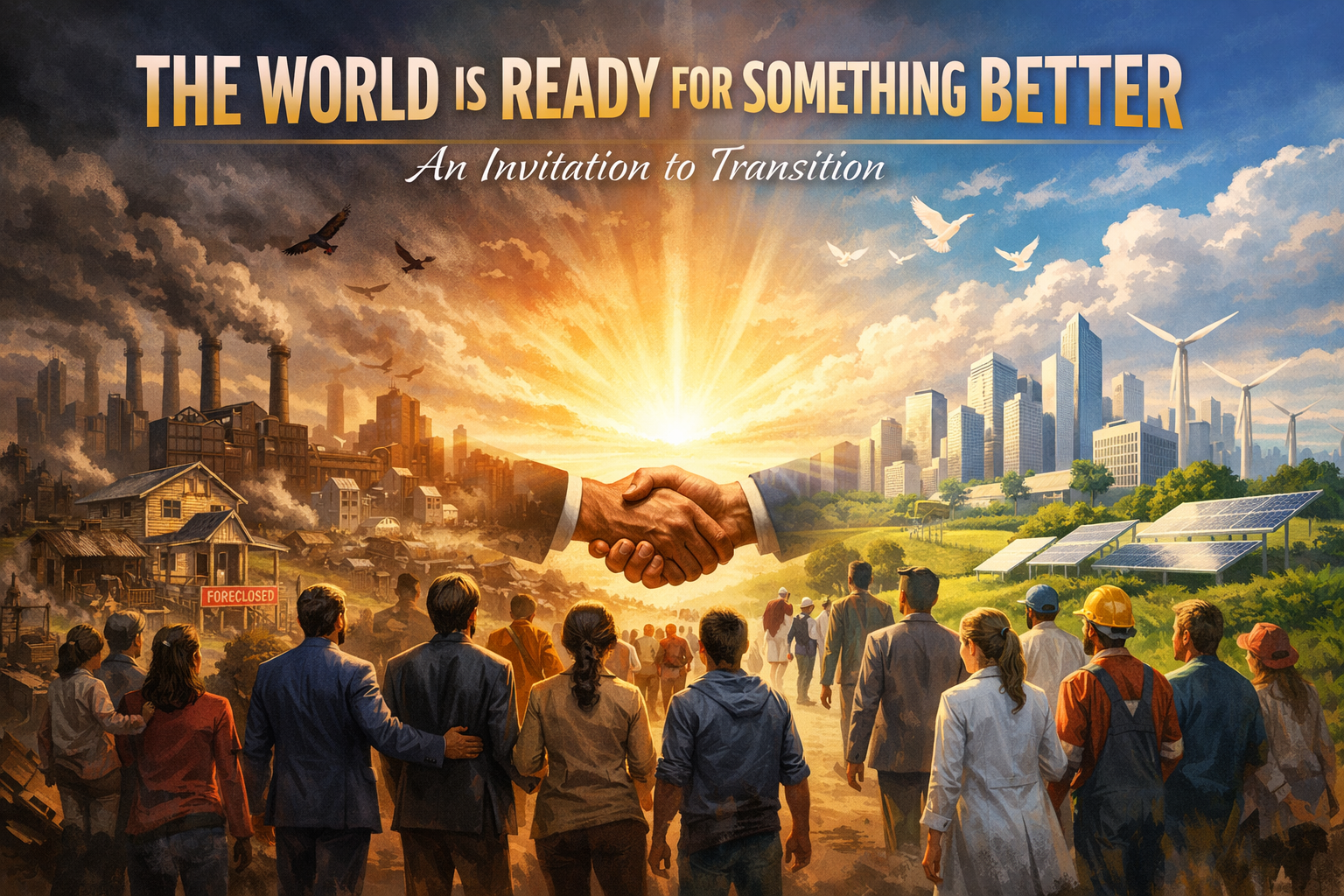
The World Is Ready for Something Better — An Invitation to Transition
By Vincent Cordova · 03-13-2025
The old status quo is trying to hold together a system that is clearly breaking. For decades, we have been told this is the only way things can work: concentrate power, extract value, and hope the benefits eventually trickle down to everyone else. But people can see the reality now. They see it in their daily lives.
They see it when their wages buy less than they did a year ago, while the companies setting those prices report record profits. They see it when a private equity firm buys their apartment building, strips away services, and raises the rent—not because the building is better, but because the algorithm says they can. They see it when they work two jobs just to afford the basics and are still one medical bill away from financial ruin. Workers are stretched thin. Families are anxious. Communities feel like they are carrying the cost of a system they did not design.
This is not just an American problem. From manufacturing towns in the Midwest to farming villages in the Global South, people are asking the same question: why are the most productive societies in human history still struggling to deliver stability and dignity for ordinary people?
The answer is not complicated. For centuries, global systems have been organized around a single logic: extraction. Extracting labor from workers while paying them as little as possible. Extracting resources from the earth without regard for the consequences. Extracting value from communities and concentrating it in financial centers far away from where that value was actually created. This cycle of extraction has repeated itself for over 500 years, producing the same outcomes: immense wealth for a few, instability for the many, and the eventual collapse of the very systems that created the wealth.
That system built wonders our ancestors could not have imagined. It lifted billions out of poverty and created technological miracles. But it also left deep fractures. Inequality has become so stark that the wealthiest few now own more than the bottom half of humanity. Environmental strain threatens the very climate that sustains us. And perhaps most dangerously, trust in the institutions that were meant to provide order—government, media, finance, even science—is collapsing.
When prosperity concentrates too narrowly while insecurity spreads too widely, confidence in the system begins to dissolve. That is not ideology. That is history.
Today, we stand at a moment every major civilization eventually faces: the moment when an old framework stops working.
History shows what usually happens next. The elites who benefited from the old system hold on too tightly, convinced they can manage the crisis with minor adjustments. The people who are suffering lose faith in the possibility of peaceful change. Institutions fracture. Order breaks down. Empires collapse, and the chaos that follows hurts everyone—the powerful and the powerless alike.
We do not need to repeat that cycle. We do not need to repeat the last 500 years.
Right now, the United States stands at a crossroads. We can continue defending the same framework and hope it somehow produces different results—a definition of insanity that has never worked in politics any better than it has in personal life. If we choose that path, the rest of the world will eventually move forward without us. Nations are already building new partnerships, new supply chains, and new alliances based on systems they believe actually work for their people. The United States, once the leader of the free world, would become a cautionary tale: a nation that had everything and squandered it because it refused to change.
But this moment does not have to be about collapse.
It does not have to be about revenge. It does not have to be about tearing down the people and institutions that helped build the modern world. Destruction is easy. Any fool with a match can burn down a house. Transition is harder—it requires patience, skill, and cooperation—but it is also the only path that protects the people inside.
And here is the truth that must be understood by everyone on all sides: I will not let the corporations or the people that have defined America fail.
The innovators who built global industries, the workers who powered them, the entrepreneurs who took risks, the financiers who allocated capital—these are not enemies to be destroyed. They are partners to be invited. They are the engine of American prosperity, and if that engine is smashed in the name of change, there will be no prosperity left to save. The goal is not to weaken America's corporations. The goal is to redirect their immense capability toward building a future that works for everyone. We need them. They need us. Together, we can create something neither could build alone.
So this is an invitation.
To governments.
To corporations.
To financial institutions.
To workers and communities.
To every nation on earth.
We can choose a different path. We can choose a path where a win for one is a win for all—because we are working toward the same global destination.
The American Moment
America has the talent, the institutions, and the creativity to lead this new direction. Our corporations are among the most innovative on Earth. Our workers are among the most productive. Our universities and entrepreneurs generate ideas that shape the global economy. The problem has never been capability. The problem has been direction.
For too long, we have measured success by the wrong metrics. We celebrated when the stock market went up, even when working families could not afford a down payment on a home. We cheered corporate efficiency, even when it meant shipping good jobs overseas and leaving communities hollowed out. We called it progress when a startup achieved a billion-dollar valuation, even if its business model depended on treating its workers as disposable.
But those corporations are not the enemy. They are the result of the incentives we created. If we change the incentives, we can change the outcomes—without destroying the institutions that employ millions and generate the wealth that funds our communities.
The next era must be built on a different principle, one so simple it is almost radical: prosperity must protect life, not consume it.
What does that mean in practice? It means protecting the essentials people need to live with dignity: housing that does not consume half a family's income, healthcare that is there when you need it, work that pays enough to live on, energy that is reliable and affordable, food that is safe and accessible, and communities where people know their neighbors and look out for each other.
These are not radical demands. They are the basic expectations of civilized life. And the fact that they have become increasingly unattainable for millions of Americans is not a sign that something is wrong with the people. It is a sign that something is wrong with the system—a system that can be fixed without destroying the corporations and people who operate within it.
The Architecture of Transition
So what would a different system look like? And how do we get there without tearing everything down?
The answer lies in a fundamental shift: from an economy organized around extraction to one organized around regeneration. Extraction takes value out. Regeneration puts value back in—into workers, into communities, into the natural systems that sustain us.
For corporations, this means rewarding long-term value creation instead of short-term financial engineering. Today, a CEO can slash research and development, cut worker training, and squeeze suppliers—all to boost this quarter's earnings—and be rewarded with a bonus and a rising stock price. A regenerative economy would create different incentives: tax structures that favor companies that invest in their workers, procurement policies that reward companies that build resilient domestic supply chains, and corporate governance that gives workers and communities a genuine voice at the table. These changes do not destroy corporations. They strengthen them by making them more resilient, more trusted, and more aligned with the society that sustains them.
For financial institutions, this means recognizing that a healthy financial sector depends on a healthy real economy. You cannot extract fees from transactions if the people doing the transactions are broke. You cannot profit from home loans if no one can afford a home. The institutions that survive and thrive over the long term will be those that see themselves as stewards of the economy, not just players in it. We need our financial institutions to be strong—but their strength must be built on the strength of the communities they serve, not on their weakness.
For government, this means shifting from deregulation as a default to intelligent regulation that protects stability. It means measuring success not just by GDP growth but by metrics that actually matter to human beings: median household income, housing affordability, life expectancy, childhood poverty rates. It means recognizing that the government's job is not to pick winners and losers but to set rules that make it possible for everyone to win.
For workers and communities, this means moving from being passive recipients of change to active participants in shaping it. That could mean employee ownership models that give workers a direct stake in the companies they build. It could mean community investment funds that keep local wealth circulating locally. It could mean labor-management partnerships that treat workers as assets to be developed rather than costs to be minimized.
None of this requires destroying the institutions that exist today. In fact, it requires working with them. Businesses, banks, unions, universities, and governments all have a role to play in building a system that can sustain prosperity over generations. We rise together, or we fall separately. That is the choice.
A Word to the Skeptics
At this point, a reasonable person might object: "This sounds like naive idealism. The people who benefit from the current system are powerful. They will not simply agree to change out of the goodness of their hearts. And why should we protect corporations that have caused so much harm?"
This is a fair criticism, and it deserves a serious response.
First, this proposal is not asking anyone to act against their self-interest. It is asking them to recognize where their long-term interest actually lies. The wealthy and powerful of pre-revolutionary France did very well in the short term by clinging to their privileges. In the medium term, many of them lost their heads—literally. When systems become so brittle that they shatter, the pieces do not discriminate between the guilty and the innocent. Everyone gets cut. Protecting corporations from failure is not about letting them off the hook. It is about recognizing that the collapse of major employers and institutions would devastate the workers and communities who depend on them.
Second, "no revenge" does not mean "no accountability." There is a difference between punishing people for playing by the rules of a broken system and holding them responsible for actively blocking the transition to a better one. Those who use their power to prevent change, who deploy their wealth to confuse the public, who lobby to maintain extraction at the expense of human life—they will be judged by history and by their fellow citizens. But that judgment should be based on what they do now, not simply on where they sit.
Third, and most importantly, we need each other. The corporations that defined America possess the capital, the infrastructure, the supply chains, and the expertise to build the next system. The workers and communities possess the labor, the creativity, and the legitimacy. Neither can succeed without the other. A win for workers is not a loss for business. A win for business is not a loss for communities. If we are working toward the same global goal—a prosperous, stable, dignified life for all—then every win is shared.
The Global Stakes
The world does not need another dominant power imposing its will. The world needs partners who build systems that actually work for human life. The last 500 years have been defined by extraction and domination. The next 500 must be defined by regeneration and cooperation.
If the United States can demonstrate that kind of leadership—by protecting its own people, preserving its own institutions, and cooperating with others—the world will not leave America behind. It will move forward with us. American leadership in this transition would not be leadership through domination, but leadership through example. It would say to the world: "We have made mistakes. We have built a system that enriched some but left too many behind. Now we are building something better, and we invite you to build with us."
Other nations are already experimenting with elements of this transition. Some are investing in worker cooperatives. Others are exploring universal basic services. Still others are rewriting corporate charters to require consideration of stakeholder interests alongside shareholder returns. America could learn from these experiments, adapt them to our own context, and combine them with our unique strengths in innovation and entrepreneurship. The goal is not American dominance. The goal is global alignment—a shared direction toward a future that works for everyone.
But if America chooses instead to cling to a failing status quo, if we decide that our current arrangements are the only possible arrangements, the world will eventually move on without us. It will build new institutions, new alliances, and new systems. And the United States, once the leader of the free world, will become a museum of what used to be—a fascinating historical case study of a nation that had everything and could not figure out how to keep it.
The Choice
This is the moment to decide what kind of country, and what kind of world, we want to build.
We can be a nation that clings to a failing status quo, hoping against hope that the old formulas will somehow start working again. We can watch as extraction continues, inequality deepens, and trust evaporates, until one day the whole brittle structure comes crashing down—taking corporations, workers, and communities with it.
Or we can be a nation that leads the transition toward a more stable, prosperous, and human future. We can invite our corporations, our financial institutions, our workers, and our communities to join in building something better. We can show the world that it is possible to move from extraction to regeneration without collapsing into chaos. We can prove that a win for one can be a win for all—because we are working toward the same global destination.
The choice is ours.
But it must be made consciously, and it must be made soon. The old system is not pausing while we deliberate. It is continuing to extract, continuing to concentrate wealth, continuing to erode the foundations of stable life. Every day we wait, the transition becomes harder and the risk of collapse grows greater.
Humanity now has the knowledge, the technology, and the global connectivity to build a system that protects life, encourages creativity, and allows prosperity to grow without sacrificing the future. We know how to generate clean energy. We know how to build affordable housing. We know how to organize work so that it serves human beings rather than the other way around. The technical problems are largely solved. The obstacles are political and cultural.
Overcoming those obstacles will require courage—from leaders willing to risk the status quo, from institutions willing to evolve, and from citizens willing to demand something better. It will require patience, because transitions take time. It will require compromise, because no single group has all the answers. And it will require trust—trust that we are all in this together, that no one is being set up to fail, that we are building a future where everyone has a place.
But it will also require clarity about what we are building and why.
We are building an economy that rewards long-term value instead of short-term extraction.
We are protecting the essentials of life—housing, food, healthcare, energy, and security—so that no person is forced into desperation simply to survive.
We are directing the immense capability of modern corporations, institutions, and governments toward solving the challenges that affect every nation.
We are preserving the institutions and people who defined America, because we need them to build the future.
We are inviting the world to join us, because a win for any nation is a win for all nations when we are working toward the same goal.
This is not about weakening prosperity. It is about protecting it for generations to come. It is not about punishing the past. It is about building the future—together.
The Invitation
To those who hold power today—in government, finance, and industry—this message is not a threat. It is an invitation.
Help build the next system.
Help guide the transition.
Help ensure stability for workers, communities, and businesses alike.
Bring your capital, your expertise, your infrastructure, and your people.
We need you. And you need us.
To workers and communities—this message is an invitation to you as well.
Help shape the future you want to live in.
Demand change, but be willing to build it.
Hold institutions accountable, but give them the chance to evolve.
Your labor, your creativity, and your legitimacy are essential.
We need you. And the future needs you.
To the world—this message is an invitation to every nation.
Join us in building systems that protect life.
Share your experiments, your successes, and your lessons.
Let us compete to see who can build the best future, not who can dominate whom.
A win for your nation is a win for all of us, if we are working toward the same goal.
Because the truth is simple: if the system collapses violently, everyone loses.
Workers lose their livelihoods.
Businesses lose stability.
Nations lose cooperation.
Families lose security.
But if we transition together, something far stronger becomes possible.
We can break the cycle of the last 500 years.
We can build a future where extraction gives way to regeneration, where domination gives way to cooperation, where a win for one is truly a win for all.
The future does not belong to those who cling to the past. It belongs to those willing to build something better—together.
No revenge. No collapse. No domination.
Only transition. Only partnership. Only the future.