Campaign design team
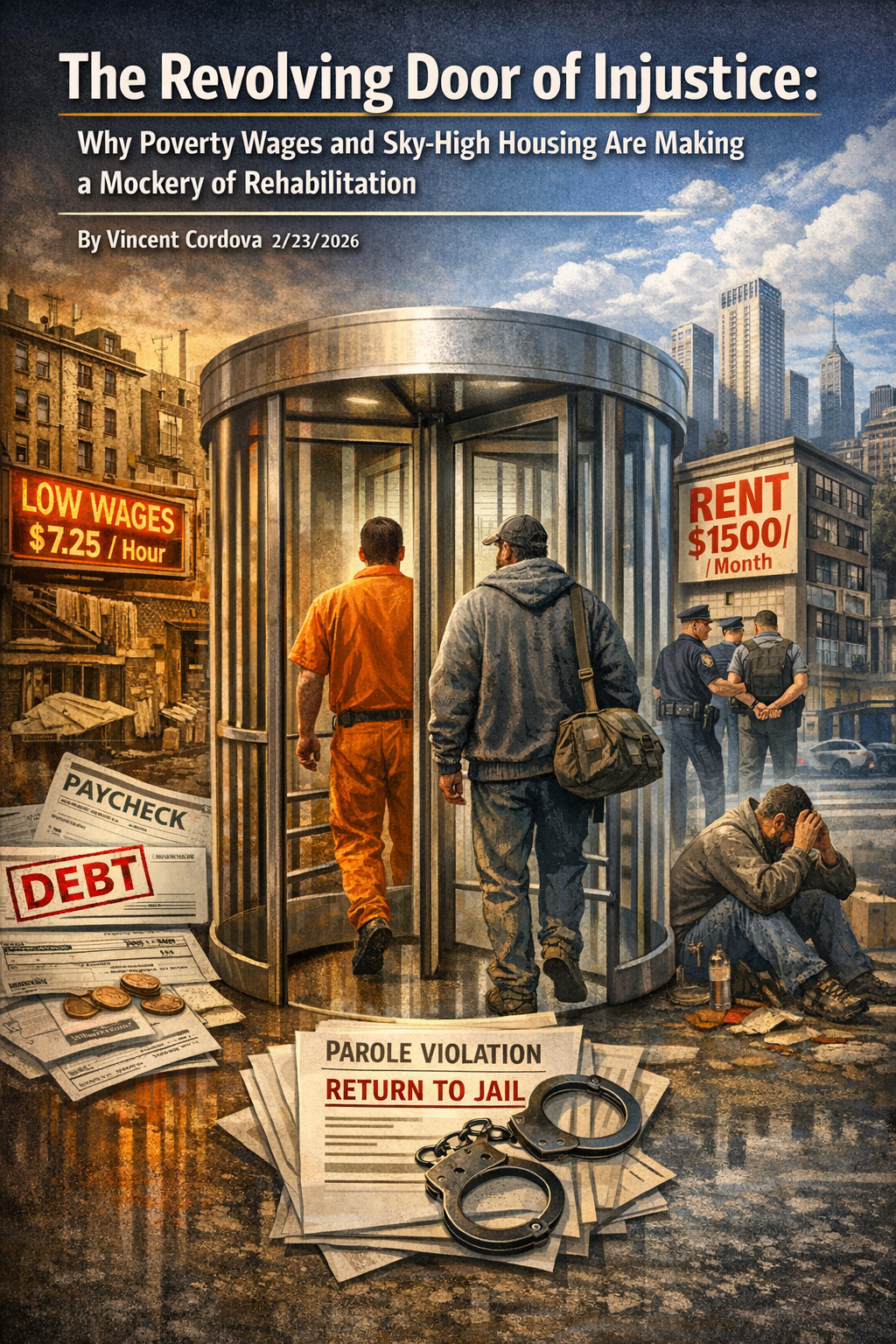
The Revolving Door of Injustice: Why Poverty Wages and Sky-High Housing Are Making a Mockery of Rehabilitation
By Vincent Cordova · February 23, 2026
Executive Order Link: EO- Housing Stability, Wage Alignment, Small Business Protection, Justice System Reform, Family Stability, and Childcare Infrastructure
The News Clip That Says It All
Turn on your local news any night of the week, and you'll hear the same refrain: "Parolee arrested for violating conditions of release." "Probation violation leads to return to custody." "Repeat offender back behind bars."
The anchors shake their heads. The public sighs in frustration. The narrative writes itself: "Some people just can't be rehabilitated." "We gave them a chance, and they blew it." "The system tried, but they failed."
But what if we're asking the wrong question? What if, instead of asking "Why do they keep failing?" we should be asking "Why does the system keep setting them up to fail?"
Because here's the uncomfortable truth that no news anchor will tell you, no politician will admit, and no prison industrial complex will acknowledge: We have built a system where failure is not just likely—it's mathematically inevitable.
And until we confront the two root causes of this crisis—starvation wages and unaffordable housing—we are not just failing the formerly incarcerated. We are actively harming ourselves, our children, and every generation to come.
The Lie of "Rehabilitation"
Let's be brutally honest about what "rehabilitation" looks like in America's correctional facilities.
It doesn't exist.
Oh, the word is used liberally. Mission statements are filled with it. Prison websites tout their "comprehensive reentry programs." But walk inside any correctional facility in this country, and you'll find a reality that looks nothing like the brochure.
The Reality Behind Bars
- Underfunded Programs: Drug treatment programs have waitlists longer than a person's sentence. Vocational training, when it exists, often teaches skills for jobs that no longer exist or pay less than a living wage. GED classes are overcrowded and understaffed.
- The Punishment Paradigm: Prisons are designed for one thing: incapacitation. They are warehouses for human beings, not rehabilitation centers. The environment is inherently traumatizing— overcrowding, violence, isolation, and the constant stripping of human dignity. You cannot "rehabilitate" someone in an environment designed to break them.
- Mental Health Crisis: A staggering percentage of incarcerated individuals suffer from mental illness, trauma, or substance abuse disorders. Yet mental health care in prisons is so abysmal that it has been ruled unconstitutional in multiple states. We are releasing people not healed, not treated, not prepared— just older.
The Inconvenient Question
If rehabilitation were truly the goal, wouldn't we fund it? Wouldn't we staff it? Wouldn't we measure our success not by arrest rates but by actual successful reentry?
The fact that we don't tells us something uncomfortable: The system is not designed to stop producing prisoners. It is designed to manage them.
The Economic Trap—Why the Math Never Works
Now let's talk about what happens when someone is released. They walk out of those gates with a bus ticket, a set of conditions, and a target on their back. And they step into an economy that is actively hostile to their survival.
The Numbers Don't Lie
Let's do the math together.
- Average minimum wage in the United States: $7.25 per hour (federal) to $15 in some states. But even at $15, the math is grim.
- Full-time work at $15/hour: $2,400 per month before taxes. After taxes, roughly $2,000.
- Average one-bedroom or a studio apartment rent in the United States: $1,200–$1,500 in most cities, and much higher in major metropolitan areas.
- Reality: That leaves $500–$800 for everything else—food, transportation, utilities, clothing, and medical expenses.
But Wait—There's More
Formerly incarcerated individuals face additional financial burdens that most Americans never have to consider:
- Parole fees: Monthly supervision fees ranging from $10 to $100 depending on the state
- Court costs and restitution: Thousands of dollars in debt accrued during their case
- Drug testing fees: Some parolees pay $5–$25 per test, multiple times per month
- Electronic monitoring fees: GPS ankle monitors can cost $10–$15 per day, charged to the parolee
- Housing application fees: With a criminal record, many landlords charge higher deposits or simply refuse applications, forcing parolees into expensive weekly-rate motels or shelters
The Impossible Choice
When your rent consumes 70% of your income, when your parole fees eat another 10%, when you're left with $200 a month for food and transportation—what happens the first time your car breaks down? What happens when you get sick and can't afford the copay? What happens when your boss cuts your hours?
You violate.
Maybe it's missing a curfew because you had to work late. Maybe it's failing to report because you couldn't afford the bus fare. Maybe it's a positive drug test for marijuana in a state where it's legal, because parole hasn't caught up with the law.
And just like that, the revolving door spins again.
Is This Intentional? The Question We Must Ask
Here's where things get uncomfortable. Because when a system produces the same predictable, devastating outcomes year after year, decade after decade, we have to ask: Is this by design?
Follow the Money
The prison industrial complex is exactly that—an industry. Private prisons profit from filled beds. Police departments receive funding based on arrest numbers. Probation companies charge offenders for the very devices that monitor them. Courts generate revenue through fines and fees.
When someone is released and set up to fail, multiple entities profit from their return.
The Political Incentive
For decades, politicians have run on "tough on crime" platforms. Being "soft on crime" is a career-ender. So the incentives align perfectly: appear tough, fund punishment, ignore prevention, and when the cycle repeats, blame the individual.
The Public Narrative
And the public eats it up. Because when the news reports on a parolee who committed a violent crime, it confirms our biases. It makes us feel righteous in our demand for harsher sentences. It lets us ignore the thousands who are quietly struggling, working multiple jobs, sleeping in shelters, and still not making it.
The narrative is carefully constructed: They are the problem. Not the system. Not the wages. Not the housing. Them.
But if we're honest, we have to ask: When you trap a person in an impossible situation, when you make survival itself a crime, who is really at fault?
The Solution Is Staring Us in the Face
Here's the thing: We can fix so many things by bringing wages up and housing down.
It's not complicated. It's not radical. It's basic math and basic humanity.
Raise the Wage
A living wage is not a luxury. It is the floor upon which a stable life is built.
- $7.25 an hour is a poverty wage. It has not been raised at the federal level since 2009. Adjusted for inflation, it should be over $20 today—and even that is insufficient in most markets.
- A true living wage must be calculated based on local costs. In many cities, that means $20–$30 per hour just to afford a one-bedroom apartment and basic necessities.
- For the formerly incarcerated, a living wage means the difference between survival and violation. It means being able to pay fees, afford rent, and build a life without choosing which bill to skip.
Bring Housing Down
Housing is a human right. We have treated it as a commodity, and the results are catastrophic.
- Affordable housing shortages exist in every major city. We have simply stopped building enough units to meet demand.
- Housing vouchers are underfunded and have waitlists years long. In some cities, the wait for Section 8 is eight years.
- Landlord discrimination against formerly incarcerated individuals is legal in most places and rampant everywhere. Even with a job and money, people with records cannot find housing.
Solutions exist: rent control, public housing investment, zoning reform, landlord anti-discrimination laws, and voucher expansion. These are not new ideas. They are simply unfunded and ignored.
The Ripple Effect
When you combine a living wage with affordable housing, everything changes:
- Reentry becomes possible. People can actually meet their basic needs and comply with parole conditions.
- Crime decreases. Desperation is the primary driver of property crime and survival offenses. Remove the desperation, remove the crime.
- Families stabilize. Children grow up in stable homes, attend stable schools, and break the cycle of intergenerational poverty and incarceration.
- Communities heal. When people aren't struggling to survive, they have the bandwidth to contribute, to volunteer, to parent, to build.
The Harm We're Causing Right Now
Let's not sugarcoat this. The current system is not merely failing—it is actively harming real people, real families, and real communities.
Harm to the Individual
Every person cycled through this system carries scars. Time in prison increases the likelihood of homelessness, unemployment, mental illness, and early death. Each return visit deepens the trauma and narrows the path to a stable life.
Harm to Families
When a parent is incarcerated, children suffer. They experience higher rates of poverty, mental health issues, and behavioral problems. They are more likely to end up in foster care. And they are statistically more likely to be incarcerated themselves.
This is how the cycle perpetuates. This is how trauma becomes inheritance.
Harm to Communities
High incarceration rates destabilize entire neighborhoods. They remove earners, parents, and community members. They concentrate poverty and fracture social networks. They create environments where crime becomes normalized because legitimate opportunity has been systematically eliminated.
Harm to Future Generations
This is perhaps the most devastating harm of all. We are building a world for our children and grandchildren where the baseline assumption is scarcity, where hard work does not guarantee stability, where the system is designed to catch you rather than catch you before you fall.
What kind of world are we leaving them? What kind of people will they have to become to survive in it?
Accountability—For Whom?
We hear constantly about individual accountability. "They need to take responsibility." "They made their choices." "They have to want to change."
And yes—individual accountability matters. People must take responsibility for their actions, their recovery, their choices.
But accountability must be a two-way street.
Where is the accountability for a system that spends billions on incarceration and pennies on prevention?
Where is the accountability for corporations that pay poverty wages while their CEOs make millions?
Where is the accountability for landlords who charge $1,500 for a one-bedroom apartment in a city where the average worker makes $30,000 a year?
Where is the accountability for politicians who cut housing funding while expanding prison budgets?
Where is the accountability for a public that demands punishment but refuses to fund solutions?
We cannot demand individual accountability while refusing to hold the system accountable for its predictable, preventable failures.
Confronting the Frameworks
This brings us to the core of the issue: "The system is the problem and if we don't confront the frameworks, we are asking for what is happening today."
So, let's confront them.
The Framework of Profit Over People
Our economy is built on the assumption that profit is the highest good. Companies pay as little as possible. Landlords charge as much as the market will bear. And human beings are treated as inputs—labor to be minimized, tenants to be maximized, prisoners to be monetized.
We must replace this framework with one that prioritizes human dignity. A living wage is not charity—it is the minimum respect we owe each other. Affordable housing is not a handout—it is the foundation of a stable society.
The Framework of Punishment Over Prevention
We have built a society that punishes failure rather than preventing it. We spend billions on prisons and pennies on schools, mental health, addiction treatment, and housing assistance. We wait until someone is drowning, then arrest them for not swimming.
We must shift resources upstream. Invest in communities. Fund what works. Stop waiting for people to fail so we can punish them for it.
The Framework of Individual Blame Over Systemic Accountability
We love stories of individual triumph—the person who "made it" despite the odds. They reinforce our belief that anyone can succeed if they try hard enough. And they let us ignore the millions who try just as hard and fail because the odds were never in their favor.
We must acknowledge that systems create outcomes. When a population fails at predictable rates, it is not a character flaw—it is a design flaw.
What We Must Do
This is not hopeless. This is not inevitable. There are concrete actions we can take—as individuals, as communities, and as a society.
What We Can Demand
- Raise the minimum wage to a true living wage, indexed to local costs of living
- Invest massively in affordable housing—public housing, vouchers, rent control, and tenant protections
- End housing discrimination against people with criminal records
- Fund rehabilitation, not just incarceration—mental health treatment, addiction services, education, and job training inside prisons
- Reform parole and probation—eliminate fees, reduce technical violations, and focus on support rather than surveillance
- Expand reentry support—housing assistance, job placement, mental health services, and mentorship for everyone leaving prison
What We Can Do Personally
- Vote for candidates who prioritize these issues
- Support organizations working on criminal justice reform, housing justice, and workers' rights
- Challenge the narrative when friends and family repeat the "they just need to take responsibility" line—ask them about the math
- Hire formerly incarcerated people if you're in a position to do so
- Be a landlord who rents to people with records, if you have that capacity
- Speak up in your community, your workplace, your faith institution
What We Must Believe
We must believe that another world is possible. We must believe that people are not disposable. We must believe that a society that ensures housing and living wages for everyone is not a fantasy—it is a choice we have simply refused to make.
And we must believe that we are harming each other, our children, and future generations by continuing on this path. The harm is real. It is happening right now. And we are all complicit in it until we demand something different.
The Revolving Door Can Stop
The news will keep running those stories. The politicians will keep giving those speeches. The system will keep producing those outcomes—unless we decide that enough is enough.
The person who violated parole today is not a failure. They are a person trapped in an impossible system, making impossible choices with impossible constraints. And until we fix the two things that would actually give them a chance—wages that sustain life and housing that doesn't require a miracle—we have no right to be surprised when the revolving door keeps spinning.
Because here's the truth that no news anchor will say: We are not failing to rehabilitate people. We are refusing to create a world where rehabilitation is possible.
And that refusal is not just policy. It is not just politics. It is harm. It is cruelty. And it is a choice.
What You're Really Saying
You're saying that we've built a system where:
Prison industrial complex + low-wage economy + unaffordable housing = a permanent underclass that can be cycled through the system forever, providing labor when needed and beds when not.
And the cruelty is that we call this "justice."
Now they are doing this to the homeless too.
We can choose differently. We can raise wages. We can build housing. We can fund solutions instead of punishment. We can build a society where coming home from prison actually means something—where a second chance is backed by the resources to make it real.
Or we can keep doing what we're doing. Keep watching the news. Keep shaking our heads. Keep blaming individuals while ignoring systems.
But if we choose that path, we must stop pretending we don't know what we're doing.
Because we do know. The facts are clear. The solutions are known. The only thing missing is the will.
Let's find it. Let's demand it. Let's build it. For ourselves. For our children. For every generation to come.
Otherwise, I DO NOT ACCEPT THIS SYSTEM NOR CONSENT TO THIS CRUELTY. -Vincent Cordova
Executive Order Link: EO- Housing Stability, Wage Alignment, Small Business Protection, Justice System Reform, Family Stability, and Childcare Infrastructure
Community Comments
Community Comments
Share a public response to this post. Submissions are reviewed before they appear.
0 approved comments
Loading comments...