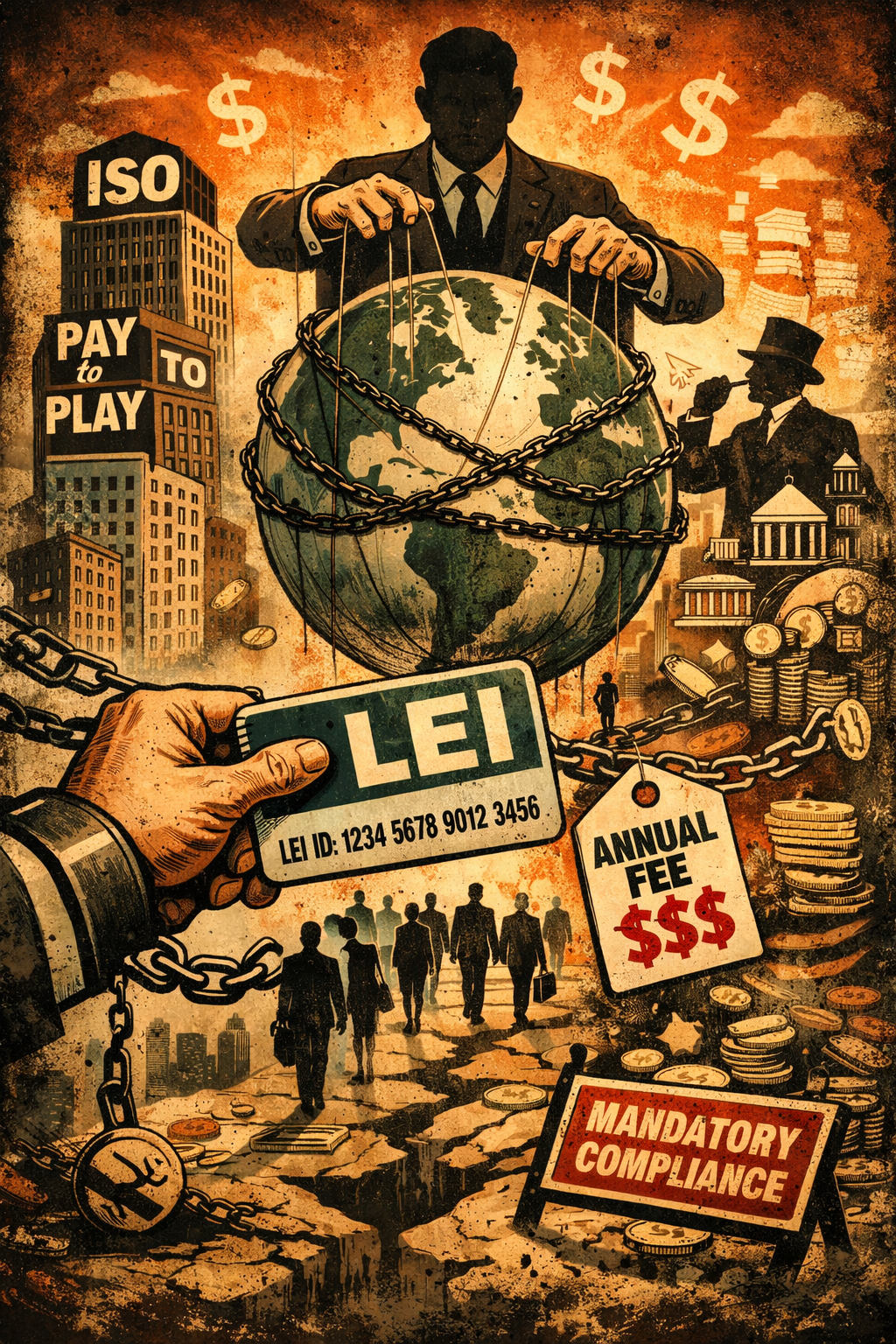
Campaign design team
The Quiet Colonization of Global Business
By Vincent Cordova | January 14, 2026
How ISO and the LEI System Normalized Pay-to-Play Without Law
There is a difference between coordination and control.
There is a difference between standards and authority.
And there is a difference between lawful obligation and manufactured compliance.
In today’s global economy, those differences have been deliberately blurred.
At the center of this blurring sits a system so normalized that most people never question it: the ISO-driven Legal Entity Identifier (LEI) framework.
This blog exists to do exactly that.
The Claim: A System of Authority Without Law
The International Organization for Standardization (ISO) presents itself as a neutral body that merely “coordinates standards.” On paper, its standards are voluntary. In practice, many of them—especially in finance—have become mandatory gateways to participation in modern economic life.
One such standard is ISO 17442, which defines the Legal Entity Identifier.
From this standard emerged the global LEI system, administered through a web of nonprofits and private intermediaries that now require annual payment simply for a business to remain “recognized” as compliant.
Let us be precise:
- No legislature passed a law creating this obligation.
- No electorate voted to fund or authorize it.
- No public process established pricing, renewal terms, or appeals.
- No constitutional framework granted ISO the power to impose economic tolls.
Yet businesses across the world are told:
- “You must have an LEI.”
- “You must keep it active.”
- “You must pay yearly.”
This is not law.
This is assumed authority.
How the System Was Built (Quietly)
The structure follows a familiar pattern:
- A private international body creates a technical standard.
- Governments and regulators reference that standard instead of writing law.
- A nonprofit intermediary is created to “govern” implementation.
- Private operating units are accredited to issue identifiers—for a fee.
- The cost is pushed onto businesses, indefinitely.
- Exit becomes impractical.
This is not coordination.
This is outsourced governance.
And it carries a smell we should all recognize.
The LEI: Identity Turned Into Rent
An LEI is not a service.
It does not move goods.
It does not reduce risk.
It does not insure against loss.
It is an identifier.
A string of 20 characters.
Once issued, it does not change. Yet businesses must pay every year to keep it “active.”
Ask yourself an honest question:
What is actually being renewed?
Not identity.
Not verification.
Not trust.
What is being renewed is permission.
Permission granted not by law, but by continued payment.
That is the definition of a rent-seeking structure.
Why This Is Exploitative by Design
If this system were truly about transparency and stability, it would be:
- Publicly funded
- Open access
- Free at point of use
- Maintained as a shared infrastructure
Instead, it is:
- Pay-to-participate
- Administered by unelected bodies
- Enforced indirectly through regulators and banks
- Renewed annually under threat of exclusion
This is not neutral.
It is extractive.
And it follows the same pattern we have seen before—over and over again.
The Pattern: Modern Economic Colonization
Colonization does not require armies anymore.
Modern colonization looks like:
- Mandatory identifiers
- Compliance gates
- Private toll booths
- “Standards” with no opt-out
- Rules written elsewhere
- Costs borne by those with the least power to resist
The LEI system colonizes business identity itself.
It says:
“You may exist — but only if you pay us to acknowledge it.”
That is not governance.
That is occupation by abstraction.
The Role of ISO: Plausible Deniability
ISO will say:
- “We do not enforce.”
- “We do not charge end users.”
- “We only create standards.”
This is a legal fiction.
If a standard is incorporated by reference into regulation, and if compliance requires payment to private entities, then the standard-setter is part of the coercive chain.
Authority does not disappear because it is diffused.
It becomes harder to challenge.
That is the danger.
What Makes This Especially Dangerous
- There is no democratic accountability
- There is no price control
- There is no due process
- There is no public appeal
- There is no expiration of authority
- There is no consent
Businesses are told:
“This is just how the system works.”
That phrase has become the most dangerous sentence in modern governance.
This Is Not Anti-Standards
Standards are necessary.
Interoperability matters.
Coordination matters.
Shared frameworks matter.
But standards must never become toll roads.
The moment participation requires ongoing payment to unelected intermediaries, a line has been crossed. That line is the boundary between order and control.
The Legal and Moral Question We Refuse to Ask
Why should identity—something intrinsic to existence—be subject to annual rent?
Why should compliance to a “voluntary” system be mandatory in practice?
Why should private organizations be allowed to monetize access to economic life without statutory authority?
Why do businesses accept this without protest?
The answer is not legitimacy.
It is fatigue.
A Call to Reclaim Sovereignty
This system persists because it has not been challenged loudly, clearly, and precisely enough.
It is time to say:
- Identity is a public good.
- Standards should not be privatized tolls.
- Compliance without law is coercion.
- Authority without consent is illegitimate.
If the global economy requires identifiers, then they must be:
- funded publicly
- governed transparently
- free from rent extraction
- accountable to the people they affect
Anything less is exploitation disguised as order.
Final Thought
The LEI system is not just a technical framework.
It is a philosophical statement about who controls participation in modern life.
And right now, that statement says:
“You exist economically at our discretion.”
That is unacceptable.
Not because it is inefficient.
But because it is fundamentally wrong.
A Call to Build What Should Have Existed All Along
If standards are truly meant to serve the public good, then it is time—long past time—for someone to build an alternative system that is structurally incapable of exploitation.
We do not need another private organization claiming neutrality while charging rent on participation. We do not need another nonprofit shielded from accountability but empowered to govern. And we certainly do not need another system where authority is assumed simply because it has gone unchallenged long enough to feel normal.
What we need is a new standards framework, built on technology that removes discretion, rent extraction, and centralized control altogether.
Why Blockchain Is Not a Buzzword Here — It’s a Safeguard
A blockchain-based standards and identity system is not about hype or speculation. It is about removing the human incentives that have repeatedly corrupted governance.
A properly designed system would ensure:
- No single issuing authority
- No annual “permission fees”
- No revocation by political or economic pressure
- No governance capture by private interests
- No monetization of identity or compliance
Once issued, an identifier would exist immutably, verifiably, and permanently—without the ability for any entity to threaten lapse, suspension, or exclusion for financial reasons.
In other words: identity without rent.
Governance by Code, Not by Committees
Human beings—no matter how well intentioned—have shown repeatedly that they can be bought, pressured, influenced, or captured. Capitalism magnifies this risk, not reduces it. When money and power concentrate, governance follows.
That is precisely why standards infrastructure should not rely on human discretion at all.
A blockchain-based system could encode:
- Transparent issuance rules
- Fixed verification logic
- Open-source validation
- Immutable audit trails
- Consensus-driven updates requiring broad, public participation
Not boards.
Not closed-door committees.
Not revolving doors between regulators and industry.
Code does not care who you are. That is its strength.
Why Capitalist Societies Must Be Extra Cautious
In a capitalist society, incentives matter more than intentions.
When standards bodies are allowed to charge fees, those fees will grow.
When authority is assumed, it will expand.
When compliance becomes profitable, it will be enforced aggressively.
This is not a moral failing—it is predictable behavior.
That is exactly why no private entity—ISO included—should ever be trusted with unchecked authority over identity, compliance, or participation. Not because they are uniquely evil, but because they are human.
A system that assumes incorruptibility is a system designed to fail.
An Open Invitation to Builders, Not Gatekeepers
This is not a call to tear down standards.
It is a call to rebuild them correctly.
To developers, cryptographers, economists, legal thinkers, and systems architects:
If you are looking for a problem worthy of your time, this is it.
Build a standards system that:
- Cannot charge rent
- Cannot be captured
- Cannot be weaponized
- Cannot exclude for profit
- Cannot be quietly rewritten to serve power
Build a system where compliance is verification, not permission.
The Question Is No Longer “Can We?”
The technology exists.
The need is obvious.
The harm of the current system is documented.
The only real question left is this:
Will we continue to accept assumed authority simply because it has wrapped itself in legitimacy—or will someone finally build a system that makes exploitation impossible by design?
History shows that every generation inherits structures it did not choose.
Progress happens when someone finally says: “We can do better—and we will.”
Community Comments
Community Comments
Share a public response to this post. Submissions are reviewed before they appear.
0 approved comments
Loading comments...