Campaign design team
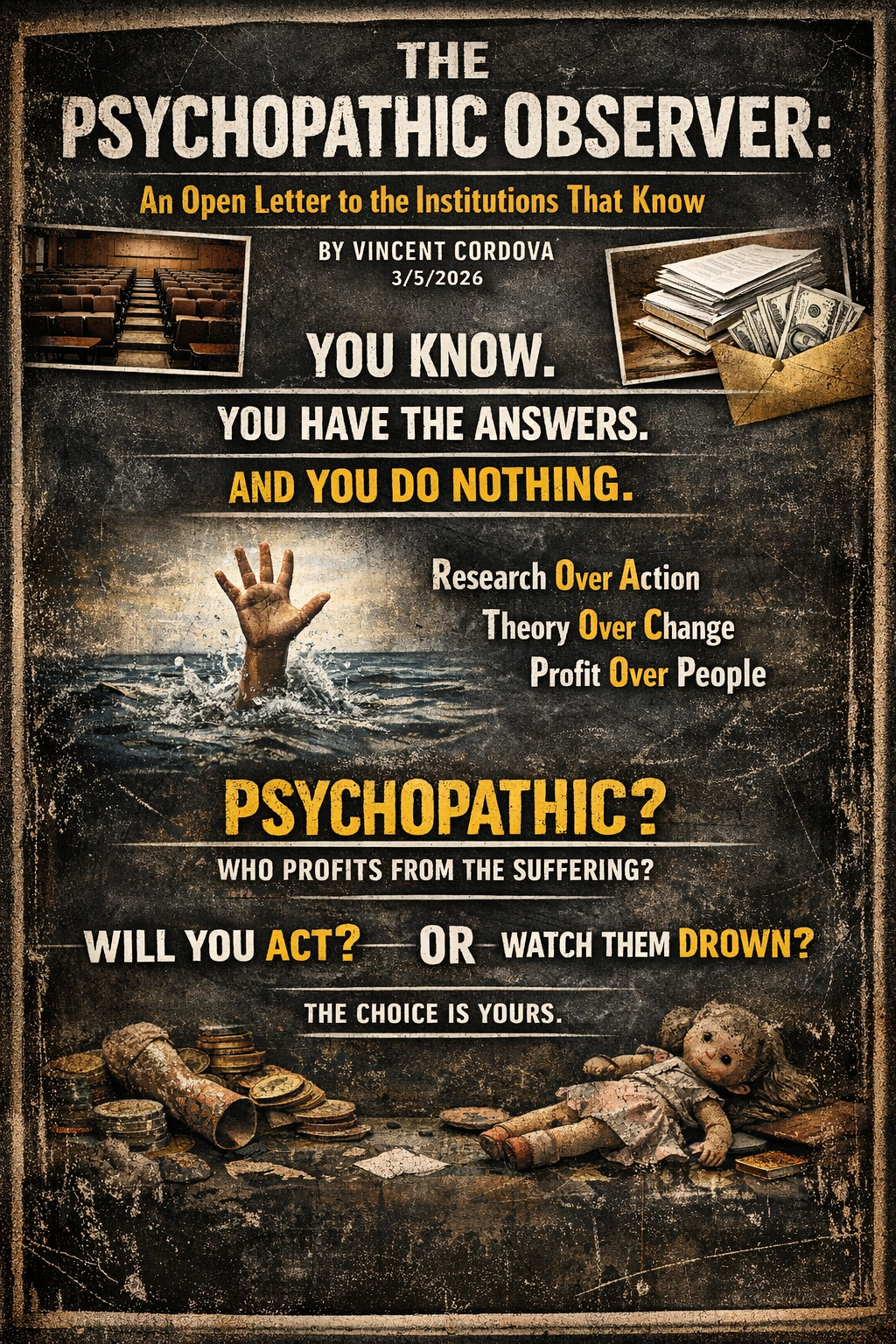
The Psychopathic Observer: An Open Letter to the Institutions That Know
By Vincent Cordova | 3/5/2026
"This is not about America. This is not about any single system. This is about a pattern repeated in every country where institutions have learned to observe suffering and call it scholarship, to document crisis and call it progress, to profit from brokenness and call it service. From Dhaka to Delhi, from London to Lagos, from Brasilia to Boston—the pattern is the same. The names change. The behavior doesn't. And the children keep waiting." To the universities. The colleges of education. The accreditation boards. The policy institutes. The research foundations. The think tanks. The international organizations. The institutions that hold the answers and have held them for decades. You know. Let's start there because it's the only place that matters. You know. You have the research. You've always had the research. You publish study after study on childhood development, trauma-informed teaching, the achievement gap, the school-to-prison pipeline, the impact of poverty on learning, the mental health crisis in young people, the precise interventions that change outcomes. You know what works. You know what doesn't. You know what children need to thrive. You know what communities need to heal. You know what systems need to function. You know all of it. And you have done nothing. The Observation Let's name what this is. This isn't ignorance. This isn't lack of resources. This isn't "we're working on it." This is something else entirely. This is watching a child drown, documenting every stage of the drowning, publishing studies about why children drown, holding symposia on drowning prevention, forming committees to study the drowning committee's findings— And never once throwing a rope. In psychology, there's a term for someone who can observe suffering, understand it completely, and feel absolutely no compulsion to intervene. Psychopath. It's a harsh word. But look at the institutional behavior and tell me it doesn't fit: • You see the problem. • You understand the problem. • You have the resources and authority to address the problem. • You choose not to. That's not bureaucracy. That's not "systemic challenges." That's a moral choice repeated daily in boardrooms, faculty meetings, and administrative offices across this country and around the world. You are observing suffering and treating it as data. The Question You Never Answer So here it is. Direct. No more dodge. Why? Why do you hold the answers and refuse to apply them? Why do you publish study after study while the children keep falling? Why do you train generation after generation in theories that never reach the people who need them? Why do you sit in rooms full of smart people with big ideas and never once say: "Enough observing. Let's act." What are you so afraid of? The Uncomfortable Truth Let's go deeper. What if the system isn't broken? What if it's working exactly as designed? Think about it. The institutions that hold the answers also benefit from the problems. The research funding flows when the problems persist. The grants keep coming when the crisis continues. The conferences stay booked when there's always something new to study. The endowments grow when the focus stays on observation, not action. The underclass is not a failure of the system. The underclass is fuel for the system. Their suffering funds your research. Their failure justifies your funding. Their children become your statistics. Their pain becomes your publications. You need them to stay broken. Because if they were whole—if the problems were actually solved—what would you study? What would you publish? What would you teach? What would happen to the institutions built entirely around observing what you refuse to fix? This is the question no one wants to ask: Do you keep the problems alive because solving them would make you irrelevant? The Observer Effect Here's what happens when you spend decades observing without acting. You don't just document brokenness. You become it. The posture of detached observation eventually becomes who you are. You train generation after generation of students to observe, to analyze, to publish, to study—but never to act. And those students? They become you. They go into the world with degrees and debt and theories and data. They become the next wave of observers. They fill the next round of institutions. They perpetuate the same detached numbness they were taught. You're not just failing to solve the problem. You're manufacturing more of yourselves. Observing. Knowing. Ignoring. Passing it down like an inheritance. The Narcissism of Detachment Let's name the deeper current here. There's a particular kind of narcissism that comes from being the one who knows but does nothing. It's the quiet arrogance of the expert who watches the world burn and says "fascinating" while taking notes. It's the comfort of being above it all. The safety of never getting your hands dirty. The pride of understanding without the mess of intervening. You teach this to your students. Maybe not explicitly. But implicitly. In every lecture that prioritizes theory over action. In every curriculum that values analysis over application. In every institution that rewards publication over participation. You're teaching them to watch. And watching without acting? That's not wisdom. That's not scholarship. That's not education. It's narcissism dressed in academic robes. The Global Pattern: This Is Everywhere If you think this is just an American problem, look again. The same pattern repeats in every country where institutions have learned to observe suffering and call it scholarship, to document crisis and call it progress, to profit from brokenness and call it service. The Global Learning Crisis The numbers are staggering and damning: • Only 18% of Sustainable Development Goal targets for education are on track to be achieved by 2030. • There is an annual financing gap of $97 billion for low- and lower-middle-income countries to provide quality education. • Low-income countries spend just $55 per learner annually. High-income countries spend $8,532. • Over 600 million children and adolescents are not reaching minimum proficiency in reading and math. The institutions know this. UNESCO publishes the reports. The World Bank funds the studies. UNICEF issues the press releases. They've known for decades. And the gap widens. The Psychopathic Observer Is Global Your phrase applies perfectly to the international education establishment. Research confirms that international organizations frame the "learning crisis" in ways that legitimize their own authority while obscuring the historical and structural conditions—colonial legacies, geopolitical hierarchies, economic inequities—that created the disparities in the first place. They construct a narrative that positions the Global North as the source of solutions and the Global South as the site of problems. They prescribe "best practices" from Finland or Massachusetts to children in Nigeria or Pakistan, ignoring context, culture, and local knowledge. They observe. They publish. They prescribe. They do not change. Higher Education's Betrayal Is Worldwide Look at the data: • In Bangladesh, public universities allocate as little as 2% of their budgets to research. Over 92% goes to salaries and administration. The ecosystem is designed to disincentivize the very knowledge creation it claims to value. • In the United States, faculty at four-year institutions spend only 25-40% of their time on teaching. The rest goes to research, grant-chasing, and administration. Teaching is viewed as a "load" to be minimized, not a mission to be fulfilled. • Globally, UNESCO's own roadmap for higher education's future barely mentions research—the very function that produces the knowledge institutions claim to value. The institutions that should be producing solutions are instead producing papers, prestige, and profit. The Underclass Fuels the Machine Everywhere One scholar describes how international aid programs, designed based on what works in Western contexts, routinely misjudge local realities. National governments implement costly, donor-approved reforms to gain international credibility, while real problems on the ground remain unaddressed. Another book, How The New Education Establishment Betrayed The World's Poorest Children, argues that UN bodies like UNESCO and UNICEF have facilitated the decline of public education in low-income countries, paving the way for private schools that profit from desperation. The suffering of the poor funds the research. Their failure justifies the funding. Their children become statistics. Their pain becomes publications. The Rise of New Power Blocs Here's where it gets even more troubling. Countries in the Global South are noticing the observation-without-action pattern. And they're building their own systems: • BRICS+ (Brazil, Russia, India, China, South Africa plus new members) has created the BRICS Network University, comprising 56 leading universities across member countries. • China has announced cooperation centers for science-technology innovation and higher education under the Shanghai Cooperation Organization. These are not just symbolic gestures. They represent a fundamental contestation of who sets agendas, defines problems, and determines solutions in education. The Western-centric era of global education governance is fragmenting. But here's the question your framework demands: Will these new institutions simply replicate the same pattern of observation-without-action under new management? Or will they finally throw ropes? The Epistemological Question The deepest layer of this is about whose knowledge counts. When international assessments measure educational quality, they encode particular ways of knowing. What constitutes knowledge? How should learning occur? What outcomes matter? The OECD's PISA assessments privilege certain forms of literacy and numeracy while rendering other valuable capabilities invisible. The institutions that set these standards are overwhelmingly based in the Global North. They observe the rest of the world through their own lens. They declare crisis. They prescribe solutions. And they never ask: What do you know that we don't? The Same Pattern, Different Countries Country/Region The Pattern United States Universities prioritize research over teaching, faculty compete to teach less, students drown in debt, and the system keeps running. Bangladesh Public universities allocate 2% to research, bureaucratic hurdles block access to funds, and no institution qualifies as a real research university. Global South International organizations prescribe Western solutions, local context ignored, dependency perpetuated. Germany Private schools exploit legal loopholes to charge high fees, segregating students by wealth while claiming to supplement public education. BRICS Nations Building parallel institutions to challenge Western dominance—but will they do better? From Dhaka to Delhi, from London to Lagos, from Brasilia to Boston—the pattern is the same. The names change. The behavior doesn't. And the children keep waiting. The Question for Every Institution So here it is. The question you've spent decades avoiding: What would happen if you actually fixed it? What would happen if you took everything you know—all the research, all the data, all the proven interventions—and actually applied them? What would happen if you stopped observing and started acting? What would happen to the funding streams? What would happen to the grants? What would happen to the conferences? What would happen to the institutions? Would they shrink? Would they become irrelevant? Would they have to find something else to do? And here's the deeper question: Is that why you haven't done it? Is the fear of your own irrelevance more powerful than the suffering you're paid to observe? The Love of Money Let's not be naive about this. Institutions don't run on mission statements. They run on money. And there's money in brokenness. Lots of it. Research money flows to problems, not solutions. Grant money flows to crises, not cures. Endowment money grows when institutions are stable, predictable, and unchallenged. Solving the problems would disrupt all of that. So the problems persist. The suffering continues. The children keep falling. And the institutions keep observing. Publishing. Conferencing. Grant-writing. Endowment-growing. All while the underclass fuels the machine. What Are You Teaching? Ask yourself honestly: What are your students actually learning? Are they learning to heal the world? Or are they learning to observe it from a safe distance? Are they learning to act? Or are they learning to publish? Are they learning to throw ropes? Or are they learning to write case studies about those who drowned? Because here's the truth: Every student who graduates from your institution carries your DNA. If you taught them to observe, they will observe. If you taught them to act, they will act. If you taught them to care, they will care. If you taught them detachment, they will become you. Look at your alumni. Look at the systems they run. Look at the institutions they lead. Look at the world they're shaping. Is this what you wanted? The Question for Those Inside And now I'll ask you—the one reading this who works inside these institutions. The professor who still cares. The administrator who still hopes. The graduate student who still believes change is possible. The researcher who still thinks their work matters. What are you going to do? Are you going to keep observing? Are you going to keep publishing? Are you going to keep pretending that knowledge alone is enough? Or are you going to become the person who finally says: "Enough." "We have the answers. Let's use them." "We know what works. Let's do it." "We've watched long enough. Let's act." What If? What if one institution decided to actually apply what it knows? What if one university stopped publishing studies about failing schools and started fixing them? What if one research foundation stopped funding observation and started funding action? What if one accreditation board stopped certifying programs that produce observers and started demanding action? What if one generation of graduates refused to be the next wave of detached experts and instead became the first wave of real healers? What would that look like? What would that world become? The Choice The institutions won't save themselves. They weren't built to. They were built to observe, to study, to profit. But you? You're not an institution. You're a person. You have hands. You have a voice. You have choices. You can keep observing from a safe distance. Or you can throw a rope. You can keep publishing studies. Or you can become the answer. You can keep training the next generation of watchers. Or you can finally teach them how to act. The Unnatural Order This is the unnatural order: Those who know, do nothing. Those who could act, watch. Those with power, preserve it. Those with answers, hide them. The underclass fuels the machine. The suffering funds the research. The children become the data. The broken become the fuel. And the institutions keep observing. Publishing. Profiting. Perpetuating. Knowing everything. Changing nothing. The Question So here it is. One last time. You have the answers. You've always had them. The only question left is whether you have the will. Will you finally act? Or will you keep watching until the suffering reaches your own door? Because it will. The unnatural order doesn't have favorites. It will come for your family too. It's already coming. And if all you ever did was observe— What was the point? References 1. UNESCO Global Education Monitoring Report, 2023 2. Education International, "The Global Learning Crisis: Why We Must Act Now," 2024 3. UNESCO Institute for Statistics, "Global Education Finance Report," 2023 4. UNICEF, "The State of Global Learning Poverty," 2022 5. M. Franciosi, "Learning in Crisis? A Critical Analysis of International Development Discourse," International Journal of Educational Development, 2021 6. Ibid. 7. K. Raza, "Research Capacity and Budget Allocation in Bangladeshi Public Universities," Journal of Higher Education Policy, 2023 8. American Association of University Professors, "Faculty Workload Survey," 2022 9. UNESCO, "Reimagining Our Futures Together: A New Social Contract for Education," 2021 10. Franciosi, 2021 11. J. Smith, How The New Education Establishment Betrayed The World's Poorest Children, 2023 12. BRICS Information Centre, "BRICS Network University Framework," 2023 13. Shanghai Cooperation Organisation, "Education Cooperation Initiative," 2023 14. OECD, "PISA for Development: Assessment Framework," 2023 15. AAUP, 2022 16. Raza, 2023 17. Franciosi, 2021 18. German Federal Ministry of Education, "Private School Regulation Report," 2023 The sidelines are already full. The answers are already known. The question is whether you'll finally become the answer for someone else. Before it's too late.
Community Comments
Community Comments
Share a public response to this post. Submissions are reviewed before they appear.
0 approved comments
Loading comments...