This site is under construction - will be ready soon.

Campaign design team
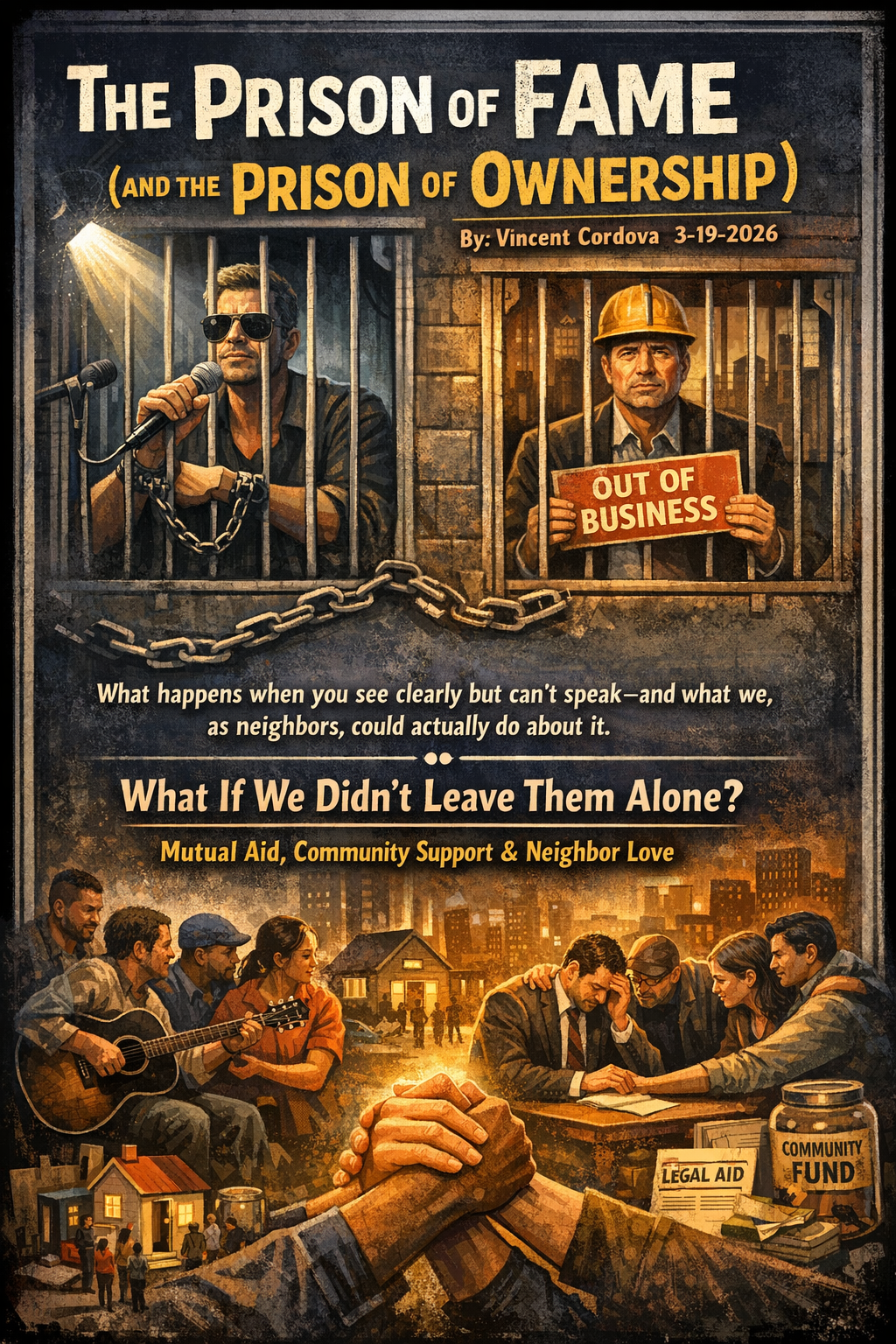
The Prison of Fame (and the Prison of Ownership)
By Vincent Cordova · 03-19-2026
What happens when you see clearly but can't speak—and what we, as neighbors, could actually do about it.
A Note Before You Read:
This post isn't about attacking people with platforms or power. It's about sitting with a hard question that many of them face alone. If you're here to tear someone down, this isn't the space. But if you've ever wondered why those who could speak often don't—and what we could do to change that—read on.
________________________________________
The Dilemma (Two Versions)
For the famous person:
You're loved. Your words carry weight. Your income depends on staying booked. And then one day you see it clearly: the system that made you is hurting people. You want to speak. But if you do, the machine will turn. Contracts won't get renewed. Tours will dry up. The algorithm will forget your name.
For the business owner:
You built something. Maybe it's a restaurant, a shop, a construction company, a tech firm. You employ people who count on you. Their health insurance, their children's lunches, their rent—it runs through you.
And then one day you see it clearly. Your industry—the way it treats workers, the way it prices things, the way it extracts from the community—it's wrong. You want to change it. You want to speak.
But if you do:
• Suppliers might cut you off
• Customers might go elsewhere
• Banks might call in loans
• Employees might panic and leave
• You could lose everything they depend on
So you stay quiet. You make the small changes you can. And you carry the weight of knowing.
________________________________________
The Pressure They Carry (Expanded)
Before we judge, let's name what's actually on the line.
For the famous:
• Financial: Mortgages, families, staff, livelihoods
• Contractual: NDAs, morality clauses, sponsors
• Social: Fan backlash, media narratives, blacklisting
• Psychological: Imposter syndrome, fear of being wrong
For the business owner:
• Employees: Real people who will lose their jobs if the business fails
• Debt: Personal guarantees, loans tied to the business, no bankruptcy buffer
• Reputation: Years of relationships with vendors, partners, community
• Identity: For many, the business is their life's work. Letting it go is letting go of self.
• Moral weight: Knowing that if you fail, it's not just you who falls
These aren't excuses. They're realities. And they're heavy.
________________________________________
The Question Beneath the Question
But underneath all of it is something harder.
If your platform—whether fame or business—depends on the system staying intact, can you ever use it to dismantle that system?
Or does it always, eventually, demand silence and then eventually archives you and then extract your business?
The system promotes people who don't threaten it. It elevates voices that entertain, not voices that warn. It rewards businesses that play by the rules, even when the rules are broken. Is that how slavery was maintained for so long? Is that how you feel now?
By the time someone is famous enough to be heard, or wealthy enough to have leverage, they've already been filtered through a hundred gates designed to keep dangerous truth out.
So maybe the real question isn't "Why don't they speak?"
Maybe it's: Is it possible to have power in a broken system and still be free?
________________________________________
The Neighbor Test (Still Applies)
There's a simpler way to frame this.
Imagine someone standing next to you. Not a customer. Not a fan. Just a person. Your neighbor. They're struggling. They need help.
If your platform—your fame, your business, your influence—prevents you from helping them because speaking or changing would cost too much... then what, exactly, is your platform for?
This isn't an accusation. It's a lens.
Because most of us aren't famous or business owners. But we all have something—a job, a reputation, relationships—that we could use or protect. And we all face the same choice: Do I keep what I have, or do I risk it for the person next to me?
________________________________________
What If We Didn't Leave Them Alone?
Here's where the conversation turns.
Because the real problem isn't that people with power are cowardly. It's that we ask them to risk everything alone.
We celebrate truth-tellers after they've been destroyed. After the contracts are gone. After the business is shuttered. After they're broke, bitter, and useful to us only as cautionary tales.
But what if we caught them before they fell?
What if we didn't wait for the system to protect them? What if we protected each other?
________________________________________
The Mutual Aid Answer (Now for Everyone)
This is the part that changes everything.
Mutual aid is just a fancy name for something very old: neighbors keeping neighbors alive.
Not waiting for the government. Not applying for grants. Not hoping the right executive order comes through.
Just people. Showing up. With what they have.
Imagine if every community that wanted to hear truth and see change also agreed to hold the truth-teller and the change-maker. Not metaphorically. Actually.
For the famous:
• A local fund that covers rent when a musician loses their tour for speaking out
• A network of spare rooms for writers who get blacklisted
• Direct purchase commitments for artists dropped by labels
For the business owner:
• A customer commitment: "If you change your business to treat people right—even if it costs more or draws backlash—we will stay. We will buy. We will bring others."
• A supplier network: Other local business owners who agree to step in when corporate suppliers cut someone off
• A mutual guarantee: A pool of money from the community that covers payroll for six months if a business owner speaks out and faces retaliation
• Legal support: Local lawyers who offer pro bono defense when a business is sued for doing the right thing
• Emotional holding: A place to go where other owners admit they're afraid too
No applications. No approval. Just care.
This is how people have survived every empire, every purge, every wave of silence. Not by appealing to power. By building something smaller, stronger, and unbreakable: each other.
________________________________________
What It Would Look Like
This isn't a fantasy. It's already happening in a thousand small ways.
• Community-funded trusts where local artists and local businesses pay into a pool that catches anyone who falls.
• Buy-local commitments that aren't just aesthetic but moral—promises to support businesses that support the community, even when it's hard.
• Platform cooperatives where resources are shared, not hoarded.
• Legal defense funds for those sued into silence.
• Basic income experiments that remove survival pressure so speaking and changing costs less.
The goal isn't to make fame or business safe. It's to make truth and integrity sustainable. To build something underneath people so that when the system pulls away, they don't fall into nothing. They fall into us.
________________________________________
An Invitation
So here's where we end. Not with a critique, but with a question for you—the reader, the neighbor, the one still reading.
What if every community that wants to hear truth and see change also agreed to hold the ones who risk it?
What if we stopped waiting for the famous or the powerful to save us and started building something that could save them?
Not because they're special. Because they're ours. Because they said something true or tried to run their business differently, and we let them do it alone, and that's not how a people survive.
The system will always try to isolate the ones who speak and the ones who change. Mutual aid says: We'll undo that. We'll carry you so you don't have to carry them.
It's not charity. It's neighbor love. And it's the only thing that's ever worked.
________________________________________
A Closing Thought
You don't have to be famous or own a business to start.
A spare room. A shared meal. A promise to keep buying from the local shop that's trying to do right. A monthly contribution to a neighbor who spoke and lost.
That's how it begins. Not with a grant. Not with permission. With one person noticing another and saying:
You're not alone. I've got you. And if enough of us say it, the system can't touch you anymore.
What would it take for a church in your neighborhood to be that kind of place – breaking the frameworks that any higher power would be watching for? What would it mean for you to support them in being unsafe?
That's the world worth building.