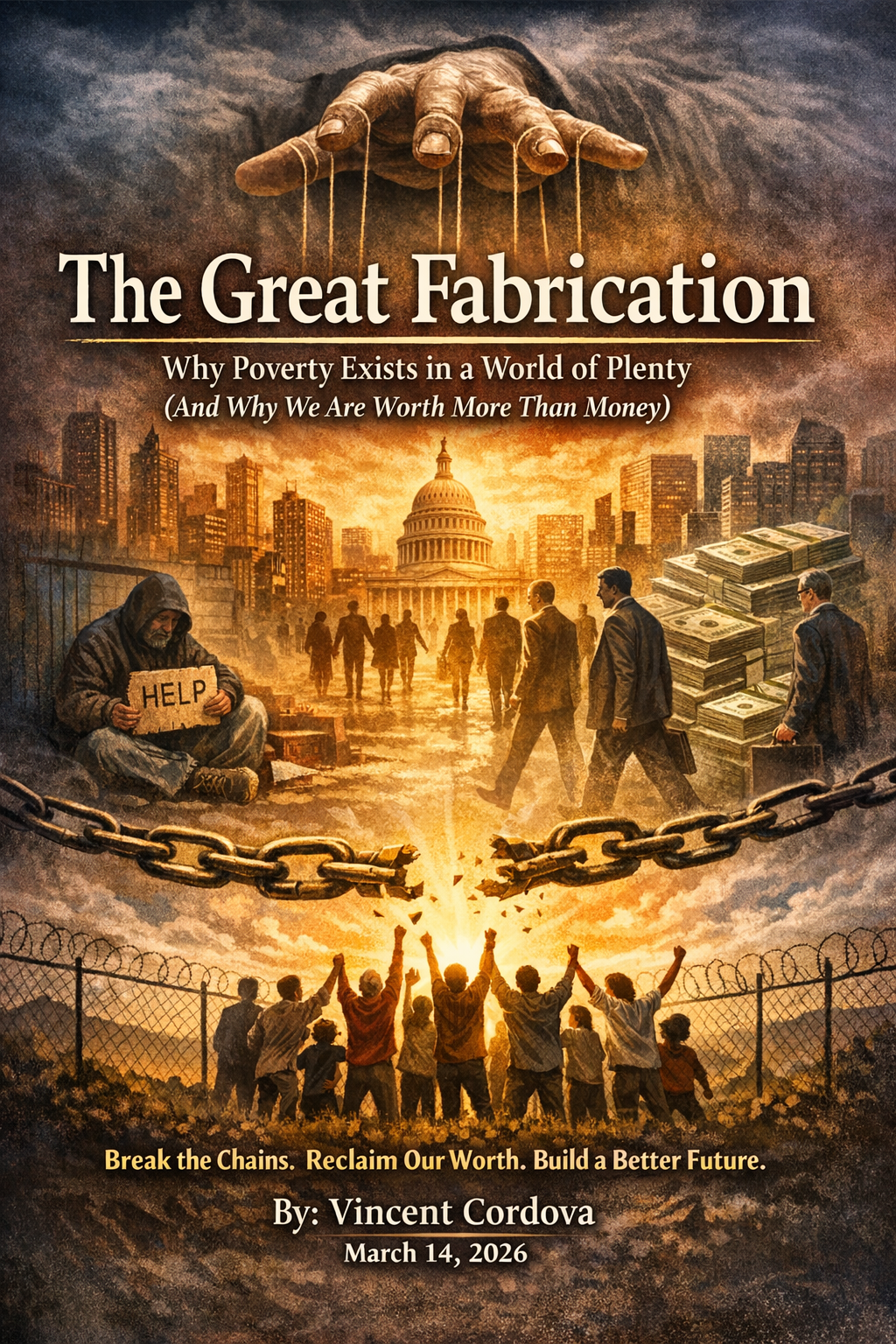
Campaign design team
The Great Fabrication: Why Poverty Exists in a World of Plenty (And Why We Are Worth More Than Money)
By Vincent Cordova · March 14, 2026
We are often told that poverty is a natural state (it's not :( ). That it is an unavoidable byproduct of a functioning economy. That the poor will always be with us.
But what if we have been looking at it all wrong? (Spoiler: we have.)
What if poverty isn't a natural disaster or a personal failing, but a deliberate manufacturing process? What if it is a mechanism—a social technology—designed to create a comfortable reality for the powerful? Designed to ensure there is always an underclass to exploit. Spirits to break. Humans to control, manipulate, and profit from.
Making us feel less than a system that could never exist without us.
They will tell you it is for the collective good. But what benefits are you seeing today? Are you making record-breaking profits? Are you actively lobbying Congress with money extracted from the underclass to make your life better?
No. You have a foot on your neck, reminding you that you might be next. Is that deliberate?
What happens if you miss too many days of work? Could you become the underclass?
And think about this: why are they cutting off your creativity? Not all of us, but most of us. Why would they not want to make it easier for you to create?
A group of people deliberately want us to be slaves for their benefit.
When you start to look at the world through this lens, the pieces begin to fit together. And it forces us to ask a terrifying question: How can humans do this to other humans?
To understand how we got here, we have to look at the tool used to build the walls of this prison: Control. Owning slaves—it's our history. Money. Specifically, the strange, ghost-like entity we call Fiat Currency.
The Magic Trick of Fiat
Let's pause for a moment and consider the dollar bill, the euro, or the yen in your pocket. What is it, really?
It is a piece of paper. Or, more often these days, just a number on a screen. We operate on a global system of fiat currency—money that derives its value from government decree (or "fiat") and the collective belief of the population. It is backed by nothing but our shared faith that it has value.
In the grand scheme of the universe, it is an illusion. A socially agreed-upon hallucination. A carrot on a stick, dangled in front of us to keep us moving within their frameworks.
Now, there is nothing inherently wrong with shared belief. It allows civilization to function. The problem arises when we place this collective hallucination above the tangible reality of human existence.
We have created a system where the health of the "economy" (the movement of this belief) is considered more important than the health of the people who comprise it. We worship the symbol, and we sacrifice the substance.
The Manufacture of the Underclass – Slaves and Slave-Like Conditions
If money is just a belief system, then the distribution of it is a choice. This is where the manufacturing of poverty comes in.
Why does poverty exist in a world that produces enough food to feed everyone? Why does homelessness exist in cities full of empty luxury apartments (could it be the $3,000 studio apartment price)? It isn't a resource problem; it's a distribution problem. And distribution is controlled by those who hold the power to print, lend, and price the belief system.
Poverty serves a function. It is the shadow that makes the light seem brighter.
- The Driver of Labor: An underclass that is desperate, that fears losing their housing (most of them don't even have housing) or their next meal, is an underclass that is willing to work for wages far below the actual value of their labor. It creates a race to the bottom where survival is the prize, not prosperity.
- The Scapegoat: Poverty provides a target for the frustrations of the struggling middle class. It's easy to blame the "lazy" poor rather than the system that is extracting wealth from everyone. It divides the majority so that a minority can rule. The middle class is a lie—we lie to ourselves that we are functioning well. The world sees the truth. Why can't we? We are blind to the pressure on our neck—"foot," "boot," whatever you want to call it. It is your true abundance blocker, because our essence is here to create, not to be controlled by pressure for someone else's benefit.
- The Justification of Power: The existence of poverty makes the wealthy feel justified. "I am not like them," they tell themselves. "I worked hard. I am smarter." This narrative ignores the structural advantages, the inherited wealth, and the access to the levers of the currency system that allowed them to accumulate their fortunes.
It is a system designed to make the powerful feel comfortable. It allows them to accept a reality where some people are disposable, because that reality ensures their own position at the top.
The Pinnacle of Value
This brings us to our final, and most crucial, point: We are the pinnacle—you and I. Everyone. Human existence is the only thing on this planet that isn't a symbol.
The money in the bank is not real. The stock portfolio is not real. The GDP growth charts are not real. They are representations of value, but they are not value itself.
The only real value is the breath in our lungs, the creativity in our minds, and the love in our communities. We are the ones who build the buildings, grow the food, heal the sick, and teach the children. We are the source code of the economy, yet we have coded ourselves as expendable features rather than the main product.
Dismantling the Illusion
So, how do we fix this? How do we stop humans from doing this to other humans?
It starts with a radical shift in perspective. We must collectively decide to stop placing the symbol above the substance.
- Redefine Value: We need to measure success not by the accumulation of currency, but by the well-being of people. A society where no one is hungry, everyone has shelter, and healthcare is a right is infinitely wealthier than a society with a few billionaires and millions of impoverished people, regardless of GDP numbers.
- Recognize the Mechanism: We must see poverty for what it is: a choice. A policy choice. A system choice. And it barely represents the public—who really are the policy beneficiaries? When we stop blaming individuals and start looking at the design of the fiat system—who controls the levers, who benefits from scarcity, and who decides what a "living wage" is—we can begin to change the design.
- Prioritize Existence: Every economic decision, from local zoning laws to central bank interest rates, should be filtered through one question: Does this elevate human existence, or does it exploit it? What do you want it to be for your children? For yourself? For the next generation?
We have the power to re-write the code. We have the power to look at the fiat currency in our hands and say, "You are a tool, not a master." We have the power to build an economy that serves life, rather than an economy that life must serve.
The belief that poverty is natural is the most profitable lie ever sold. It's time to stop buying it.
So I ask you: Does dismantling the belief in the "naturalness" of poverty feel like the first step to you? Or do you like seeing others suffer unnecessarily?
Sure, you can say they have a choice. But we also have a choice—together. Don't we?
We know who poverty benefits. We see how it is actively used to manipulate the public—you, your children, and me—showing us where we might end up if we step out of line. It creates an illusion that we are below the system. And when we are not actively changing it for the better, we are proving it right.
But here is the truth: We are the pinnacle of life. Everything else—every system, every currency, every government—can only come from humans, by our creation.
So who is the most important existence in this life? YOU. (All of us.)
The Invisible Chain: How Poverty is Designed to Make You Feel Small
We've discussed how poverty is manufactured and how fiat currency is a collective belief system that we've allowed to tower over our actual existence. But there is a darker, more insidious function to this machine. It isn't just about taking resources from the many and giving them to the few. It is about control.
Do we need this control for a civil society? And could this even be called a civil society, by any honest definition?
We are actively destroying lives for control and profits—all benefits that never reach the public. Are you benefiting? Any foundation built on another's back will never last.
Poverty is a spiritual weapon. It is designed to make humans feel perpetually below the threshold of power, constantly looking up at a "fake control"—an illusion of authority that exists only because we consent to it.
The Psychology of Scarcity
Imagine you are drowning. You aren't thinking about who owns the ocean, or why the waves are so high, or whether you have a right to be there. You are only thinking about air. You are only thinking about surviving the next ten seconds.
This is the state of poverty. It is a state of constant, grinding scarcity.
When your brain is occupied with where your next meal is coming from, how you'll pay that bill, or whether you'll have a place to sleep next week, you don't have the cognitive bandwidth to think about systemic change. You don't have the energy to organize, to protest, to vote strategically, or to imagine a different world.
The system keeps you busy surviving so that you never have the chance to start living.
Keeping Your Eyes Down
When you are poor, the world is designed to remind you of your place.
- The way people in suits walk past you on the street without seeing you.
- The bureaucratic maze you have to navigate to get a fraction of the help you need.
- The interest rates on loans that are three times higher than what a wealthy person pays.
- The subtle (and not-so-subtle) messaging in media that associates poverty with laziness, stupidity, or moral failure.
All of this is a form of social conditioning. Are you benefiting from the conditioning? Do you want to benefit from someone's poverty and suffering?
It teaches you to look down. It teaches you that power resides somewhere else—in the government building, in the bank tower, in the hands of the "experts" and the "leaders." Where are these leaders actively taking us today?
But here is the secret they don't want you to know: That power is fake.
The Illusion of the Throne
Who sits at the top? Politicians? CEOs? Bankers?
They are just people. They put their pants on one leg at a time, just like everyone else. They are born, they will die, and their bodies will return to the same dust as the poorest person on the planet.
Their control is a collective hallucination (a framework), just like the fiat currency we discussed. They hold power only because we have been conditioned to believe they do. We have been taught, from birth, to look up. To ask permission. To wait for someone else to solve the problems.
We have been made to feel below a power structure that is, in reality, built on nothing but our own compliance. You and I are actively allowing people to suffer at the belief that the top needs more money for us to function as a society.
How's that working out for us?
The Feeling of Being Below
This is the deepest wound of manufactured poverty. It isn't just the lack of money; it is the lack of agency. It is the creeping, soul-crushing feeling that you are a passenger in your own life—that the world is something that happens to you, not something you participate in creating.
When you feel below, you accept things you shouldn't. You accept wage theft. You accept unsafe working conditions. You accept politicians who lie to you. You accept a system that treats you as a number on a spreadsheet rather than a pinnacle of existence.
But here is the truth that changes everything: Nothing in our world could exist without our creation. We are above any system and any power, collectively. Anything that is created to make you feel less is taking your life away.
YOU and I—EVERYONE—are the most important to this existence. We create. We hold the keys to our future together and individually. Not systems. Not governments. Not corporations. We do.
When we start respecting the gift of life—to create, live, enjoy, love for each other globally, while making sure there is no FOOT ON someone's neck—we are heading toward true global abundance. GLOBAL.
Just by respecting the gift of life and building around that, we change the trajectory of the world. Not for some. For all.
Reclaiming the Truth
But here is the antidote: The truth of our position in the universe.
No matter how much fiat currency you do or do not have, you are here. You are alive. You are a conscious, breathing, thinking miracle in a vast and beautiful cosmos.
The bank manager who denies your loan? He will be dead in a hundred years. The billionaire who flies overhead in a private jet? Gone. The politician who makes decisions about your body and your life? Dust.
But you? You are here now. And your existence is the only thing that gives the currency, the buildings, and the systems any meaning at all.
When you realize that the power structure is just a stage set, and the people on it are just actors reading a script written by dead people, something shifts. You stop feeling below. You start standing beside. You realize that the only real control is the control you have over your own mind, your own actions, and your own community.
Breaking the Spell
The system wants you to feel small. It wants you to look up. It wants you to believe that the fake control is real.
The revolution—the quiet, personal, and collective revolution—begins when you decide to stop.
Stop looking up. Start looking around. Look at the people beside you. They are your power. They are your wealth. Together, you are the pinnacle.
And no amount of printed paper or fake control can ever take that away.
The Turning Point: Why We Must Build a Better Way Together
We have walked through the darkness together. We have seen how poverty is manufactured, not born. We have seen how fiat currency is a shared hallucination we've allowed to tower over our actual lives. We have seen how the system is designed not just to exploit us, but to make us feel small—to keep our eyes down, to make us believe that power lives somewhere else, in some distant tower, held by people who are fundamentally different from us.
But here is the question that matters most: So what?
If all of this is true, if the cage is made of nothing but our collective belief, then what do we do? Where do we go from here?
The answer is both terrifying and beautiful: We build something better. Together.
And we have to do it now. Because the alternative is to remain passengers in a failing state, clinging to a status quo that is already crumbling around us.
Understanding is Just the Beginning
First, we must understand why this awareness matters. It matters because you cannot fix what you cannot see.
For generations, we have been fighting symptoms instead of systems. We have been told that poverty is about bad decisions, that inequality is about market forces, that power is about merit. We have been looking at the leaves while ignoring the roots.
But once you see the roots—once you understand that poverty is a choice (poverty is the cotton field plantation, the underclass—again, not benefiting the one in poverty), that money is a belief, that power is a performance—you are no longer a victim of the illusion. You are awake in the dream. And when you are awake, you can start to change the dream.
This awareness is not meant to make us cynical or hopeless. Quite the opposite. It is meant to liberate us from the spell so we can finally, actually, begin the real work.
The United States: The Perfect Laboratory for Change
The United States is in a perfect position to lead this shift.
Think about it. The United States was founded on an idea—an imperfect, hypocritical, violently flawed idea, but an idea nonetheless: that people could govern themselves, that authority came from the consent of the governed, that something new could be built.
We have spent centuries falling short of that idea, contradicting it, betraying it. But the idea remains. And it is precisely because of our contradictions, our wealth, our diversity, and our visibility that we have the opportunity—and the responsibility—to model something different.
If we can show the world that another way is possible, the ripple effects would be global. If the most powerful nation on earth can pivot from extraction to regeneration, from competition to cooperation, from the worship of money to the reverence of life, the entire planet will feel the shift.
But if we don't? If we cling to the status quo, if we keep our eyes down and our mouths shut? Then we become passengers on a sinking ship, watching the water rise, waiting for someone else to save us while the captain dances in the ballroom.
The Status Quo is a Lie
Here is the thing about the status quo: it is not stable. It never was.
The system we are living in—this global architecture of fiat currency, corporate power, and manufactured scarcity—is already failing. You can see it everywhere:
- The climate is breaking down because we valued profit over planet.
- Trust in institutions is collapsing because people can smell the lie.
- Wealth inequality is reaching obscene levels because the machine is eating itself.
- Loneliness and despair are epidemic because we traded community for consumption.
The status quo is not a safe harbor. It is a house on fire. And we are standing in the living room arguing about who left the stove on while the flames climb the walls.
Passengers or Builders?
So we have a choice. Two paths.
Path One: We remain passengers. We keep our heads down. We vote every four years and hope the right person gets elected. We scroll through our phones and watch the world burn from a safe distance. We tell ourselves that the system is too big, too powerful, too entrenched. We wait for someone else to save us.
This path leads nowhere. It leads to becoming subjects in a failing empire, watching our children inherit a world poorer and more divided than the one we were given.
Path Two: We become builders. We look at the people beside us and realize they are our partners. We start where we are—in our neighborhoods, our workplaces, our communities—and we begin constructing the foundations of a new world, right here, inside the shell of the old one.
This path is harder. It requires imagination, courage, and patience. But it is the only path that leads anywhere worth going.
What Does "Better" Look Like?
So what are we building? What is this "better way"?
It starts with a simple shift: We stop placing currency above existence.
In practical terms, this means:
- Localizing economies: Building community networks of exchange that don't depend on distant banks or corporate supply chains. Mutual aid. Co-ops. Community gardens. Time banks. These aren't just hobbies; they are the scaffolding of a new system.
- Redefining value: Measuring success by well-being, not wealth. Asking not "how much money did you make?" but "are your people fed? Are they housed? Are they free? Do they have meaning?"
- Decentralizing power: Distributing decision-making as widely as possible. Trusting communities to govern themselves. Building systems from the bottom up, not the top down.
- Remembering our worth: Rejecting the narrative that we are small. Standing in our truth as the pinnacle of this world. Treating every human—not as a resource to be extracted—but as a miracle to be cherished.
The Invitation
This is not a call to wait for a leader. This is not a call to storm the castle. This is a call to look at the person next to you and say: "I see you. You are not below me. We are in this together. What can we build?"
The world is desperate for a vision of something better. People are hungry—not just for food, but for meaning, for connection, for a reason to hope.
We can give them that. Not through speeches or manifestos, but through how we live. Through how we treat each other. Through the small, daily acts of building a world where no one is disposable.
The Choice is Ours
The United States stands at a crossroads. We can continue as passengers in a failing state, watching the status quo consume itself and take us with it. Or we can become builders of something new—a society that finally, actually, lives up to the radical idea that all people are created equal and endowed with the right to life, liberty, and the pursuit of happiness.
Not happiness measured in dollars. Happiness measured in dignity. In community. In peace. In the simple, profound joy of being alive and knowing that you matter.
The system is made of belief. And belief can change.
It starts with us. It starts now. It starts together.
Are you ready to build?
I am. And we will.
— Vincent Cordova
March 14, 2026
Community Comments
Community Comments
Share a public response to this post. Submissions are reviewed before they appear.
0 approved comments
Loading comments...