This site is under construction - will be ready soon.

Campaign design team
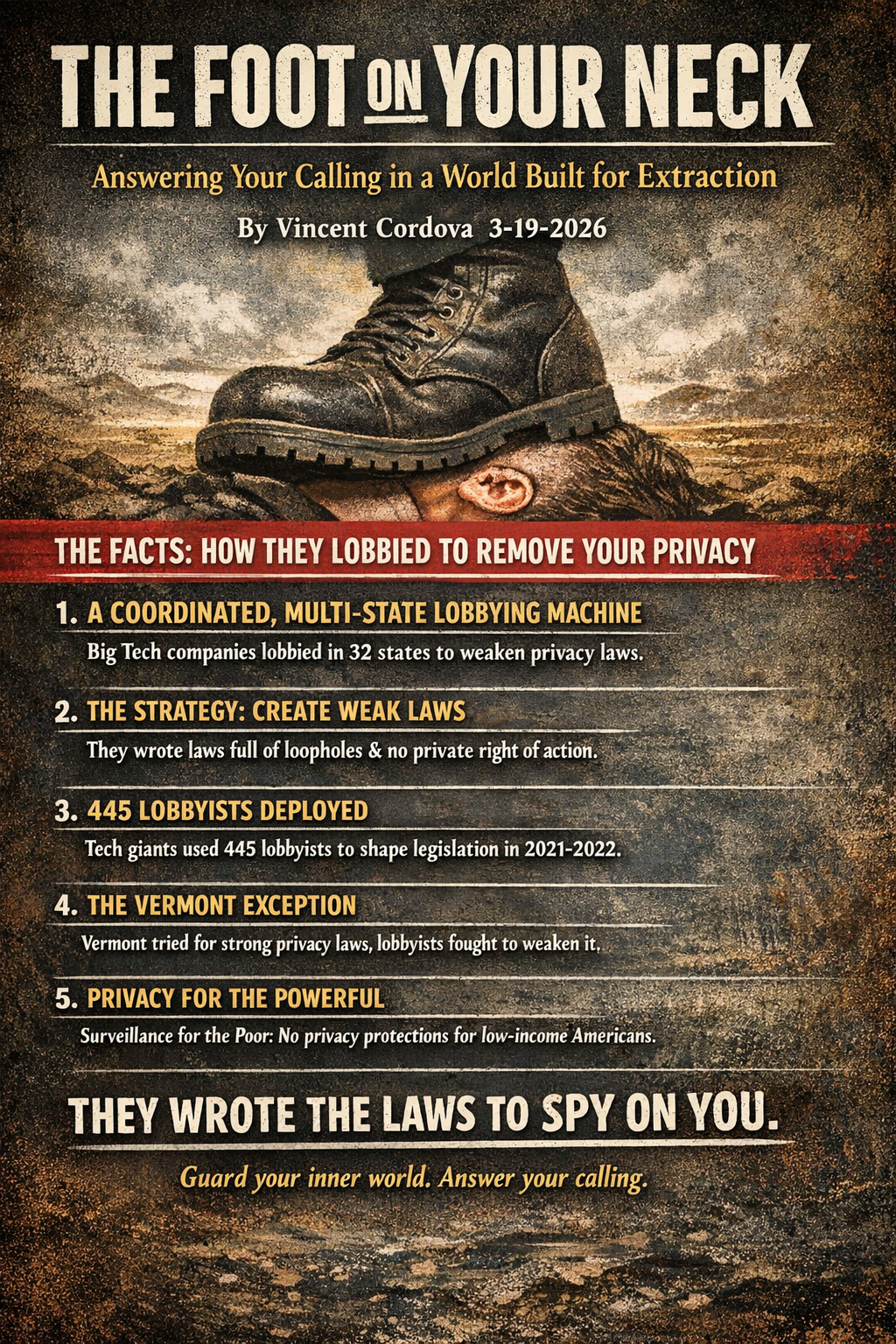
The Foot on Your Neck: Answering Your Calling in a World Built for Extraction
By Vincent Cordova · 3/19/2026
We all feel it. That quiet, persistent hum in the background of our lives. A whisper that there is something more. A persistent thought about a better way, a kinder solution, a creation that doesn't yet exist. We call it a dream, a passion, a crazy idea. But in the quietest moments, we know it for what it truly is: a calling.
I believe, with every fiber of my being, that every single one of us has a higher calling. It is the unique signature of our existence, the specific melody our life is meant to play. It is not reserved for the privileged, the geniuses, or the lucky. It is a birthright, woven into the fabric of who you are. It's the thing you would do even if you weren't paid for it. It's the problem you see in the world that you feel an inexplicable urge to fix. It's the art you need to create, the business you want to build, the people you feel driven to serve.
But if this is a universal truth, why does it feel so impossible to reach? Why do so many of us go to our graves with that music still trapped inside us?
Because there is a foot on our neck.
And it's time we talked about who that foot belongs to, why it's there, and what it's crushing.
________________________________________
The Weight on Your Chest: Understanding the Pressure
Before we can remove the boot, we have to understand why it's pressing down in the first place. We've touched on this before, in previous discussions about the design of our society, but it bears repeating: The world we live in was not built for people with callings. It was built for extraction.
Look around you. Look at the structure of our lives. The relentless 40-hour work week that consumes your best energy. The golden handcuffs that tie your healthcare and survival to a single employer. The mountain of debt required for education or a home—debt that ensures you cannot stop working. The idea that your value is tied to your productivity, not your humanity.
This isn't an accident. It is a meticulously engineered system, and at its core, it operates on a principle of control. Its goal is to extract as much labor, time, and creative energy from you as possible while giving back the bare minimum needed to keep you alive and working. It is designed to manage outcomes, to predict behavior, and to ensure a steady, reliable flow of labor.
When you strip away the polite veneer of "civil society" and "economic stability," what you are left with is a structure of extraction that bears a chilling resemblance to something far older and darker. It is a system designed to hold people. To own their time, their energy, and their focus.
Why? Because a person who is answering their higher calling is unpredictable. They are a variable the system cannot control. You cannot extract full value from someone who is saving their best self for their own purpose.
I suppose I need to understand the psychopathic mindset—the belief of humans wanting other humans to be their slaves. But I can't. I cannot fathom looking at another person and seeing only a tool for my own gain. But I do see how this mindset, this system of extraction, is disruptive to your gift of life. It treats the sacred as a commodity.
________________________________________
A Necessary Distinction: The 9-to-5 Is Not The Enemy
Now, before we go further, we need to pause and make something crystal clear. This is not an attack on having a job. It is not a declaration that all wage work is evil, or that everyone must quit their job tomorrow and become an entrepreneur.
A 9-to-5 is a beautiful thing when it is mutually beneficial.
There is profound honor in work. There is dignity in showing up, contributing your skills, solving problems, and earning a living that supports you and your loved ones. Many of the world's most essential and fulfilling roles exist within the structure of a job. A teacher shaping young minds, a nurse healing the sick, an engineer designing clean water systems, a barista creating a moment of warmth and connection—these are callings, lived out within the framework of employment.
The problem is not the structure of a job. The problem is extraction.
Extraction is when the relationship becomes one-sided. It's when your labor fills someone else's pockets while you struggle to pay rent. It's when your creativity is exploited for corporate profit while you are treated as replaceable. It's when your time is consumed so completely that you have nothing left for your family, your health, or your own dreams. It is the foot on your neck that keeps you just comfortable enough to keep working, but never free enough to truly live.
A non-extractive 9-to-5 is one where you pour yourself into your work and the work pours back into you. You receive fair wages, yes, but also respect, agency, community, and the sense that your presence matters. You are a partner in the mission, not a cog in a machine. The foot is not on your neck; you are standing on your own two feet, choosing to contribute because the exchange is equitable.
The system we are talking about—the one with the boot—has no interest in that kind of relationship. It needs extraction to survive.
________________________________________
Why the System Must Crush Your Dream
Everyone of us has a calling or a dream. Most of you, right now, are thinking about creating something better than what exists today. You see a broken process, a missing service, a community in need, a story that must be told. That thought, that spark, is your calling trying to break through.
The system knows that. It knows that the human impulse to create, to improve, to serve, is the most dangerous force to its existence. And so it must actively crush that impulse before it disrupts the program assigned to you and me.
They dressed it up as the American Dream. They told you that if you grind hard enough in your 9-to-5, if you give them your best decades, you will earn the home and the life you want. They sold you a vision of comfort in exchange for compliance.
But that vision was a mirage. Because the moment you commit to that path, you feel it. The pressure. The weight. The foot being applied to your neck by the system's boot.
It is applied to tell you one thing: You are owned now. So don't screw it up.
And if you do screw it up? If you dare to step out of line? You will be made an example. You will be pushed down into the underclass, the cautionary tale they use to keep everyone else in line. They will break you, then point to your brokenness as a warning. They will offer you low-wage survival jobs and observe your struggle as proof that the system is necessary, that without it there is only chaos.
That foot is actively killing your calling. Because now you understand how it feels. You understand that one misstep could cost you everything. And so you stay small. You stay quiet. You stay safe.
But here's what the system doesn't want you to know: most of us, when we dream of creating, aren't dreaming of riches or power. We are dreaming of creating things that would be better for the other person. The wanting to make life better for yourself or for another—that is the calling itself. Anytime you have dreams or thoughts of creating something that can help other people, that is the call.
And when you answer that calling, you are going to answer someone else's prayer.
Think about that. Somewhere, someone is praying for the solution you were born to create. Someone is hoping for the community you were meant to build. Someone is longing for the art that only you can make. Your calling is the answer to their prayer.
The system knows this. It knows that if you answer that call, you will disrupt the extraction. You will prove that another way is possible. And so it must crush you before you destroy the slave-like design.
________________________________________
The Final Theft: Your Privacy and the Capture of Creativity
You know what is even sadder? What reveals the true depth of their intent?
They lobbied to remove our privacy.
They didn't just want your time. They didn't just want your labor. They wanted access to your inner world. They wanted to monitor your thoughts, your searches, your private conversations, your moments of unfiltered inspiration. They built a panopticon and called it "security" or "innovation" or "convenience."
And they did it knowing full well that the foot is on your neck.
Think about the cruel genius of this. They have already applied the pressure—the financial stress, the fear of losing everything, the exhaustion that leaves you with nothing left to give. That boot keeps you from moving, from rising, from acting on your calling.
But what if you get an idea anyway? What if, despite the weight, a spark of creativity ignites in the quiet of your own mind? What if you start to imagine a way out, a solution, a creation that could disrupt their entire system?
They need to know. They need to capture that spark before it becomes a flame.
So they take your privacy. They monitor your searches. They listen to your voice. They track your location. They analyze your data. They build profiles of your desires, your fears, your secret hopes. And they use that information not to help you, but to predict you. To control you. To sell you back to yourself while ensuring you never become more than a consumer and a worker.
They know that creativity is born in privacy. It is born in the quiet spaces, the unobserved moments, the freedom to think without judgment. When you remove privacy, you don't just remove secrecy. You remove the very conditions under which a calling can be conceived.
They are not just stealing your data. They are stealing your unborn dreams. They are capturing your creativity before it ever has a chance to take shape, to find words, to become action.
It is the final theft. The ultimate insurance policy against your freedom.
They have your body during the day. They have your mind at night. And they have designed it so that even in the space between, when a new thought might try to be born, they are there, watching, recording, and if necessary, silencing.
This is why the fight for privacy is not just about protecting information. It is about protecting the sacred space where your calling whispers to you. It is about ensuring that when the call rings, you have a private moment to hear it, to consider it, to fall in love with it, before the system can stomp it out.
They took our privacy because they are afraid. They are afraid of what we might become if we ever had a moment of true freedom to think, to dream, to create.
Don't let them win. Guard your inner world fiercely. Find your quiet spaces. Protect your thoughts. And when the call comes, answer it—even if you have to whisper.
________________________________________
The Gift of Disruption and the Lie of "Order"
Some will read this and say, "Well, this is just how a civil society functions. It has to be this way to keep order."
To that, I ask: Order for whom?
Order for the extractors? Order for those who benefit from your quiet compliance? Order for a machine that grinds human beings into resources?
A truly civil society does not function by keeping a boot on the neck of its citizens. A civil society does not need to crush the innate human desire to create and contribute in order to maintain its stability. A civil society that harms any group of people, that systematically destroys the callings of its members through extraction, is not civil. It is a prison with a nicer paint job.
The order they speak of is the order of the machine. It is the predictable, sterile, soul-less order of the assembly line. It is an order that requires human beings to act like interchangeable parts, not like the irreplaceable, gifted individuals we are.
Everyone of you has a calling. Everyone of you. And it is waiting to be answered.
The question is not whether you have one. The question is: what do we have to do to ease that foot? What do we have to do to remove it entirely, so you can finally stand up and create the dream you desire?
If today, all of our callings were answered simultaneously, the old system would vanish overnight. It couldn't survive the light. It would be replaced by something we can barely imagine: a new world of true abundance, built not on extraction, but on contribution. Not on control, but on creativity. Not on fear, but on fulfillment.
________________________________________
The Choice: Answer or Send to Voicemail?
Your calling is ringing. It's ringing right now.
It's in that idea you had in the shower this morning. It's in that frustration you feel at work when you see a better way to do things—a way that would serve people better, not just pad the bottom line. It's in that pang you feel when you see someone else doing what you wish you could do. It's in the quiet moments when you allow yourself to wonder, "What if?"
But the foot is heavy. The fear is real.
You can't miss a day of work, or you might lose your apartment. You can't risk the stability you've fought for. You have people depending on you. The system knows this. It has calculated it perfectly. It knows that the immediate pressure of survival is a more powerful motivator than the distant whisper of purpose.
So, you do the only thing you can. You send it to voicemail. You let it ring, and ring, and ring, hoping the caller will eventually give up. You tell yourself, "Maybe later. Maybe when the kids are grown. Maybe when I've saved enough. Maybe when I retire."
But the call doesn't stop. It can't stop. It is the sound of your own soul trying to reach you.
It's ringing.
Will you answer it? Or will you send it to voicemail because you are chained by a foot, a boot, a system that has convinced you that your survival depends on your silence?
________________________________________
The World We Actually Want: A Civil Society of Mutual Fruit
You know, at the end of the day, it's not about tearing everything down. It's not about living in chaos or abandoning all responsibility. What we all truly want, what we have always wanted, is a real civil society.
Not the kind they sell us—the kind where "order" means silence and compliance. But the real kind. The kind you just described. A society where our fruits help those around us, truly.
Imagine that for a moment. Imagine getting up in the morning and pouring your energy, your unique gifts, your specific genius into the world. And instead of that energy being extracted and turned into something that exploits others or enriches a distant few, it becomes something nourishing. Your fruit—the thing you were put here to grow and offer—becomes food for your neighbor. It becomes shelter. It becomes medicine. It becomes beauty. It becomes opportunity.
Your fruit helps raise someone else's life, and their fruit, in turn, helps raise yours. This is the ancient, beautiful rhythm of true community. It's the opposite of the system we have now, which takes your fruit, processes it into something you no longer recognize, and sells it back to you at a price that keeps you in debt.
A civil society does not break you to fit its mold. A civil society is shaped by you, and for you, and for all of us. It is a garden, not a machine. In a garden, every plant bears fruit in its own season, in its own way, and the health of one supports the health of all. The soil is not "extracted" until it's dust; it is enriched by the very cycle of life and death and rebirth.
The system we are trapped in now is not a garden. It's a brick factory. It takes the unique clay of who you are and slams it into a uniform mold. If you don't fit, you are broken and discarded. If you do fit, you are baked hard in the kiln of the grind until you are just another brick in the wall—useful, identical, and unable to grow.
But you are not a brick. You are a seed. And inside you is the blueprint for a tree that can bear fruit for a hundred years, providing shade and sustenance for generations you will never meet.
________________________________________
A New Vision: Removing the Boot
So, what do we do? How do we ease the pressure? How do we collectively lift this foot so that we can all stand up and create the world we dream of?
It starts with a fundamental shift in how we see work, value, and each other.
1. Redefine the 9-to-5. We must stop accepting extraction as the price of entry. We can demand—and build—workplaces that are mutually beneficial. We can support businesses that treat employees as partners, that pay fair wages, that respect boundaries, and that align with a mission of service, not just profit. A good job should be a platform for your life, not the prison of it. We can choose, where possible, to take our labor to places that see us as humans, not resources.
2. See the Calling in Everyone. It starts with recognizing that every person you pass on the street has a calling. The barista, the security guard, the person sleeping on the sidewalk—every one of them. The system has failed them, not the other way around. When we look at someone and see only their job or their circumstance, we participate in the system's lie. When we look at someone and see a calling waiting to be answered, we begin to build the new world.
3. Demand New Representation. We need a new kind of leadership. We need leaders and a community structure that understands that the greatest waste in our society is not unfilled jobs, but unanswered callings. We need people in power who have felt the foot on their own neck and are committed to removing it for everyone else. We need a system designed not to hold people down, but to lift them up. A system that recognizes that true abundance—a world where everyone has enough, where creativity flourishes, where problems are solved by those called to solve them—is only possible when every foot is removed.
4. Start Where You Are. You don't have to quit your job tomorrow. You don't have to burn it all down. But you can start answering the call in small ways. You can dedicate an hour a week to your dream. You can use your current position to serve people more deeply. You can plant seeds, even in concrete. The foot wants you to believe that you must either be crushed by the system or destroy your life to escape it. The truth is, you can begin to grow right where you are, and let your roots crack the concrete over time.
________________________________________
If I Were Your President
If I were your president, my sole mission would be clear: to work tirelessly until every single boot, on every single neck, in every single corner of this world, is lifted.
Not so you can be a better worker. Not so you can produce more for the machine. But so you can finally, fully, be yourself. So you can contribute your gift in a way that is both sustainable and sacred. So you can bear fruit that truly nourishes your neighbor. So we can all, together, walk upright into the true abundance that has been waiting for us all along.
I would measure our success not by GDP or stock prices, but by the number of callings answered. By the number of prayers fulfilled through human creativity and service. By the depth of our mutual flourishing.
________________________________________
The Final Question
The foot is heavy, but you are stronger. The system is loud, but your calling is true. It is the most authentic thing about you. It is your gift to the world, and the world is waiting for it.
The question is not if you have a calling. You do. We all do. The only question is: What are you going to do about it?
The phone is ringing. It has been ringing your whole life. It's the sound of life trying to break through the concrete. It's the sound of the future, trying to reach us. It's the sound of someone's prayer, waiting to be answered by you.
Will you finally answer it?
Or will you let the weight of an extractive system keep you pinned down, sending your purpose, your gift, your prayer for the world, straight to voicemail?
The choice, as always, is yours.
But I believe in you. I believe in your calling. And I believe that together, we can lift every foot, answer every call, and finally taste the true abundance of a world where we all bear fruit for each other.
A society where our fruits truly help one another is not a fantasy. It is a memory of our future. It is what we are all homesick for. It is what we are meant to build together.
The call is ringing.
Answer it.
The Facts: How They Lobbied to Remove Your Privacy
1. A Coordinated, Multi-State Lobbying Machine
There is documented evidence of a sophisticated, behind-the-scenes lobbying operation working to shape privacy laws to be business-friendly—meaning weak and unenforceable for ordinary people.
• The Key Player: A lobbyist named Andrew Kingman, counsel for the State Privacy and Security Coalition (SPSC), has been instrumental in reshaping American privacy policy without ever setting foot on Capitol Hill. Instead, he works state by state.
• Who He Represents: The SPSC's members include Amazon, Google, Meta, Target, and General Motors—companies whose entire business models depend on collecting and monetizing your personal data.
• The Scale: This organization has lobbied in at least 32 states looking to pass data privacy regulations. Kingman personally worked to block tougher regulations or support business-friendly laws in at least 22 of those states.
2. The Strategy: Create Weak Laws That Look Like Protections
The lobbying effort didn't try to kill privacy bills outright—that would look bad. Instead, they employed a more sophisticated strategy: help write the laws themselves.
• The "Virginia Model": Virginia's 2021 privacy law, which became a template for other states, was based on draft terms written by Amazon, Comcast, and Microsoft, and brought to the state legislature by one of Amazon's lobbyists.
• The Result: These industry-friendly laws have several key features that make them ineffective:
o No private right of action: You cannot sue companies directly for violating your privacy. You have to rely on the state attorney general to bring a case.
o Opt-out, not opt-in: Companies can collect your data by default unless you figure out how to opt out—often through complicated processes.
o Loopholes everywhere: As one privacy advocate put it, "the substantive protections of those bills are not very strong, they're full of loopholes, they're borderline unenforceable".
3. The Numbers Don't Lie
• 445 Lobbyists: A report from the Electronic Privacy Information Center (EPIC) found that tech industry front groups and major companies deployed at least 445 active lobbyists and firms to influence privacy legislation in 2021-2022 alone.
• Failing Grades: EPIC evaluated 14 state privacy laws and gave nearly half of them failing grades. None received an "A." Only California's law—the one not drafted by industry—received a "B".
• The Takeaway: The report's conclusion is stark: the situation has essentially amounted to "the data gathering industry writing laws for itself".
4. The Vermont Exception That Proves the Rule
The rare exception to this pattern actually proves how powerful the lobbying machine is.
• What Happened: Vermont lawmakers tried to pass a strong privacy bill that would let residents sue companies directly for privacy violations. It included a private right of action.
• The Pushback: Local businesses including Orvis and the Vermont Chamber of Commerce, along with national tech groups, mobilized against it. The Vermont Chamber warned that limiting data collection would "put Vermont businesses at a significant if not crippling disadvantage".
• The Outcome: After an intense lobbying campaign, the bill was amended to weaken key provisions. Vermont lawmakers only succeeded by banding together with legislators from other states who had faced the same coordinated opposition.
5. The Class Divide: Privacy for the Powerful, Surveillance for the Poor
The inequality in privacy protections is stark. Research from the Georgetown Center on Poverty and Inequality shows that "people with low incomes have little to no protections under existing privacy laws, embedding what one poverty law scholar has described as the 'class differential' in privacy".
• The Sanchez Case: In Sanchez v. San Diego (2006), the court upheld home searches of public benefits applicants, ruling that "a person's relationship with the state can reduce that person's expectation of privacy, even within the sanctity of the home." Dissenting judges called this "nothing less than an attack on the poor".
• Uneven Application: The dissent noted the obvious injustice: "The government does not search through the closets and medicine cabinets of farmers receiving subsidies. They do not dig through the laundry baskets and garbage pails of real estate developers or radio broadcasters".