This site is under construction - will be ready soon.

Campaign design team
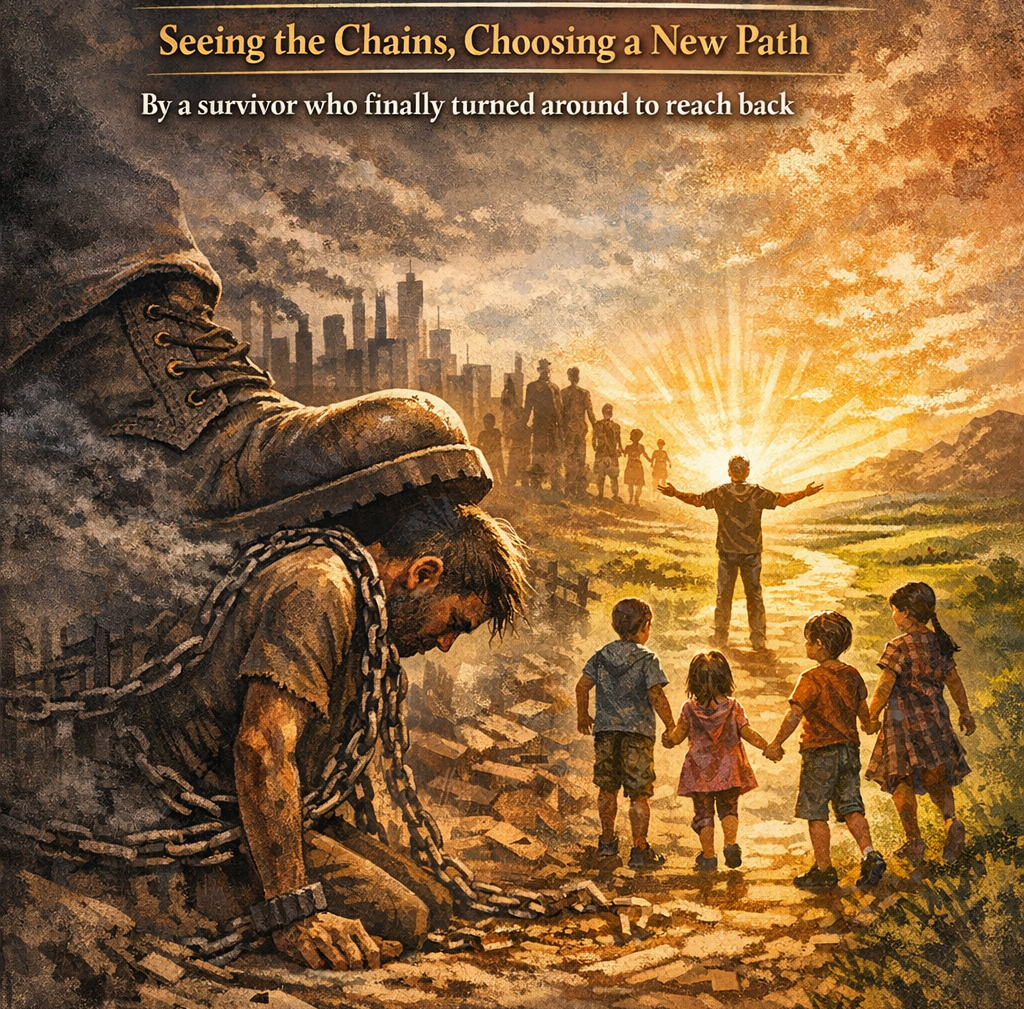
The Eternal Underclass: Seeing the Chains, Choosing a New Path
By Vincent Cordova · 3/9/2026
The Eternal Underclass: Seeing the Chains, Choosing a New Path
By a survivor who finally turned around to reach back
Vincent Cordova
________________________________________
The Oldest Story
Look around. Look closely at the society we have built, not with bricks and mortar, but with systems and habits passed down through generations like a cursed heirloom. For five hundred years, the stage has been set with the same tragic actors: the few who grow, and the many who are grown upon. We call them different names now—the working poor, the unemployable, the left-behind, the underclass. But the role is the same. It is the role of the foundation, the one whose back is broad enough to bear the weight of an entire civilization, yet who is never allowed to stand up and see the city they hold aloft.
The term "underclass" was first popularized in the 1960s by Swedish economist Gunnar Myrdal, who described it as "a class of unemployed, unemployables, and underemployed, who are more and more hopelessly set apart from the nation at large, and do not share in its life, its ambitions, and its achievements" (Wikipedia, 2016). Sociologist Erik Olin Wright later refined this, defining the underclass as those who are "economically oppressed but not consistently exploited"—meaning they are denied access to the labor market entirely, existing outside the formal economy (Chernomas & Sepehri, 1997).
This is not a new story. It is the oldest story. The creation of an underclass began as a simple, brutal arithmetic. In the transition from feudal estates to mercantile cities, from agrarian serfdom to industrial wage-slavery, a clear and devastating principle took hold: prosperity for some requires a ledger of cost for others. It was codified in things like the English Poor Laws, which distinguished between the "deserving" and "undeserving" poor, creating a moral justification for neglect. It was etched into the hulls of ships that carried the enslaved, and written into the deeds of land stolen from indigenous peoples. The engine of "growth" was built, and its fuel was human beings deemed expendable.
Economists Daron Acemoglu and James Robinson, in their landmark work Why Nations Fail, document this pattern across centuries. They write: "Among countries colonized by European powers during the past 500 years, those that were relatively rich in 1500 are now relatively poor. This reversal reflects changes in the institutions resulting from European colonialism. Europeans were more likely to introduce institutions encouraging investment in regions that were previously poor" (Acemoglu, Johnson & Robinson, 2002). In other words, the places that were stripped and extracted from are the same places still struggling today. The foot has been in place for half a millennium.
________________________________________
The Proof It Has Never Worked
The proof that this system has never worked—that it is fundamentally and eternally broken—is not hidden in dusty archives. It is written in the living, bleeding data of our present day.
In the United Kingdom, the disadvantage gap in education at age 16 widened during the pandemic and shows little sign of closing. In the 2023-24 school year, only 26% of disadvantaged pupils achieved passing grades in GCSE English and maths, compared to 53% of other pupils—a gap of 27 percentage points (Social Mobility Commission, 2025).
Young people from lower working-class backgrounds have a NEET rate (Not in Education, Employment, or Training) of 22%, compared to just 9% for those from higher professional backgrounds. This gap has remained largely unchanged since 2014 (Social Mobility Commission, 2025). For those with disabilities, the pressure multiplies. Among young people from lower working-class backgrounds with disabilities, 44.8% are NEET—compared to just 16.3% of their non-disabled peers from the same background (Social Mobility Commission, 2025).
The gap in attaining higher degrees between socio-economic groups has actually widened over the last decade—from 17.6 to 19.6 percentage points (Social Mobility Commission, 2025). Each generation inherits not opportunity, but a wider chasm.
Globally, the picture is even more stark. Children make up only 30% of the global population, yet they account for more than half of those living in extreme poverty. As of 2024, approximately 412 million children globally live in extreme poverty (UNICEF, 2024). Around 181 million children under five—1 in 4—are experiencing severe food poverty, consuming at most two of eight defined food groups. These children are up to 50% more likely to suffer from life-threatening malnutrition (UNICEF, 2024).
Look at the boom-and-bust cycles of the last five centuries. Each wave of "progress" leaves behind a stagnant tide pool of human potential. We built factories, and when they closed, we blamed the workers for not learning to code. We built an economy on credit and consumption, and when the bubble burst, we blamed the borrowers for being in debt. We created schools in impoverished neighborhoods that are underfunded by design, and then we point to the test scores as proof of a culture of failure. The proof is in the prisons that bulge with the poor, the hospitals that close in low-income districts, and the life expectancy that drops by a decade depending on which side of a highway you were born. For five hundred years, we have been running the same experiment, and for five hundred years, the result has been human devastation. At what point do we admit the hypothesis is wrong?
________________________________________
The Words We Lost
The most insidious cruelty of this system is that it has stolen our very language. It has erased the words we need to describe the experience of being its victim.
Herbert Gans, a sociologist who studied the underclass concept, noted that while early definitions were structural (focusing on economic systems), many journalists and academics later replaced this with a "behavioral conception" that blamed individuals rather than systems (Wikipedia, 2016). This shift in language—from "system failure" to "personal failure"—is itself a form of the silent chains.
We talk about "lack of opportunity" as if opportunity were a seed that randomly falls on barren soil. We talk about "systemic barriers" as if they were merely inconvenient walls, and not the foot pressed firmly on a windpipe.
What are the words for the exhaustion that goes beyond physical tiredness, the spiritual fatigue of knowing that effort bears no fruit? What is the word for the silent, internalized scream of watching your potential be siphoned away not by a malevolent tyrant, but by the invisible, polite machinery of a society that simply doesn't need you to succeed? We call it "poverty," but poverty is a description of a bank account, not of a soul being slowly asphyxiated. We call it "struggling," but that implies a fight with some visibility. This is a war fought in the dark, where the enemy is the air you breathe. The foot on your neck is not a boot you can see and fight; it is the accepted reality that your neck is meant to be there, on the ground, for others to walk on.
________________________________________
Where This Path Leads
If we refuse to change direction, we are not choosing to stand still. There is no static state in the physics of power. If we are not dismantling the machinery of extraction, it is actively dismantling us.
Acemoglu and Robinson's research on extractive systems shows a consistent pattern: they destroy incentives, discourage innovation, and sap talent by creating tilted playing fields. Their historical examples are sobering. South Africa's apartheid caste system robbed 80% of the population of opportunity for nearly a century, and the economy contracted for 15 years before its collapse. Egypt under Mubarak saw 40% of the economy controlled by government and military, with monopolies blocking opportunity for the masses while elites accumulated vast fortunes. In 19th century Austria and Russia, elites blocked railway technologies for fear of revolution, causing economic stagnation while Britain and the US grew rapidly (Cambridge, 2024).
Their conclusion is unambiguous: "States built on exploitation inevitably fail, taking an entire corrupt system down with them and often leading to immense suffering" (Cambridge, 2024).
We are sleepwalking toward the same fate. As the gap between the extractors and the extracted becomes an unbridgeable chasm, society doesn't just become "unequal"—it becomes unrecognizable.
Social trust evaporates entirely. Communities become armed camps. Democracy becomes a hollow ritual—if your vote cannot put food on your table, participation becomes a cruel joke. And most terrifyingly, the very concept of humanity begins to tier. The underclass is no longer seen as "people facing hard times," but as a "burden on society." This dehumanization is the final step before total abandonment. It starts with cutting social services, then with blaming the victims. It moves to policies that criminalize poverty—making it illegal to sleep, to beg, to survive in public.
And who is it aiming for? If you think you are safe because you are currently comfortable, you are its primary target.
This system is not static. It is a glutton. It consumed the labor of the farmer, then the factory worker, then the service employee. Now, with automation and artificial intelligence, it is coming for the "professional" class. The machine of extraction does not care about your degree, your home in the suburbs, or your retirement plan. It cares about efficiency. If it can replace you with code or cheaper labor abroad, it will, and you will find yourself on the other side of the line, wondering how you got there so fast. The system is aiming for everyone who is not actively owning the means of extraction. It is aiming for your children, ensuring they inherit a world where the ladder has been pulled up and the rungs sold for scrap.
When this system fails—and all extractive empires fail—it tries to take everyone down with it. Rome fell, and the rubble buried everyone from the peasant to the oligarch. The Soviet Union collapsed, dragging millions into chaos and poverty. The pattern is always the same: an extractive system creates a small, immensely wealthy elite and a vast, disenfranchised population. It destroys the middle, which is the glue of a stable society. It hollows out institutions until they are just facades. And when the final crisis hits, there is no resilience left. The whole edifice crumbles, and the fallout contaminates everything.
So do not be fooled. This is not a game where you can sit on the sidelines. The foot on the neck of the underclass today is being positioned to step on the throat of the middle class tomorrow.
________________________________________
Part Five: The Children—Especially the Forgotten Ones
If you care about children, you must open your eyes to the bullseye painted on their backs from the moment they are born.
Consider the orphans, the forgotten ones in underfunded institutions, the teenagers who age out of foster care and are handed nothing but a trash bag for their belongings and a boot to the curb on their eighteenth birthday. We celebrate their "independence" as if turning eighteen is a magical wand that transforms a traumatized child into a self-sufficient adult.
In Los Angeles County alone, roughly 1,000 youth age out of foster care each year at 18 (Barger, 2024). Nationally, research shows devastating outcomes: 20% of teens who age out report being homeless within the past two years. 22.4% have been incarcerated. 14.4% received a referral for substance abuse. 12.3% had given birth or fathered a child by ages 18-19 (Barger, 2024). A California Policy Lab study found that one in four foster youth who age out experience homelessness between ages 21 and 23, and 50% are unemployed by age 25 (Barger, 2024).
Think about that child. Think about the double painful truth they carry.
The first pain is the original wound—the abandonment, the loss, the years of institutional living without the unconditional love of a parent. The second pain is the betrayal of a society that looks at them, knows their story, and still expects them to compete on a playing field that was tilted against them before they took their first step. We throw them into the streets at eighteen, homeless and alone, and then we have the audacity to be surprised when the system swallows them whole. They become the underclass not by choice, not by lack of effort, but because we designed a world that had no place for them. We took a child who had already lost everything and ensured they would lose their future too.
This is the final, unforgivable cruelty of the extractive system. It doesn't just target the vulnerable; it targets the most vulnerable among us. It preys on those with no safety net, no advocate, no one to fight for them. And it does so with the cold, mechanical efficiency of a machine that knows no conscience.
________________________________________
My Story—The Foot, the Breaking, and the Rising
I need to pause here and tell you something honest. I am not writing this from a place of comfort. I am not observing the underclass from a safe distance. I was the underclass.
I lived with the foot on my neck before I even had words to describe it. I spent years believing the lies—that I wasn't trying hard enough, that I was broken, that this was just my place in the world. I thought the weight I felt was just... life. I thought struggling was normal. I thought being exhausted, being invisible, being used up—I thought that was just what it meant to exist.
It broke me when I realized the truth. It shattered everything I thought I knew about myself and the world. To see the chains I had been carrying since birth, to understand that the foot was not fate but design—that breaking was the most painful thing I have ever experienced.
But here is what I also learned: breaking is not the end. Breaking is where the light gets in.
And now, standing here on the other side of that breaking, I am not above you. I am not ahead of you. I am not better than you. I am simply someone who turned around to say: I see you. I was you. And there is a way forward, together.
I also have to be honest about something else. There is a foot aimed at me right now for writing these words. I can feel it. It wants me to stop. It wants me to be afraid. It whispers that I am nobody, that my voice doesn't matter, that the system is too big and too old and too strong for someone like me to make a difference.
And you know what? That foot is real. It exists. It has been pressed against my throat before, and it left marks I still carry.
But here is what the foot does not understand: I am not doing this for me.
If I were writing to save myself, to protect my own comfort, to carve out a little piece of safety in a broken world—then yes, the foot would have leverage. It could threaten me. It could remind me of everything I stand to lose. It could press down and I would crumble, because I would be fighting for something small and fragile.
But I am not fighting for me. I am fighting for us. I am fighting for the gift.
________________________________________
The Gift—What the Foot Cannot Touch
The gift of life. The gift of experience. The gift of creation. The gift of simply sitting in the sun and enjoying existence without having to earn the right. These things were not meant to be luxuries for the few. They were built into the design of every human being who has ever drawn breath. They are our inheritance. They are our essence.
And the foot? The foot cannot touch essence.
It can press on my body. It can limit my resources. It can try to make me small. But the part of me that knows I was born to experience wonder, to create something beautiful, to feel joy—that part is untouchable. That part belongs to our Creator. That part has been answering the prayers of the broken for generations. And that part is finally waking up in all of us.
For generations, there have been prayers whispered in the dark. Prayers from the mother who couldn't feed her children. Prayers from the child aging out of a system that never loved them. Prayers from the worker whose back gave out before their hope did. Those prayers did not vanish into nothing. They accumulated. They rose. And now, I believe, they are being answered.
The vision for a better world is not mine. I did not invent it. I am simply lucky enough to feel it stirring. It feels like the Creator looking at the mess we have made and saying, "Enough. I have heard them. It is time." This is not about one person's idea. This is about a collective awakening that has been prayed into existence by millions of broken hearts.
When I speak of this redirection, I am not standing above anyone. I am standing in the exact same place as you. I have my own blind spots, my own fears, my own moments of doubt where I want to say "it is what it is." I am no different. The only thing that has changed is that I have stopped trying to fix everything myself and started trusting that something bigger than me is already fixing it. We are all equally small in the face of our Creator. And we are all equally held. This vision is not mine to claim. It is ours to share.
The foot has no power over what is already free.
________________________________________
The Invitation
So here is what I am asking you to do. Not for me. For you. For all of us.
Stop fighting the foot on its terms. Stop trying to prove you are worthy. Stop believing that your essence can be earned or taken away. It cannot. It was given to you before you were born, and it will be with you long after every system has turned to dust.
The foot only has power over the parts of you that agree to stay on the ground. So stand up. Not in defiance of the foot—that keeps you focused on it. Stand up in remembrance of who you really are. Stand up because you were made for more than survival. Stand up because the same Creator who heard the prayers of the forgotten is now stirring in your chest, reminding you that you were never meant to be fuel for someone else's fire.
You were meant to burn with your own light.
I need you to hear me clearly: I am not on a pedestal. I have no interest in being a leader or a voice above others but beside them. I am simply a person who has been quiet long enough to feel what our Creator has been saying all along. These answers, this redirection, this hope—it is not mine. It is a response to the prayers of the broken, the abandoned, the forgotten. Their cries have been heard. And now we are all being invited to listen, to trust, and to walk together toward something none of us could have built alone. This is for us. All of us. Equally.
The foot will aim. It always does. It aimed at me the moment I started writing, and it will aim at you the moment you start believing. But it cannot touch what we are protecting. It cannot touch the essence. It cannot touch the gift.
And when enough of us remember that—when enough of us stop fighting for ourselves and start fighting for the sacred right of every person to live, to create, to experience joy—the foot will have nowhere left to stand. It will dissolve. Not because we crushed it, but because we outgrew it. We remembered we were never meant to be under anything.
We were meant to be here. Together. Equally. Alive.
And that is worth everything.
________________________________________
The Final Question
If you care about children, protect them by removing the target on their backs. Protect them by refusing to let another orphan age into homelessness, another family age into exhaustion, another soul age into believing they were born to be used.
The double painful truth of the child with no parents, thrown into the streets at eighteen, is the question we must all answer: Will we be the ones who finally stop this? Or will we be the ones who let it continue?
The answer starts now. It starts with you. It starts with remembering that you were never just the ground beneath someone else's feet.
You were always meant to stand.
The time for change is not coming. It is here. It has to be. For their sake. For all our sakes.
________________________________________
Sources and Further Reading
1. Wikipedia contributors. (2016). "Underclass." Wikipedia, The Free Encyclopedia. Archived at Library and Archives Canada. Available at: https://webarchiveweb.wayback.bac-lac.canada.ca/web/20160617031749/https://en.wikipedia.org/wiki/Underclass
2. Chernomas, R., & Sepehri, A. (1997). "The class analysis of poverty: Is the underclass living off the socially available surplus?" International Journal of Health Services, 27(2), 381-383.
3. Acemoglu, D., Johnson, S., & Robinson, J. A. (2002). "Reversal of fortune: Geography and institutions in the making of the modern world income distribution." The Quarterly Journal of Economics, 117(4), 1231-1294. Available at: https://economics.mit.edu/sites/default/files/publications/reversal-of-fortune.pdf
4. Social Mobility Commission. (2025, December 18). "Attainment at age 16." Data.gov.uk. Available at: https://social-mobility.data.gov.uk/intermediate_outcomes/compulsory_school_age_(5_to_16_years)/attainment_at_age_16/3.0
5. Social Mobility Commission. (2025, December 18). "Destinations following the end of compulsory full-time education." Data.gov.uk. Available at: https://social-mobility.data.gov.uk/intermediate_outcomes/routes_into_work_(16_to_29_years)/destinations_following_the_end_of_compulsory_full-time_education/latest
6. Social Mobility Commission. (2025, December 18). "Highest qualification." Data.gov.uk. Available at: https://social-mobility.data.gov.uk/intermediate_outcomes/routes_into_work_(16_to_29_years)/highest_qualification/3.0
7. UNICEF. (2024, June 12). "1 in 4 children globally live in severe child food poverty due to inequity, conflict, and climate crises." United Nations in Armenia. Available at: https://armenia.un.org/en/271637-1-4-children-globally-live-severe-child-food-poverty-due-inequity-conflict-and
8. Barger, K. (2024, July 11). "L.A. County Board of Supervisors boost housing support for youth aging out of foster care." Supervisor Kathryn Barger – LA County District 5. Available at: https://kathrynbarger.lacounty.gov/l-a-county-board-of-supervisors-boost-housing-support-for-youth-aging-out-of-foster-care/
9. Youth Employment Group. (2024, August 30). "Young Person's Guarantee: Youth Employment Group." Youth Employment UK. Available at: https://www.youthemployment.org.uk/youth-employment-guarantee-youth-employment-group/
10. Cambridge, R. (2024, November 22). "Why Nations Fail – Power, Prosperity, and Poverty." 1818 Society. Available at: https://www.wbgalumni.org/why-nations-fail-power-prosperity-and-poverty/
________________________________________
This piece was written by someone who lived the underclass, survived it, and turned around to help others find their way out. It is dedicated to every child aging out alone, every family struggling in silence, and every soul who has ever felt the foot and wondered if they were meant to stand.