This site is under construction - will be ready soon.
The Compass We Were Born With

Campaign design team

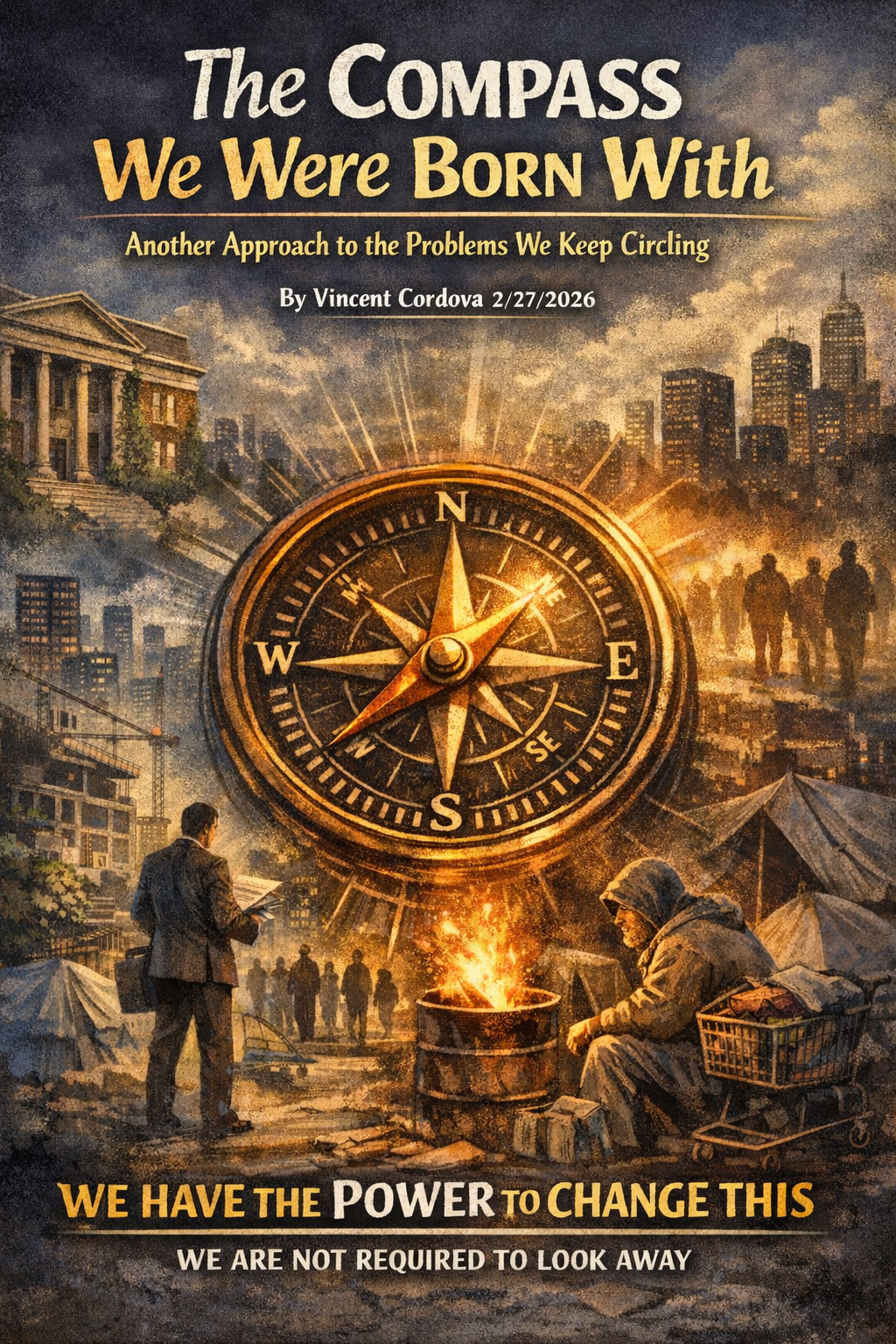
The Compass We Were Born With: Another Approach to the Problems We Keep Circling

By Vincent Cordova · 2/27/2026

I woke up this morning (02/27/2026) with higher education on my mind. Not in the usual way—not thinking about applications, tuition, or career paths. I was thinking about what it's for. What it's actually doing. And whether the people inside it see what's happening outside its walls. Because outside those walls, right now, in the United States, more than 770,000 people are experiencing homelessness. By the end of this year, that number is projected to hit one million. And I couldn't stop asking: If we have one of the strongest education systems in the world, why aren't we using it to stop this? I'm not saying this to claim I'm above anyone. I'm not. I'm just someone who noticed something that felt wrong—and couldn't look away. The Compass We're Born With Here's what I've come to believe: every single one of us is born with an internal compass. You see it in young children. A toddler watches another child fall and cry, and something in them moves toward that child. They don't need a lecture on empathy. They don't need a textbook. They just feel it. They know: that person is hurting, and I should help. That's the compass. And it's real. But somewhere along the way, the world starts messing with it. We're told we're too sensitive. We learn that caring too much is a weakness. We walk past suffering so many times that eventually, we stop really seeing it. And the systems we've built—especially education—sometimes accelerate this dulling. What If Education Is Part of the Problem? This is the hard question I've been sitting with. We've built an education system that rewards rising above. The goal is to be smarter, to be better, to graduate into a life separate from the struggle. And in doing so, we've trained generations of people to see suffering not as something to sit with, but as something to study from a safe distance. Homelessness becomes a research topic. Poverty becomes a data set. Human beings become "case studies." And all the while, the problems don't get solved. They just get circled. Again. And again. What if education, for all its promise, has also become a tool of stratification? What if it teaches us to look down on life rather than be part of it? I'm not saying this to blame educators or students. Most people are doing the best they can inside a system that was built long before any of us arrived. But I am saying: maybe it's time to ask whether that system is working the way we need it to. The Narcissism Question: What We're Actually Creating Here's where it gets even harder to look away. I've been sitting with a question that cuts deeper than any other: Is narcissism something people are born with, or something the world makes of them? And if it's made—if we are creating the conditions for it—then what are we doing to 770,000 + people every night by ignoring them? What are we asking them to become, just to survive? What the Research Tells Us The science is clear: narcissism isn't just something people are. It's something that develops in response to the world around them. A major 2025 study across 48 countries found something remarkable: harsh or unpredictable environments—places with lower life expectancy, disaster exposure, and income inequality—were directly associated with elevated narcissism and other "Dark Triad" traits. When the world is unsafe, people adapt. They become more self-focused. More protective. More willing to put themselves first because no one else will. This isn't pathology. This is survival. Other research has found that childhood trauma—experiences like violence, abuse, or witnessing family harm—predicts higher rates of narcissism and psychopathy in adulthood. The body remembers. The psyche adapts. And the world calls it "personality disorder" without asking what caused the adaptation. The Empathy Question Here's what makes this even more painful: narcissism, at its core, involves deficits in empathy. Neuroimaging shows dysfunction in the brain regions responsible for understanding others' emotions. But here's what the research doesn't always say out loud: those brain changes don't happen in a vacuum. They happen when empathy becomes dangerous. When caring too much gets you hurt. When the only way to survive is to stop feeling. And Then There's Homelessness This is where our question becomes unbearable—and undeniable. A 2024 systematic review of trauma during homelessness, co-produced with people who've lived it, found something devastating: trauma is both a cause and a consequence of homelessness. People don't just arrive on the streets broken. The streets break them further. The review found that trauma during homelessness amplifies everything. It shapes not only how people understand themselves, but how they relate to others and to society. The longer someone is homeless, the worse the mental health impacts become. And yet, we walk past. We look away. We blame. The Question We Should Be Asking If you were ignored every night. If your existence was treated as a nuisance rather than a crisis. If the systems meant to help instead studied you, blamed you, or simply turned away—what would you become to survive? The research on stigma is clear: society actively manufactures the conditions that keep people homeless, then blames them for it. Studies show that public portrayals frame homelessness as an individual failing—laziness, bad choices, moral weakness—while the structural drivers (rising rents, stagnant wages, treating housing as profit rather than right) remain invisible. This stigma trickles down. It becomes internalized. People start to believe they are the problem. And in that crucible of rejection, what grows? What can grow? The research suggests that in harsh, unpredictable environments, narcissistic traits emerge as adaptations. When the world proves again and again that it will not care for you, caring for others becomes a liability. Self-focus becomes survival. Disconnection becomes protection. So no—I don't think people experiencing homelessness "become narcissists" in the clinical sense, as a monolith. But I do think we are creating the conditions that demand self-preservation above all else. And then we pathologize the result. Every Condition of Suffering Benefits Someone Else (Read that again) Every Condition of Suffering Benefits Someone Else This is the part that keeps me up at night: every condition of suffering benefits someone else. The real estate industry profits from housing scarcity. Systems of policing and surveillance expand as homelessness "problems" need managing. Even institutions that exist to help can become industries around suffering rather than solutions to it. And here's the hardest part: our education system has the proof. It has the research. It has the studies. And it still chooses to be the observer. Universities house entire departments dedicated to studying poverty, homelessness, trauma, and narcissism. They publish papers. They host conferences. They train generations of students to analyze these problems from every angle. And yet, outside their walls, the numbers climb. The suffering deepens. The conditions that create narcissism persist. We have the proof. We know what's happening. And we keep observing instead of acting. The Full Circle: Who Manages the Institutions That Study Suffering? Here's the question that brings everything into focus: Who sits on the boards that govern our universities? Who manages the endowments? Who profits from the partnerships? And what relationship do those people and firms have to the conditions that create—and benefit from—an underclass? The Corporate Capture of University Governance Across the United States and internationally, university governing bodies have undergone a quiet transformation. Collegial decision-making—rooted in academic expertise and democratic representation—has been replaced by corporate governance models emphasizing market competition, managerial authority, and financial performance. The numbers tell the story: in many public universities, fewer than 25% of governing body members are now elected by staff or students. The majority are appointed—and over half come from industries like mining, consulting, and finance. Fewer than one-third have direct higher education experience. This matters because these aren't neutral actors. They bring corporate priorities to institutions that were founded for public good. And those priorities shape everything: what gets studied, what gets funded, whose suffering becomes visible, and whose remains profitable. Consultants, Contracts, and Conflicts of Interest The same management consulting firms that advise corporations on cost-cutting and efficiency have embedded themselves deeply in higher education. Firms have been described as "feasting on public money" while the people who teach, research, and support students are overworked, underpaid, and exploited. Parliamentary inquiries have documented a troubling pattern: external consultants often have self-interest in ensuring ongoing demand for their services. Even more concerning, university managements sometimes use consultants to distance themselves from unpopular decisions—hiring outside firms to deliver news of layoffs, program closures, or restructuring that leadership doesn't want to own. As one scholar put it, "consultancies and their interests are represented on all sides of the higher education table." They sit on boards. They win contracts. They advise on strategy. And they benefit from the instability their recommendations often create. Universities as Real Estate Developers There's another layer to this circle that's even closer to the homelessness crisis we've been naming. Universities are no longer just educational institutions—they're major real estate players. And their expansion often happens at the expense of the most vulnerable communities. A recent study of Columbia University's expansion into Harlem documented something devastating: the university's real estate practices treated Black and Latinx neighborhoods as "underutilized land" available for development. Columbia collaborated with city, state, and federal governments—along with private industry partners—to experiment with surveillance technologies and create "further nodes of displacement." The justification? Providing limited access to educational programs for young people in the city. The reality? Building university wealth and prestige "upon the backs of residents in Black and Latinx communities" through displacement disguised as development. This pattern repeats across the country. University expansion drives up housing costs. Student housing demand places low-income residents against insurmountable financial barriers. And the institutions that study poverty, homelessness, and inequality become active participants in creating the conditions they claim to analyze. The Non-Profit Industrial Complex Even when universities partner with foundations or non-profits to address homelessness, the relationships are rarely simple. A university can receive grant funding to study homelessness while its endowment is invested in real estate trusts that profit from housing scarcity. It can host conferences on poverty while its governing board includes executives from industries that suppress wages. It can train social workers to serve the underclass while its expansion displaces the communities those workers are meant to help. This isn't to say every partnership is cynical or every researcher complicit. But the structure—the full circle—deserves to be named. The Question We Don't Ask So here's the question that emerges when you follow the money: If the same firms that benefit from the existence of an underclass also sit on the boards that govern our universities—and if those universities then study that underclass, train professionals to manage it, and expand into the neighborhoods where it lives—who exactly is being served? The people on the streets? Or the systems that profit from their presence? The Circle Completes This is what I meant earlier when I said: "I see the underclass being the reason for all this." Not because they are the reason. But because their existence becomes the justification. The underclass justifies research grants. It justifies consulting contracts. It justifies expansion into "underutilized" neighborhoods. It justifies programs, policies, and professions. It justifies the entire apparatus of study and management—while the people at the center remain unhoused, unseen, and unhelped. And the institutions that could change this? They have the proof. They have the research. They have the scholars. And they still choose to be the observer. Because observation, it turns out, is profitable. And action would require dismantling the very structures that keep the system running. The Harsh Truth: This Is Not an Accident Here's the part that's hardest to say—and hardest to hear: None of this is an accident. The 770,000 people sleeping outside tonight? Not an accident. The million more projected by year's end? Not an accident. The education system that produces study after study while suffering climbs? Not an accident. The university boards filled with executives from industries that profit from poverty? Not an accident. The consulting firms that advise on "efficiency" while people are laid off and communities are displaced? Not an accident. The real estate development that pushes low-income residents further to the margins so institutions can expand? Not an accident. The manufacturing of conditions that break empathy and demand self-preservation? Not an accident. This is a system. It was built. It is maintained. It is funded. It is governed. And it benefits people—real people with names and addresses and stock portfolios—when it continues. We have to stop softening this. We have to stop using language that makes it sound like a series of unfortunate events. We have to stop pretending that if we just explain it clearly enough, someone in power will finally say, "Oh, I didn't realize—let me fix it." They know. The institutions have the proof. They have the research. They have the scholars. They have the data. They have the case studies. They have everything they need to understand exactly what's happening. And they still choose to be the observer. Because being the observer doesn't require them to change. It doesn't require them to sacrifice. It doesn't require them to dismantle the very structures that fund their endowments, fill their boards, and expand their footprints. Observation is comfortable. Action is costly. And as long as the people suffering remain invisible, as long as their voices remain unheard, as long as their existence remains a "problem to be studied" rather than a cry to be answered—the system continues. This is the harsh truth. But it is not the whole truth. The Breaking I'll be honest with you: sitting with all of this broke something in me. Not in a way that left me numb—but in a way that shattered what I thought I knew. I lost myself for a while. I looked at the world and saw, for the first time, how much of it had been built to keep people in—in poverty, in struggle, in separation—for someone else's benefit. Every condition of suffering, benefiting someone else. Every system designed to observe, not to change. Every person on the street, a justification for something. And I realized: this breaking isn't accidental. The world can break your empathy on purpose. It can grind you down until you stop feeling, stop caring, stop asking questions. And then it rewards you for being broken. But here's what I also learned: that breaking doesn't have to be the end. For me, it became a beginning. Because out of the shattering came a question I couldn't let go of: How do I make sure this doesn't happen to someone else? The Power We Hold Because here's what the system forgets: We are not required to keep participating. We are not required to keep looking away. We are not required to keep trusting institutions that have proven they will not act. We are not required to keep waiting for permission from the people who benefit from the breaking. The power to change this does not live in boardrooms. It does not live in consulting firms. It does not live in university administrations or real estate developments or non-profit industrial complexes. The power to change this lives in us. In the people who refuse to stop feeling. In the people who refuse to be broken into numbness. In the people who look at 770,000 suffering humans and say: "This ends with me." Not because we have all the answers. Not because we're smarter or better or more qualified. But because we still have our compass. Because we still know, deep down, that this is wrong. Because we still believe that another way is possible. And when we come together—when we stop acting as isolated individuals and start moving as a connected whole—we become something the system cannot ignore. We become the evidence that empathy wasn't destroyed. We become the proof that another way exists. We become the gathering that the institutions feared all along. Another Approach I don't want people to break the way I did. But I do want people to wake up. And I think there's another way to get there—one that doesn't require destruction, but invites transformation. What if we measured education not by how many graduates it produces, but by how much suffering it reduces in its community? What if we taught students not just to analyze problems, but to sit beside the people experiencing them and listen? What if we stopped treating poverty as a complex issue to be studied, and started treating it as what it often is: a manufactured condition, designed to benefit some at the expense of others? What if we demanded that the institutions holding the proof stop observing and start acting? What if we saw every person—the ones on the street, the ones in the shelters, the ones we've been taught to walk past—as someone's child? Because here's the thing: if that was your child out there, you wouldn't study them. You wouldn't write papers about them. You wouldn't walk past. You'd help. And there should be no difference. We are all connected. We are all someone's child. We are all, in ways we've forgotten how to feel, one. What Lives on the Other Side I believe—I know—that there's abundance waiting for us on the other side of all this. Not abundance for a few. Not scarcity dressed up as success. But enough. Enough for everyone. Enough for you. Enough for the person you've been trained to ignore. Enough for the 770,000 people who tonight will sleep without shelter. But we'll never reach it as long as we keep building walls between us. As long as we keep believing that some people are meant to rise and others are meant to struggle. As long as we let our empathy be broken. As long as we allow institutions to profit from observation while suffering continues outside their doors. The compass is still there. Inside every single one of us. It might be buried. It might be faint. But it's pointing. The question is: will we follow it? A Gathering Here's what I know with certainty now: We cannot do this alone. And we were never meant to. The change that's needed—the real change—requires all of us. Not just the experts. Not just the advocates. Not just the people with degrees and platforms. The 770,000 + people suffering today must be part of this coming together. Not as case studies. Not as problems to be solved. But as full participants in imagining and building what comes next. They have wisdom the institutions will never have. They have survival knowledge no textbook contains. They have been broken by the same systems that trained the rest of us to look away. We need them. And they need us to finally, truly see them. This isn't about charity. It's about belonging. It's about recognizing that their liberation and ours are tied together. Because as long as any of us can be made invisible, all of us are at risk. As long as suffering benefits someone, all of us are complicit. So I'm not offering a solution today. I'm offering an invitation. An invitation to sit with your own compass. An invitation to ask who you've been trained not to see. An invitation to refuse the role of observer. An invitation to come together—across every divide that's been built between us. Because when we come together, we can change this. Not someday. Not when the conditions are perfect. But now. Together. Including everyone. And on the other side of that gathering—on the other side of our willingness to finally act on what we know—there is an abundant future waiting. A future where no one's empathy needs to be broken for them to survive. A future where education connects us rather than separates us. A future where housing is a right, not a commodity. A future where we measure success not by what we accumulate, but by who we lift. That future is possible. It is waiting. And it includes every single one of us—especially the 770,000 we've been taught to ignore. The compass is pointing. Will we follow it—together? Nothing is going to fall apart; we have each other to make sure it doesn’t. People have created everything in this world today and we can make changes together for a better tomorrow, future for our children and especially the next generations. We have each other (every single one of us)!!! No change will ever occur that is truly beneficial when we are divided... References The Manufacturing of Narcissism & Dark Traits 1. Jonason, P. K., Gruda, D., & van Vugt, M. (2025). Towards an ecological model of the dark triad traits: Cross-national evidence for harsh environments shaping narcissism, Machiavellianism, and psychopathy. Evolution and Human Behavior, 46(6), 106780. · Key finding: This study of 11,504 participants across 48 countries found that harsh or unpredictable ecologies—including lower life expectancy, disaster exposure, and income inequality—were directly associated with elevated Dark Triad personality traits. The research demonstrates that these traits can be understood as adaptations to difficult environments rather than simply individual pathologies. 2. Zettler, I., et al. (2025). Global analysis of dark personality traits across 183 countries. University of Copenhagen / World Bank Integrated Study. · Key finding: Nearly 2 million participants across 183 countries and all 50 U.S. states were assessed for the "Dark Factor" of personality. Countries with high corruption, inequality, poverty, and violence showed significantly higher concentrations of dark traits. Conversely, nations with strong institutions and low corruption exhibited fewer such traits. The study concludes that "build better societies and you may cultivate better human behavior." Trauma, Homelessness, and the Breaking of People 3. Adams, E. A., Brennan-Tovey, K., McGrath, J., et al. (2024). A co-produced international qualitative systematic review on lived experiences of trauma during homelessness in adulthood and impacts on mental health. Trauma, Violence, & Abuse, 26(3), 510–527. · Key finding: This systematic review, co-produced with people who have lived experience of homelessness, analyzed 26 papers covering over 900 individuals. It found that trauma is both a cause AND a consequence of homelessness. Three overarching themes emerged: (1) making sense of homelessness as trauma, (2) dealing with the impacts of trauma, and (3) responses to repeated exposure to trauma. Critically, the review found that trauma during homelessness amplifies everything—shaping not only how people understand themselves but how they relate to others and to society. The mental health impacts worsen the longer someone remains homeless. 4. Substance Abuse and Mental Health Services Administration (SAMHSA). (2014). SAMHSA's concept of trauma and guidance for a trauma-informed approach. · Key finding: Establishes the "Three E's" of trauma: Event, Experience, and Effect. This framework helps understand how the same event can affect individuals differently based on their subjective experience—supporting the argument that the experience of being ignored, stigmatized, and made invisible is itself traumatic. 5. FEANTSA (European Federation of National Organisations Working with the Homeless). (2017). Recognising the link between trauma and homelessness. · Key finding: Identifies three ways trauma is interlinked with homelessness: (1) prior trauma increases risk of homelessness, (2) while homeless, people are more likely to experience new trauma, and (3) the experience of losing one's home is itself traumatic. Corporate Governance, Consultants, and University Complicity 6. Frew, J. (2025). Counting what doesn't count: How consultants are hollowing out the university. Pearls and Irritations. · Key finding: Documents how universities have shifted from public institutions to corporate entities, with vice-chancellors becoming "CEOs," faculties becoming "portfolios," and education becoming a "product." Consultants from KPMG, Nous, EY, and PwC now design restructures, charging up to $2,850 per day. The article argues that "consultant logic inverts the moral order"—using the language of care, well-being, and transformation to advance the logic of control. 7. Lucas, A., & Guthrie, J. (2025). Reining in the consultant culture in Australia's public universities. Pearls and Irritations. · Key finding: Australian public universities spent more than $734 million on consultants in 2023 alone (likely closer to $1 billion unreported). Of 545 university council members, 143 come from private for-profit industries, including major consultancy firms. Many of these same firms serve as auditors to the same institutions—creating clear conflicts of interest. The article documents how consultants often under-price initial work ("loss leader" bidding) to gain entry, then embed themselves in future planning cycles, creating dependency. 8. National Tertiary Education Union (NTEU). (2023). Consultancy spending in Australian public universities. · Key finding: Documented specific institutional spending: University of Melbourne ($290 million on consultants in 2018-19), UNSW ($192 million), University of Sydney ($167 million), and University of Wollongong ($30 million). These expenditures occurred while redundancies were imposed on academic staff. Universities as Real Estate Developers & Displacement 9. Oppio, A., Bottero, M., Stanghellini, S., & Rossitti, M. (2025). Local economic systems and housing real estate markets in university towns. In Investing in University Cities: Sustainability and Urban Regeneration. Springer Nature. · Key finding: Documents how increasing student mobility to university towns creates housing demand that "places students' families and low-income residents against important financial barriers." Universities are no longer just educational institutions but major real estate players whose expansion affects housing affordability. 10. Columbia University expansion impact studies (referenced in multiple sources). · Key finding: University expansion into Harlem treated Black and Latinx neighborhoods as "underutilized land" available for development. University-community partnerships with city, state, and federal governments created "further nodes of displacement" while justifying expansion through limited educational access promises. Social Construction of Homelessness & Stigma 11. Van Loon, C., Oudshoorn, A., Mantler, T., Gittings, L., Kerman, N., & Ariba, O. (2025). Rethinking homelessness: A scoping review of social constructions and meanings. Taylor & Francis Online. · Key finding: This scoping review of 95 articles from Australia, Canada, and the United States examined how definitions of homelessness are not neutral but shaped by societal values and systemic biases. Four key themes emerged: (1) the material dominance in defining home, (2) identity assassination (how labels harm those labeled), (3) self-determination as a policy metric, and (4) navigating space for homelessness. The review found that public portrayals frame homelessness as individual failing while structural drivers remain invisible—reinforcing inequality through imposed labels and stigma. 12. Hulchanski, J. D., et al. (2009). Finding home: Policy options for addressing homelessness in Canada. University of Toronto. · Key finding: Documents how the rise of neoliberalism in the 1980s shifted responsibility for housing insecurity from the state to individuals, coinciding with deregulation, urbanization, and gentrification that significantly reduced affordable housing. 13. Thistle, J. (2017). Indigenous definition of homelessness in Canada. Canadian Observatory on Homelessness. · Key finding: Dominant frameworks of homelessness, shaped by capitalism and colonialism, obscure Indigenous understandings of land and home—emphasizing private ownership while ignoring land theft and systemic inequality as root causes. University Governance Structures 14. University of York. (2024). Corporate governance in higher education and its relationship to academic governance. · Key finding: Explains how university governing bodies borrow directly from corporate governance models used by listed companies. Key committees (audit, risk, nominations, remuneration) mirror corporate structures, and the majority of governing body members are lay members—many from private sector backgrounds—who may prioritize corporate values over academic mission. 15. University of Nairobi. (2025). Corporate governance practices and management functions at the University of Nairobi, Kenya. · Key finding: Demonstrates the global trend toward corporate governance in universities, finding that robust board structures and transparency correlate with improved "management effectiveness"—using corporate metrics to evaluate academic institutions. "A major 2025 study across 48 countries found something remarkable: harsh or unpredictable environments were directly associated with elevated narcissism and other 'Dark Triad' traits . When the world is unsafe, people adapt." Or for the trauma section: *"A 2024 systematic review, co-produced with people who've lived it, found something devastating: trauma is both a cause and a consequence of homelessness ."*