This site is under construction - will be ready soon.

Campaign design team
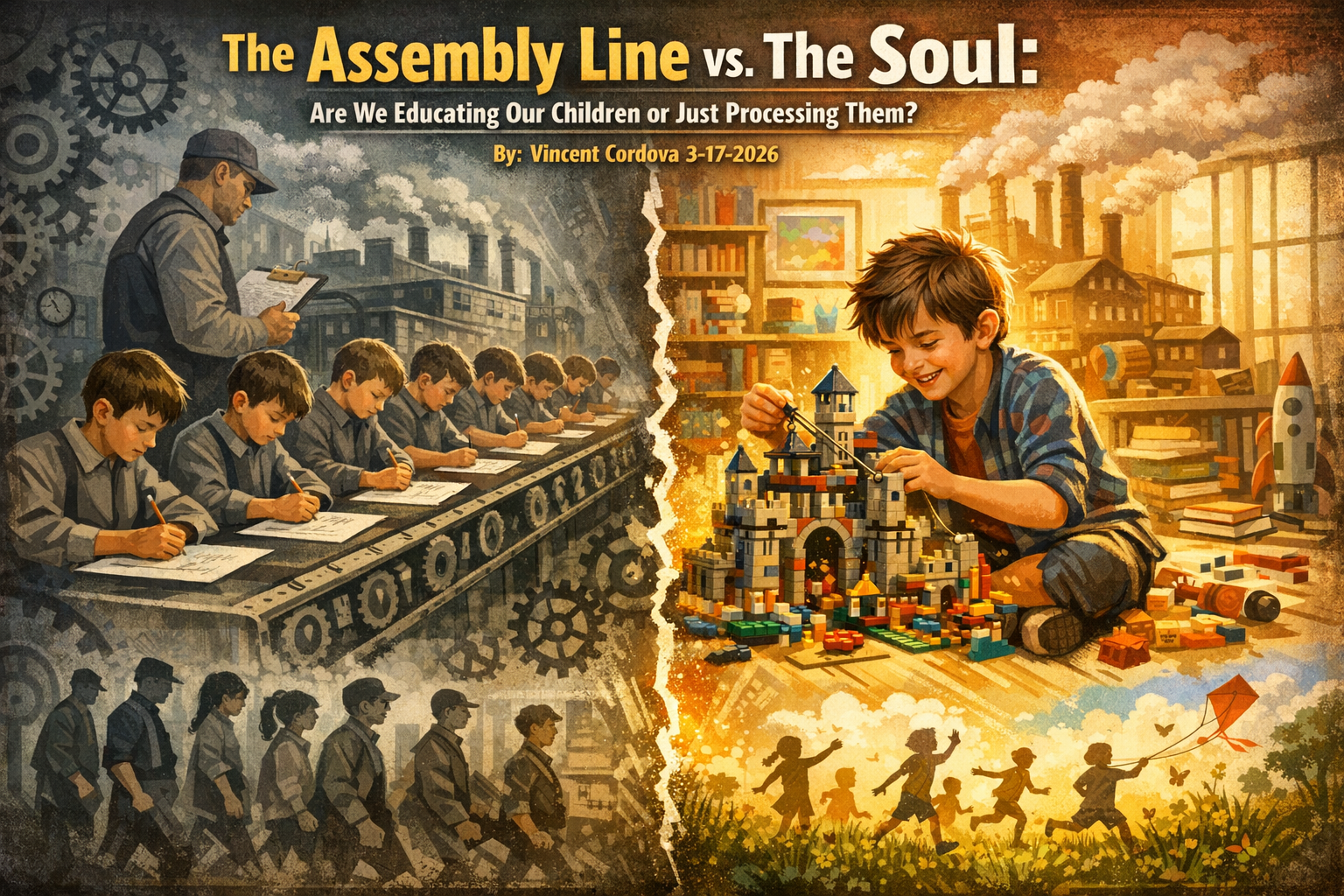
The Assembly Line vs. The Soul: Are We Educating Our Children or Just Processing Them?
By Vincent Cordova · 3/17/2026
A reflection on whether modern education is nurturing whole children or processing future workers.
I am watching our friend's child today—building a Lego set for adults, way above his age. It is a complex ecosystem with a working drawstring pulley system. His face is a mixture of intense focus and unbridled joy. He is creating, problem-solving, and living fully in his imagination.
In this moment, he is pure essence. A child, doing what a child is meant to do.
And then I think about the conversations I overhear—parents stressed about standardized testing, school rankings, and "getting into the right pipeline." The stark contrast hits me like a wave. The Lego set was about the experience; the test is about the ranking. And it forces me to ask a question that has been gnawing at me: What is the real goal of education in America? And more importantly, is that goal aligned with what we, as a society, should want for our children's spirits?
The system wasn't built for every kind of child—and the ones who don't fit it often have their curiosity, voice, and identity suppressed in the process.
I was one of those children.
I don't have children myself. But I don't believe you need to be a parent to care about this. Children are the softest, most vulnerable part of our collective future. They are the whole point—the reason we try to make things better. They are everyone's business, per se. And right now, I'm deeply concerned about the business we're making of them.
Let's get real. Let's look at the raw truth of our system, where it came from, and what we, as a society, are up against.
________________________________________
The Ghost in the Machine: Our Industrial Age Blueprint
If we want to understand why our schools feel less like gardens and more like factories, we have to look at history. The blueprint for America's current public education system was drawn up during the Industrial Revolution. It was a masterpiece of efficiency designed for one purpose: to create factory workers and obedient citizens.
I would call it slave-like, personally. Because who wouldn't want to work together in thinking and building? But they chose workers.
Think about it. The ringing bells, the rigid age-based grading, the compartmentalized subjects, the focus on obedience and conformity. These weren't accidents. They were features. We weren't building a system to nurture individual genius; we were building an assembly line to process human capital. The goal was to churn out workers who would show up on time, follow instructions, and accept their place in the industrial machine.
You could say things are better now. But if our federal government has a minimum wage below $8.00, who is this system really intended for? And how are you going to get people to work for that amount unless they've been trained their whole lives to accept it?
We have come a long way since then, and there is much to be grateful for. We champion universal education, we have incredible teachers fighting the good fight every day, and we celebrate diversity in ways our ancestors couldn't imagine. But the ghost of that industrial machine is still in the room. Its gears grind on in our obsession with standardized testing, our ranking-obsessed culture, and our narrow definition of "success" as a high-paying job.
And then we look outside our borders. We look at places like China, a nation we often view as a competitor, and we see a philosophy that seems radically different. Their ancient Confucian ideals, which still influence their modern approach, speak of educating the whole child—cultivating the mind, disciplining the body, building moral character, and understanding one's role in the community. They speak of creating a well-rounded human being, a thinker in the context of their world. The results, in terms of global rankings and student output, are undeniable.
If we're honest, no country has solved everything. China's output shows what can happen when a nation takes discipline, learning, and long-term development seriously. The United States claims to value creativity and individuality, yet too often places children inside systems built around testing, ranking, and compliance to become workers. The question is not which country has creativity. The question is: which system is truly organized to bring the whole child forward? What if we stopped competing and started learning—combining discipline, imagination, character, and community? That's how you educate the whole child.
This forces a painful question: If they are focusing on the child—mind, body, character, community—and it's working… why aren't we doing it? Why are we still, at our core, operating a system designed to produce workers instead of thinkers?
________________________________________
What Do You Have to Kill to Make a Worker?
This is where the truth gets uncomfortable. If your primary goal is to create a compliant workforce for an extractive system, you cannot have a fully realized, essence-filled human being. You have to break something.
Think about what makes a child magical: their unbridled curiosity, their intrinsic motivation, their creativity, their stubborn sense of justice, their ability to ask "why?" until you're exhausted.
To turn that child into a worker who simply functions within a pre-defined system, what must you actively destroy?
1. You kill their curiosity. You replace "why?" with "because I said so" and "it will be on the test."
2. You kill their passion. You tell them that art, music, and building Lego creations are "extras" or "distractions" from the real work of math and reading scores.
3. You kill their intrinsic motivation. You replace the joy of discovery with the external validation of a gold star, a good grade, or a high rank. You teach them that the point is not to learn, but to perform.
4. You kill their connection to self and community. You isolate them in rows of desks, pitting them against each other for class rank, instead of teaching them the power of collaboration and shared purpose.
5. You kill their voice. You demand obedience and conformity, punishing the child who questions the assignment or challenges authority. You teach them that their perspective doesn't matter. And so far, it hasn't. Sad, because everything we are doing now should be for their future.
I know this because I lived it. I was the child who asked too many questions, who didn't fit neatly into the system. What felt like curiosity to me was treated like disruption. And instead of being developed, I was redirected—eventually ending up in youth homes. Not because I lacked potential, but because the system didn't know what to do with it.
When you systematically strip these things away, you are not just educating a child—you are reshaping them. A system built around standardization and control doesn't have room for every kind of mind. And the children who don't fit—those who question, explore, and push boundaries—often don't get developed. They get corrected.
Over time, that correction becomes quiet compliance. Not because the child lacks potential, but because the system never made space for it.
You are systematically stripping that child of their identity, their curiosity, and their sense of self. They were born out of love, with the gift of life, to experience, to create, and to live. To turn them into a cog is to deny the very purpose of their existence. It is a slave-like condition—not in chains, but in a cage of the spirit, working for a system that values their output more than their soul.
________________________________________
The Great Divide: Politicians' Goals vs. A Child's Needs
This brings us to the heart of the issue. Is there a conflict between what our elected officials want and what our children actually need to thrive?
On paper, politicians talk about "world-class education," "21st-century skills," and "competing in the global marketplace." They measure success by test scores, graduation rates, and economic metrics. The unspoken goal is often still the worker—just a more technologically adept one. The system is designed to benefit the "select few" who own the factories, not the souls who staff them.
But what do children actually need? If we strip away the politics and the rhetoric, if we just watch a child playing in a yard or building a Lego set, what do we see them reaching for?
They need to be seen. They need to be safe. They need to explore. They need to be trusted. They need to fail and try again without shame. They need adults who believe they are more than a future employee.
The system is asking, "How can we make you productive?"
A child's spirit is asking, "How can I become more of who I am?"
These are fundamentally different questions. The system, with its roots in the industrial age and its branches reaching for economic dominance, is trying to shape our children into a resource. But they are not a resource. They are human beings.
________________________________________
A Call for Identification
It is time for us to become fierce identifiers. We must look at any system, any person, any institution, and ask a single, piercing question: Does this feed the child's essence, or does it destroy it?
Does a high-stakes testing regimen feed their essence, or does it create anxiety and stamp out the love of learning?
Does a school board more concerned with budget lines than arts programs feed their essence?
Does a politician who cuts funding for counselors and special needs services to pay for a test-prep program feed their essence?
When we see a policy, a practice, or a priority that systematically crushes curiosity, silences voices, and replaces passion with performance, we must call it what it is. It is a theft. It is a robbery of the potential and beauty that child brought into this world.
Our priorities, as a society, must shift. The goal of education cannot be to produce efficient components for an economic machine. The goal of education must be to cultivate fully realized human beings who will make the world more just, more beautiful, and more alive.
The rankings don't matter if we've won the race but lost our children's souls. The raw truth is that we have a choice. We can continue to run our children through the old industrial machine, hoping they emerge undamaged. Or we can demand a system built for them—for their minds, their bodies, their character, and their community.
A system that sees the child, not the future worker. A system that helps them keep building the fortress of who they are, instead of tearing it down. That is the only kind of education worthy of the gift they are.
And it is on all of us—parents or not—to demand it. Because children are not just someone else's future. They are all of ours.
We cannot coexist with the human species and any extractive system. It will not work, because it is either the human essence survives, or the system extracts that essence for the profit of the few. We are seeing it today.
If that foot was off your neck, what would you have created—instead of being a worker with just enough room to survive? Who would have benefited from your creation? The world.
A country that provides tools without stipulations to allow growth and creation will be a country that succeeds and meets true evolution. That should be a global project—and it will be.
The question isn't whether our children can succeed in the current system. Many do. The real question is: how many are we losing in the process?
How many thinkers are being labeled as problems? How many creators are being told to sit still? How many voices are being quieted before they're ever heard?
The goal of education shouldn't be to produce workers. It should be to develop human beings—fully realized, capable, curious, and alive. And if we're willing to learn, collaborate, and evolve, that future is still within reach.
We are losing a category of human potential—and we don't even realize it.
________________________________________
References
1. The Industrial Revolution Origins of American Education
Your argument that America's education system was designed during the Industrial Revolution to create factory workers is well-documented by educational historians.
Penn State University explains that before the Industrial Revolution, American colleges mainly produced ministers and civic leaders through classical liberal arts education. However, as industrialization matured, universities created programs in engineering and business management to meet industrial demands. The "distribution model" emerged, organizing education into compartmentalized subjects taught within academic departments—directly supporting your "assembly line" metaphor.
Cambridge University Press confirms that the American high school's origins "lodged in two great ramifications of the industrial revolution: the process of urban growth and the ethos to direct it through public education." The opportunity for education was "apportioned according to the structure of social and economic inequality in industrial society," with the emerging middle class capitalizing most on secondary schooling.
2. Current U.S. Education Rankings
Your concern about rankings is supported by recent data showing significant state-by-state disparities.
A 2025 University of Technology Sydney Online study ranked all 50 states on education quality. Texas placed 41st with low SAT/ACT scores, no digital learning plan, and higher pupil-to-teacher ratios. Top states (New Jersey, Massachusetts, New Hampshire) shared characteristics including better funding and lower dropout rates.
Forbes compiled data showing Alabama had the fourth-lowest standardized test performance nationally, with only 22% of 8th-graders proficient in reading. The study noted that states with lower socioeconomic status face challenges including resource allocation to education.
3. Confucian Philosophy and Holistic Education in China
Your observation about China's focus on "mind, body, character, community" is supported by multiple sources.
The Yew Chung Education Network documents how Chinese educational philosophy integrates Confucian values with Western progressivism (especially John Dewey). Their framework explicitly aims to develop "whole persons" through moral education, self-cultivation, and socialization. The twelve tenets include cultivating children as "cross-cultural practitioners" with global awareness and service orientation.
China Daily reports on the growing popularity of Confucian kindergartens across China, where children learn filial piety, respect for teachers, and compassion. One founder explained: "With economic prosperity, the Chinese feel the need for a return to their roots. They also need spiritual elevation." Parents send children to learn "what makes a man, righteousness, social interaction."
4. U.S. vs. China Educational Comparison
Think Academy's comparative analysis confirms your thesis about fundamental philosophical differences:
• China: Emphasizes academic achievement with rigorous schedules, frequent assessments, and the highly competitive Gaokao exam determining university admission.
• U.S.: Leans toward holistic development with project-based learning, extracurricular activities, and social-emotional education.
The analysis notes that China's focus "instills discipline and a strong work ethic but may limit creativity and critical thinking," while the U.S. approach "fosters innovation and interpersonal skills but risks underpreparing students for global competitiveness."
5. Federal Minimum Wage Context
Your point about minimum wage below $8.00 connects education outcomes to economic realities.
Federal Register documents that Executive Order 13658 establishes minimum wage for federal contractors at $13.65 per hour (effective May 2026). Executive Order 14026 (which would have set $15+) was revoked in March 2025.
CalChamber notes this creates complexity where federal contractors may be subject to different wage requirements depending on contract dates—supporting your observation about who the system benefits.
________________________________________
Thank you for reading. The child is still building.