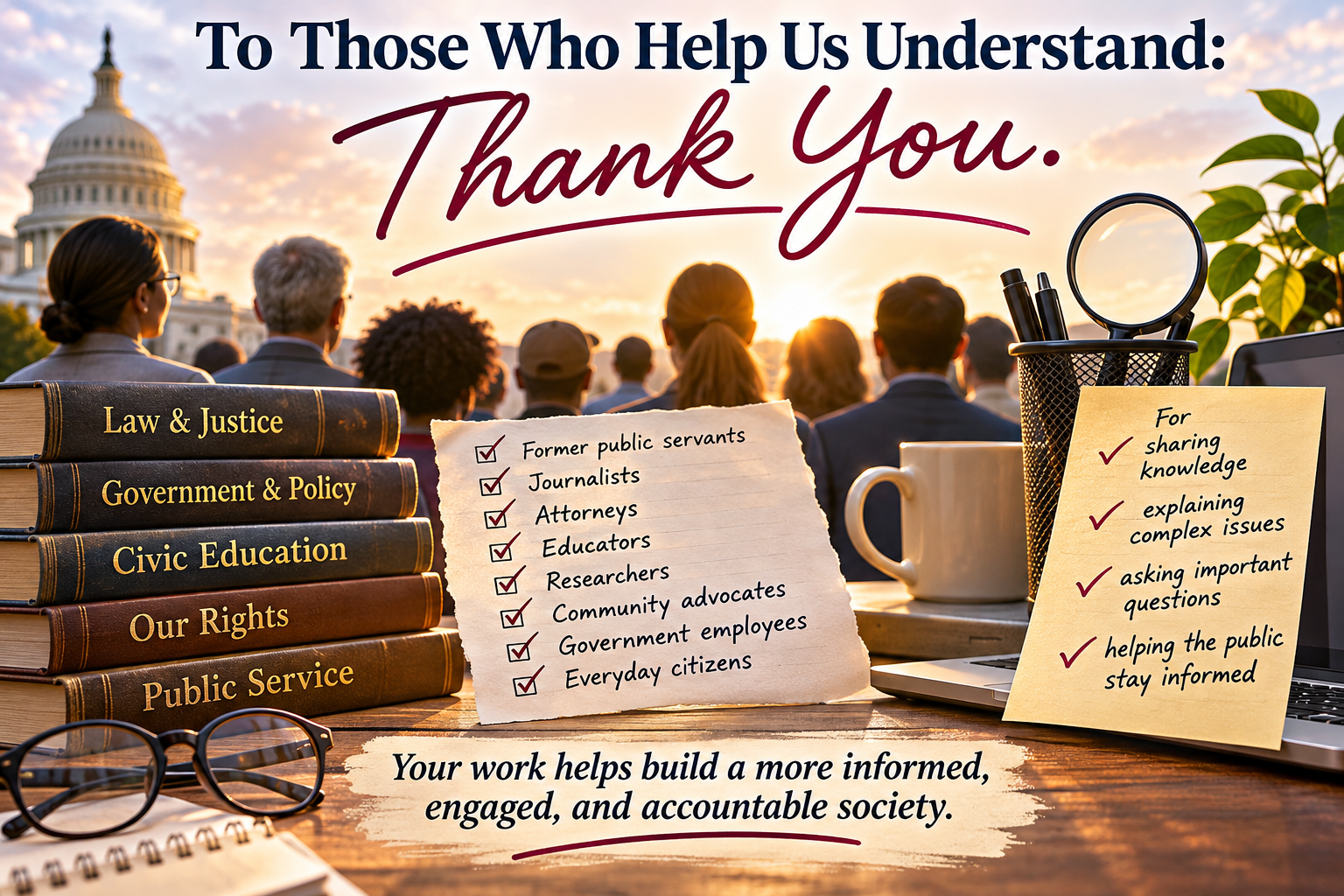
To Those Who Continue Helping the Public Understand:Thank You.
Public service does not always end when someone leaves government. Sometimes, it continues through the knowledge they share, the questions they raise, and the people they help understand the world around them.
By Vincent Cordova · Cordova 2028: Moving Forward Together ·
Illustration by the campaign design team
There are people in this country who continue serving the public long after their official responsibilities have ended.
There are also people whose names we may never know. People working quietly behind the scenes, researching laws, explaining government decisions, examining public records, educating their communities, and helping others understand issues that affect their lives.
Today, I want to take a moment to recognize them.
Not because of their political affiliations.
Not because we necessarily agree on every issue.
And not because they belong to a particular institution.
But because helping people understand the decisions that shape their lives is a meaningful contribution to our shared society.
Law & Justice
Recognizing Liz Oyer and the Value of Public Knowledge
One person I have recently come across is Elizabeth “Liz” Oyer, the former United States Pardon Attorney.
Oyer was appointed to that position in April 2022, following a career that included ten years as a federal public defender. As Pardon Attorney, she helped oversee the federal process for reviewing applications for presidential pardons and commutations.
A career in public service
Elizabeth G. Oyer
1
~10 years
Federal public defender
Representing people who could not afford a lawyer in federal court.
2
April 2022
Appointed U.S. Pardon Attorney
Leads the Justice Department office that reviews clemency petitions and makes recommendations to the President.
3
March 2025
Leaves the Department of Justice
Her government service ends.
4
April 2025 →
Becomes “Lawyer Oyer”
Begins explaining pardons, prosecutions, and the justice system to the public on TikTok and in her newsletter.
Her position placed her within an important part of our justice system, where questions of fairness, accountability, mercy, and executive authority intersect.
FairnessAccountabilityMercyExecutive authority
After leaving the Department of Justice in March 2025, Oyer continued speaking publicly about legal and governmental matters.
Through platforms including TikTok, she shares explanations and perspectives that help members of the public engage with subjects they might otherwise find difficult to understand.
I have encountered some of her videos, and I appreciate her willingness to continue sharing her knowledge.
I do not know her personally. I do not know which political party she supports, and frankly, that is not what matters to me.
What matters is recognizing the value of making knowledge accessible.
That appreciation does not require agreement with every statement or interpretation. Every public claim should remain open to examination, verification, and respectful challenge.
But we can recognize the contribution of someone sharing professional knowledge without turning that recognition into a partisan statement.
Public Service
Public Service Is Bigger Than a Government Position
We often associate public service with elected office, government employment, or an official title.
But service to humanity is not limited to a job description.
Former public servants
A former government employee who explains how an institution operates can continue contributing to the public good.
Journalists
A journalist who investigates a decision affecting thousands of families can help communities understand its consequences.
Attorneys
An attorney who explains constitutional protections can help someone recognize their rights.
Educators
A teacher who encourages students to examine evidence rather than blindly accept conclusions can influence generations.
Everyday citizens
And an ordinary citizen who takes the time to research an issue and share reliable information can help neighbors make informed decisions.
These contributions may look different, but they share something important.
They give people the opportunity to understand the systems that influence their lives.
Knowledge should not be reserved for those who hold power.
Civic Education
To Those Whose Names We May Never Know
This appreciation is not limited to public figures.
There are countless people whose work rarely receives recognition.
Some work within government institutions, carefully carrying out responsibilities that protect the public.
Some identify problems and raise concerns through appropriate channels, even when doing so is difficult.
Some work in nonprofit organizations, legal aid offices, libraries, classrooms, newsrooms, and community organizations.
Others simply spend their own time helping people navigate complicated systems.
They may never receive national attention.
They may never have thousands of followers.
They may never be invited to speak before Congress or appear on television.
Yet their contributions can still change someone’s life.
To those people, I want to say:
We may not know your names, but your work matters.
The person who helps a family understand its housing rights matters.
The person who explains a confusing medical bill matters.
The person who helps a worker understand employment protections matters.
The person who makes government records understandable matters.
The person who asks why a policy is causing harm, and searches for evidence rather than accepting an easy answer, matters.
Every one of these efforts can help build a society where people are better informed and better equipped to participate in decisions affecting their future.
Government & Policy
We Do Not Have to Agree to Appreciate One Another
Somewhere along the way, political affiliation became a reason for people to dismiss information before examining it.
A person’s political identity can become more important to an audience than the evidence that person presents.
That should concern all of us.
We are capable of something better.
We can listen to someone whose political beliefs differ from our own.
We can recognize a contribution without endorsing every opinion.
We can challenge a statement without attacking the humanity of the person making it.
And we can express gratitude without demanding political loyalty in return.
Truth does not belong to a political party.
Neither does the responsibility to seek it.
The important questions should be:
1Is the information accurate?
2Can it be verified?
3What evidence supports it?
4What perspectives or facts might be missing?
5And how does this information affect the people whose lives are shaped by these decisions?
Those questions help us move beyond political identity and toward a more informed society.
Our Rights
Understanding Government Should Never Be a Privilege
Our government makes decisions affecting healthcare, education, housing, employment, public safety, civil rights, and countless other aspects of daily life.
HealthcareEducationHousingEmploymentPublic safetyCivil rights…and countless more
Yet understanding those decisions can require navigating complicated laws, lengthy documents, technical terminology, and institutions that many people have never had the opportunity to study.
That creates an imbalance.
What people are expected to do
People are expected to live under laws and policies they may not fully understand.
They are expected to participate in elections without always having clear explanations of what government agencies do or how particular decisions are made.
And they are expected to hold public officials accountable while sometimes struggling to obtain the information necessary to evaluate their actions.
The gap
How we close it
Public institutions should communicate clearly.
Government records should be accessible.
Civic education should help people understand their rights and responsibilities.
And those with specialized knowledge should be encouraged to explain it in ways ordinary people can understand.
We should be working to close that gap.
An informed public is not a threat to good government.
An informed public is essential to accountable government.
Where anyone can start
Free, public places to read the law, request records, and find help understanding your rights.
Librarians help people find laws, records, and reliable sources, free.
Civic Education
Our Responsibility to Future Generations
Imagine what we could accomplish if every generation grew up understanding not only how government works, but also how to question it responsibly.
Imagine students learning how to…
examine legislation
understand constitutional protections
identify reliable evidence
recognize when a public explanation is incomplete
Imagine students learning how to examine legislation, understand constitutional protections, identify reliable evidence, and recognize when a public explanation is incomplete.
Imagine people being taught that disagreement does not make someone an enemy.
That another person’s heritage, religion, political beliefs, or background does not diminish their human worth.
That we are members of the same human species, sharing a world whose future depends on our ability to learn from one another.
Education should do more than prepare people to participate in the economy.
It should equip them to understand the society they inherit and give them the tools to improve it.
We should want future generations to ask better questions than we asked.
To recognize problems earlier than we did.
And to develop solutions that protect human dignity rather than preserve unnecessary suffering.
That begins with making knowledge accessible and encouraging people to think independently.
Public Service
A Thank You That Extends Beyond Politics
Liz Oyer
To Liz Oyer, thank you for continuing to share your professional knowledge and perspectives with the public.
Thank you.
Former public servants
To former public servants who continue explaining the institutions they once worked within, thank you.
To journalists, attorneys, educators, researchers, and community advocates who help people examine important issues, thank you.
Thank you.
Those still serving
To those still serving within our government who carry out their responsibilities with integrity, thank you.
Thank you.
Those whose names we may never know
And to those working quietly, without recognition, helping others understand their rights, their government, and the decisions affecting their lives: thank you.
Thank you.
We may not agree on everything.
We may come from different backgrounds.
We may hold different beliefs about how our country should move forward.
But none of those differences prevents us from recognizing a meaningful contribution to the public good.
Our shared humanity is greater than our political divisions.
Law & Justice
Closing: Keep Helping People Understand
I hope more people with experience in government, law, education, science, public administration, and other important fields will continue sharing what they know.
Not to tell people what to believe.
Not to demand agreement.
But to provide knowledge, evidence, and understanding that allow people to make informed decisions for themselves.
And I hope we learn to recognize these contributions more often, including when they come from people whose names we may never know.
Because the goal should never be to create a society where everyone thinks alike.
The goal should be to create a society where everyone has a fair opportunity to understand, question, learn, and contribute.
To everyone helping make that possible:
Thank you.
Please keep going.
Our future generations deserve a society that values knowledge, protects independent thought, and recognizes the equal worth of every human being.
And building that society is a responsibility we all share.
Vincent Cordova
Independent Candidate for President of the United States — 2028
Career dates for Liz Oyer: Bloomberg Law and Gizmodo. This post recognizes public knowledge-sharing; it is not an endorsement by or of any person named.