Workers · Wages · Thanksgiving
She Worked to See Her Family for Thanksgiving.Then She Was Made to Pay a Customer's $300 Bill.
An Open Letter to Anna, Restaurant Workers, Employers, and the American People
November 23, 2026 · Vincent Cordova | Independent Candidate for President — 2028
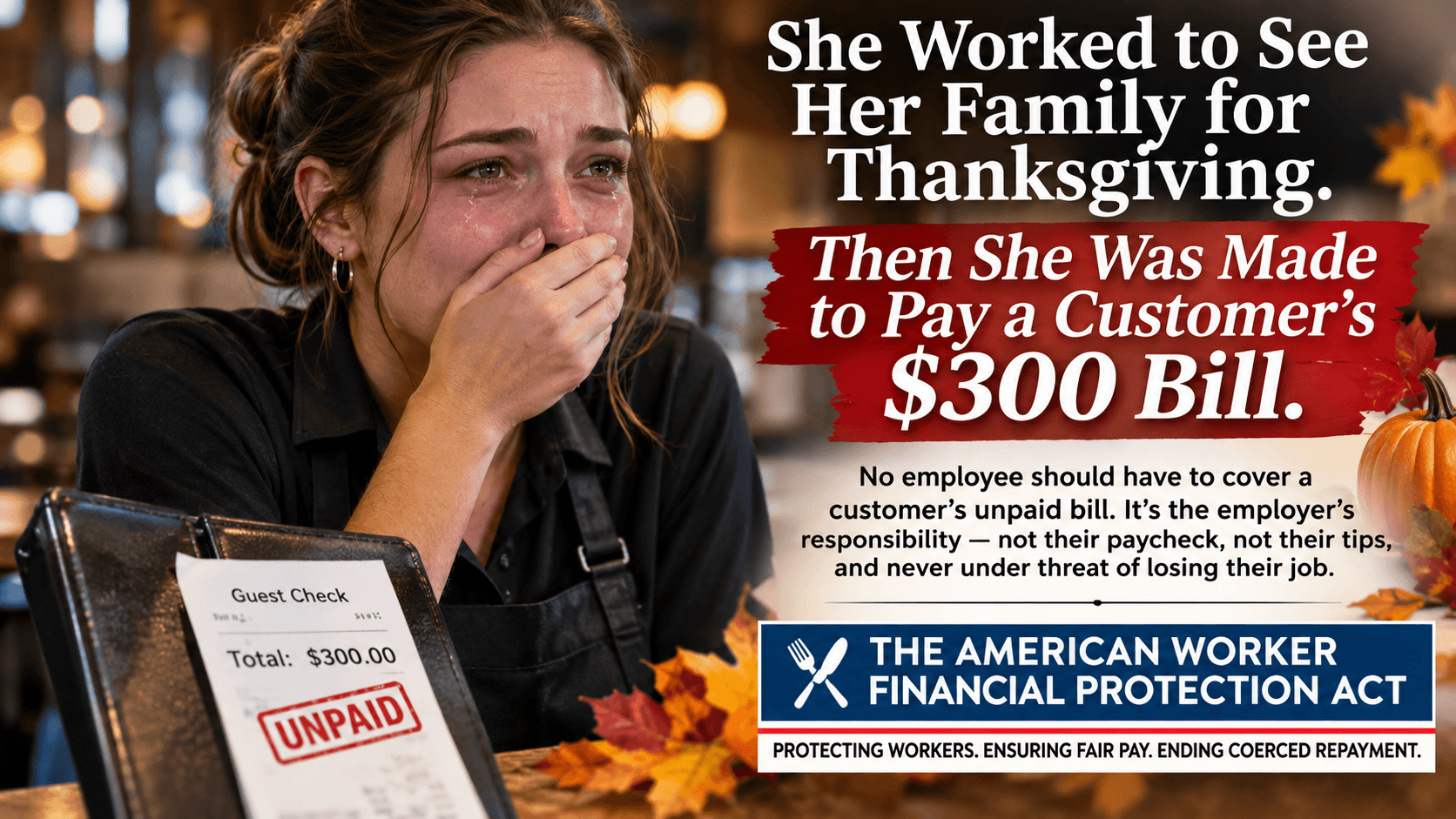
The American Worker Financial Protection Act
Protecting workers. Ensuring fair pay. Ending coerced repayment.
Anna, I Am Sorry.
Today, I watched a video that I believe every employer, policymaker, and American should take a moment to consider.
A restaurant worker named Anna was crying.
She explained that two customers had visited her restaurant for a birthday celebration.
She served their meals.
She sang happy birthday.
She tried to make their experience special.
And then, according to her account, they left without paying their $300 bill.
But that was not the end of what happened.
Anna says she was required to pay that $300 herself.
Money she needed to visit her family for Thanksgiving.
Think about that for a moment.
A young woman went to work, performed her responsibilities, cared for her customers, and tried to make someone's birthday memorable.
And after everything she did, she says she was left paying for the very people she served.
Anna, I am deeply sorry.
I am sorry that you were put in this position.
I am sorry that the money you worked to earn, money you intended to use to see your family, was reportedly taken from you to cover someone else's actions.
And I am sorry that you were made to feel that this financial loss was somehow your responsibility.
You deserved better.
You deserved to finish your shift knowing that the money you earned was yours.
You deserved to look forward to seeing your family without worrying about whether someone's unpaid restaurant bill would prevent you from making that trip.
Your hard work matters.
Your family matters.
And the life you are working to build matters.
You are not responsible for financing someone else's dinner simply because you were the person who served it.
To the Customers Who Left Without Paying
If Anna's account is accurate, your actions had consequences that went far beyond a restaurant losing $300.
Someone was hurt.
Someone who worked to make your experience enjoyable.
Someone who had plans for Thanksgiving.
Someone who needed that money.
I do not know why you left without paying.
I do not know whether you understood what would happen afterward.
But I hope you understand now.
Our decisions affect other human beings.
When we enter a restaurant, the people who welcome us, prepare our meals, serve our food, and clean our tables are not simply there to perform a service.
They are members of our human family.
They have parents, children, spouses, siblings, and people they love.
They have dreams.
They have financial obligations.
And many are working extremely hard just to afford the basic necessities of life.
We should never become so disconnected from one another that we stop considering the consequences of our actions.
If you left without paying, I encourage you to make this right.
Pay the bill.
And consider apologizing to the person who worked so hard to serve you.
But There Is Another Question: Why Was Anna Made Responsible?
The customers' alleged actions are one issue.
The employer's reported response is another.
If Anna was required to cover this unpaid bill, we must ask:
Why would an employer transfer the financial consequences of a customer's actions onto an employee?
Who holds what
- The restaurant establishes its prices.
- The restaurant receives the revenue.
- The restaurant determines its operating procedures.
- The restaurant benefits financially from the employee's labor.
- And the restaurant is responsible for managing the ordinary risks of operating its business.
So why should the person who served the meal become responsible for the unpaid bill?
Employees are hired to perform work.
They are not hired to personally insure their employer against customers who refuse to pay.
A restaurant does not transfer its profits to a server simply because that server provided exceptional service.
It should not automatically transfer its losses to that server, either.
Business profits belong to the business under its ownership arrangements. Ordinary business losses should not become debts imposed on employees.
What Does the Law Actually Say?
Many Americans may be surprised to learn that existing federal and state laws already protect workers against certain practices involving customer walkouts.
But the protections are not uniform across the country.
And some legal distinctions leave employees vulnerable.
Federal Law: Tips Belong to Employees
Under the Fair Labor Standards Act, employers are prohibited from keeping employees' tips for their own purposes.
That protection applies whether or not the employer claims a federal tip credit.
Federal regulations also prohibit deductions for customer walkouts when the employer uses the tip credit, because those deductions would undermine the required minimum wage.
For employees whose employers do not claim a tip credit, federal law generally prohibits business-loss deductions that reduce required minimum-wage or overtime compensation.
However, federal law does not categorically prohibit every business-loss deduction from wages above those protected levels.
That is one reason stronger state protections matter.
A worker should not lose protection simply because they earn more than the minimum wage.
California: Workers Are Protected Against Ordinary Customer Walkouts
California's labor agency explicitly addresses restaurant customers who leave without paying.
Its guidance explains that an employer generally cannot deduct the loss from an employee's paycheck.
California recognizes narrow exceptions involving dishonesty, willful misconduct, or gross negligence, subject to legal requirements.
Ordinary customer nonpayment does not automatically make the employee financially responsible.
New York: Customer Nonpayment Is Specifically Addressed
New York's hospitality wage regulations expressly prohibit deductions resulting from customer nonpayment.
The regulations also prohibit employers from separately charging employees for expenses that cannot lawfully be deducted from wages.
This is particularly important.
An employer should not be allowed to circumvent a legal protection by saying:
"We won't deduct it from your paycheck. You just need to pay us directly."
New York's regulations address that distinction.
Colorado: Unpaid Customer Bills Are Business Losses
Colorado's labor agency identifies unpaid customer bills as business expenses that generally cannot be transferred to employees through wage deductions.
Its guidance also makes clear that prohibited deductions cannot be made lawful simply by requiring employees to make payments outside payroll.
This is the kind of comprehensive protection we want to establish nationwide.
Oregon, New Jersey, and Massachusetts: Strong Restrictions
These states also restrict employers from deducting ordinary business losses and expenses from employees' wages.
Their rules demonstrate that protecting workers while allowing businesses to operate is entirely possible.
The country does not need to invent the concept of protecting workers from ordinary business losses.
Several states already recognize it.
Illinois and Texas: Important Gaps Remain
Illinois restricts deductions and reimbursement demands involving cash or inventory shortages, generally requiring an employee's freely given written consent at the time of the transaction.
Texas generally requires written authorization for lawful wage deductions not otherwise authorized by law.
Both states remain subject to federal minimum-wage and overtime protections.
But this raises an important concern.
How freely can an employee consent to losing money when their employer controls their job and livelihood?
What happens when a worker fears termination?
What happens when an employee is presented with a deduction agreement during onboarding and believes signing is necessary to get the job?
We should examine whether consent mechanisms can be used to transfer ordinary business losses to employees who have little practical power to refuse.
Washington: Protections With Narrow Exceptions
Washington generally restricts deductions for customer walkouts.
Limited deductions from final wages may be allowed under specific circumstances involving dishonest or willful employee conduct.
A customer simply leaving without paying does not establish that the employee acted dishonestly.
These distinctions matter.
And they demonstrate why our proposed national legislation must protect workers while preserving fair procedures for investigating genuinely intentional misconduct.
Labels on each check are the campaign's classifications from the state-law explorer, where 9 of 51 jurisdictions have been researched so far. Not legal advice.
What If Anna Paid With Her Tips?
This is particularly concerning.
We do not yet know whether Anna's $300 was taken from her tips, deducted from wages, or paid directly to the restaurant.
That distinction matters when determining which laws may have been violated.
But under federal law, an employer generally cannot keep employees' tips to cover its business expenses.
If Anna was required to surrender $300 in earned tips to cover a customer walkout, that would raise serious federal wage-law concerns.
Likewise, requiring an employee to pay the employer directly can implicate the law's protections against unlawful wage kickbacks.
The method of collection should never become a loophole for taking money workers are legally entitled to keep.
We believe any employer engaged in these practices should be required to return unlawfully collected money and face appropriate enforcement.
Why Are We Still Allowing Employees to Depend on Tips for Survival?
This incident also exposes a much larger issue in the American economy.
Under federal law, qualifying employers may pay tipped employees as little as $2.13 per hour directly, provided employee tips and employer-paid wages together satisfy the applicable minimum-wage requirements.
Research note · The federal tipped wage, per hour
Many states require higher wages.
But the federal system still permits an arrangement in which an employer relies on customers' tips to satisfy part of its minimum-wage obligation.
Consider what that means.
A restaurant can benefit from an employee's labor while placing part of the responsibility for meeting that employee's minimum compensation on customers.
And when those customers refuse to pay, the employee may be left vulnerable to additional financial pressure.
We should ask ourselves:
Why should the people who make a business successful be among those least financially protected by it?
If a restaurant is consistently profitable, why should its employees still struggle to earn enough to afford housing, healthcare, food, and transportation?
Why should a worker have to depend on the generosity of strangers to afford a visit with their family?
We recognize that many small restaurants face significant financial challenges.
Those businesses deserve to be heard.
We should examine their operating costs, insurance expenses, rent, food costs, and other financial pressures.
But a business struggling financially is not a justification for transferring its ordinary operating losses onto employees.
And a profitable business should not be rewarded for maintaining an unnecessarily low wage structure while workers remain financially insecure.
A fair economy should allow responsible businesses to succeed without requiring employees to sacrifice their financial stability.
Our Commitment: National Worker Financial Protection
As part of our broader American Worker Protection initiative, we intend to develop a proposed federal law:
The American Worker Financial Protection Act
Its purpose will be straightforward.
Protect workers from being forced to personally finance ordinary business losses.
We propose developing the following national protections:
- Order 01
1. Prohibit employee liability for customer walkouts.
An employee should not be required to pay for a customer's unpaid purchase merely because the employee was responsible for serving that customer.
- Order 02
2. Protect earned tips without exception for business losses.
No employer should be permitted to confiscate earned tips to reimburse itself for customer walkouts, cash shortages, or ordinary business expenses.
- Order 03
3. Prohibit indirect reimbursement demands.
Employers should not be allowed to evade the law by requiring employees to pay cash, transfer money electronically, purchase replacement inventory, or reimburse losses outside payroll.
- Order 04
4. Prevent coerced waivers.
An employee should not be required to sign away these protections as a condition of employment.
- Order 05
5. Establish expedited wage recovery.
Workers whose money has been unlawfully collected should have access to a meaningful, timely process for recovering those funds.
- Order 06
6. Protect employees against retaliation.
Workers must be able to report suspected violations without facing unlawful retaliation, intimidation, or punishment.
- Order 07
7. Establish appropriate employer accountability.
Knowing or repeated violations should carry meaningful consequences, including restitution and proportionate penalties.
- Order 08
8. Preserve legitimate investigations of intentional wrongdoing.
The law should distinguish ordinary customer nonpayment from proven theft, fraud, or deliberate employee misconduct.
Employers must have fair processes to address intentional wrongdoing, but those processes should not become excuses for charging innocent employees.
- Order 09
9. Protect stronger existing state laws.
Our national standard must establish a floor of protection, not a ceiling.
States with stronger worker protections must remain free to enforce and expand them.
- Order 10
10. Build the law with the people directly affected.
Restaurant workers, labor advocates, independent restaurant owners, and employment-law specialists should participate directly in developing the final legislation.
We should never design workplace protections without listening to the people who work under those conditions.
We Will Also Address the Federal Tipped-Wage System
The American Worker Financial Protection Act should not be the end of this discussion.
We also intend to examine the federal tipped-wage system as part of our broader commitment to sustainable wages.
Our objective is to establish a compensation structure in which workers receive an adequate employer-paid base wage without having to depend on customer tips to meet basic living expenses.
Tips should represent customer appreciation.
They should not substitute for an employer's fundamental responsibility to compensate employees fairly.
Any proposed transition must be evaluated carefully, including its effects on employment, restaurant prices, independent businesses, and workers' actual take-home earnings.
But maintaining a system simply because it has existed for decades is not sufficient justification.
If the system is leaving working people financially insecure, we have a responsibility to examine how it can be improved.
To Restaurant Owners Across America
We are not approaching this issue as an attack on responsible restaurant owners.
Many of you are working long hours yourselves.
Some are struggling with rent, insurance, equipment costs, and increasingly expensive supplies.
We recognize those challenges.
And we want to hear from you.
But we also need to establish an important boundary.
An employee's paycheck is not an emergency reserve fund for the business.
An employee's tips are not available to cover ordinary operating losses.
And an employee's financial vulnerability should never become an opportunity to shift business expenses onto someone less able to absorb them.
We want businesses to succeed.
We want entrepreneurs to build companies.
We want restaurants to thrive in their communities.
And we want the people working inside those establishments to thrive alongside them.
These goals should not be mutually exclusive.
Anna, Your Experience Should Lead to Meaningful Change
Anna, I hope you receive your $300 back.
I hope you are able to see your family this Thanksgiving.
And I hope you know that your experience has reached someone who believes this is an issue worth addressing.
I cannot promise that a federal law will be changed overnight.
I cannot promise that every employer will immediately recognize the harm these practices can cause.
But I can promise that we intend to examine these laws, listen directly to the people affected, and work toward a national standard that protects employees from this kind of financial burden.
- We will begin by listening.
- We will examine the facts.
- We will work with employees, employers, and legal professionals.
- And we will develop proposals that address the underlying problem rather than simply responding to one incident.
Because the question is not just what happened to Anna.
The question is:
How many other workers have gone home with less money than they earned because someone else refused to pay?
How many have remained silent because they feared losing their jobs?
How many have been told that covering customer losses is simply part of working in a restaurant?
And how many have missed time with their families because money they earned was taken to protect someone else's business?
We need to know.
And we need to act on what we learn.
A Government That Listens — and Proves It With Results
Our responsibility is not to simply acknowledge suffering.
It is to investigate the conditions creating that suffering and determine what can be changed.
If the law protects workers, we must ensure it is enforced.
If the law contains loopholes, we must work to close them.
If a business practice places unnecessary financial burdens on employees, we must ask whether that practice should continue.
And if people are working hard yet still struggling to afford the basic necessities of life, we must examine whether our economic policies are serving the people they were created to represent.
A successful economy should allow people to build meaningful lives.
To raise families.
To pursue their dreams.
To answer their individual callings.
And to enjoy the fruits of their labor.
Anna went to work to earn money so she could see her family.
She should never have had to worry that a customer's unpaid meal could take that opportunity away.
Our work should help us build our lives, not place those lives at the mercy of someone else's actions.
Anna, I hope you have a wonderful Thanksgiving.
And to every worker who has experienced something similar:
We want to hear from you.
Your experiences matter.
Your voices matter.
And your lives matter.
Vincent Cordova
Independent Candidate for President of the United States — 2028
Moving Forward Together.
Share Your Experience
Have you ever been required to pay for a customer who left without paying?
Has an employer deducted money from your wages or tips to cover a business loss?
Were you pressured to reimburse an employer because of a mistake, shortage, or customer complaint?
We invite workers and responsible business owners to share their experiences and proposed solutions.
Our goal is to listen, investigate, and develop meaningful protections.
You do not need to support a political candidate or party to participate.
Please avoid submitting unnecessary sensitive personal information. We will seek permission before publicly identifying anyone who shares their experience.
Research note · If this happened to you
- Keep what you already have: pay stubs, tip records, schedules, and any messages about the bill.
- U.S. Department of Labor, Wage and Hour Division: 1-866-487-9243 · how to file a complaint. Federal law prohibits retaliation for filing one.
- Your state labor office: find it here, or check your state in our state-law explorer.
This is general information, not legal advice. For advice about your situation, contact a licensed attorney or legal aid office.
Legal References
This article discusses existing federal and state protections as of November 23, 2026. Laws vary by jurisdiction and depend on individual circumstances.
Primary references include:
- U.S. Department of Labor — FLSA Fact Sheet #2: Restaurants and Fast Food Establishments.
- U.S. Department of Labor — FLSA Fact Sheet #15: Tipped Employees.
- California Division of Labor Standards Enforcement — Wage Deductions FAQ.
- New York State Department of Labor — Hospitality Industry Wage Order, Section 146-2.7.
- Colorado Department of Labor and Employment — INFO #16, Deductions from Employee Pay.
- Oregon Bureau of Labor and Industries — Paycheck Deductions.
- New Jersey Department of Labor — Wage Payment Law.
- Massachusetts Attorney General — Pay and Recordkeeping.
- Illinois Administrative Code — Section 300.730.
- Texas Workforce Commission — Texas Payday Law.
- Washington Department of Labor & Industries — Paycheck Deductions.
This article is an expression of public-policy positions and does not constitute an allegation of proven legal wrongdoing by any unidentified employer.