Campaign design team
In Color
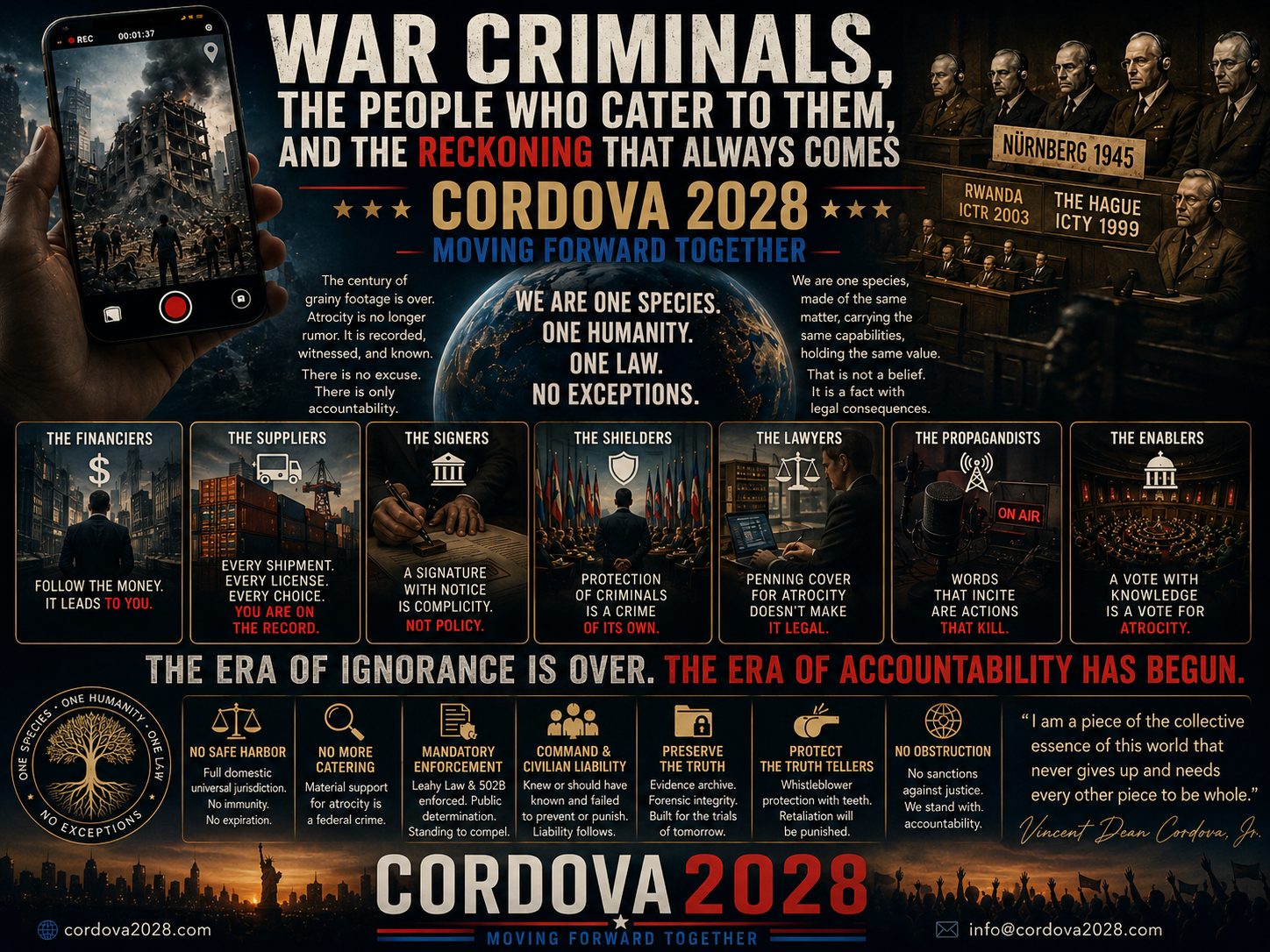
War Criminals, the People Who Cater to Them, and the Reckoning That Always Comes
Cordova 2028 — Moving Forward Together
I. The Century of Grainy Footage Is Over
For most of human history, atrocity arrived as rumor. A traveler's account. A refugee's testimony that could be doubted because it came from a person with an obvious reason to exaggerate. Then it arrived in black and white — newsreels weeks late, photographs of a liberated camp, a still image of a village that no longer existed. Grainy. Distant. Easy for a comfortable person to file away as something that happened to somebody else, somewhere else, in a different kind of place than the one they lived in.
That era is finished.
Atrocity now arrives in color, at full resolution, timestamped and geolocated, uploaded by the people it is happening to, on the same device the viewer uses to order dinner. A person in Manteca can watch a building collapse in real time and see the faces of the people who were inside it. Not a summary. Not a reconstruction. The thing itself.
This is the single most important political fact of our moment, and almost nobody in power has adjusted to it.
The old defense was always the same defense. We did not know. Every commission, every tribunal, every belated apology across the last hundred years has been built on some version of that sentence. It was rarely true even then. It is not available now. The record is being made continuously, by millions of witnesses, on infrastructure no ministry controls, and it does not degrade.
And people are waking up. Not to a slogan — to an image. That is a different kind of waking. A slogan can be argued with. A child's body cannot be argued with. You can only look at it or look away, and looking away is now a choice a person makes knowingly, which means it is now a choice a person can be held to.
That is what the powerful have not understood yet. The evidence is not going to be lost. It is going to be indexed.
II. We Are One Species. That Is Not a Sentiment. It Is a Fact With Legal Consequences.
Before the law, there is the biology, and the biology is not in dispute.
Every human being alive is Homo sapiens. One species. There are no subspecies. The genetic variation between any two individuals is trivial, and more of it exists within the populations people call races than between them. The categories that have justified every mass killing in modern history — race, blood, purity, civilization, "the kind of people who understand only force" — describe nothing that exists in the body. They are administrative fictions invented to make killing easier to organize and easier to live with afterward.
Look at how the rest of life behaves. Wolves do not exterminate wolves as policy. Elephants do not organize the industrial destruction of elephant populations. Every social species on this planet has arrived at the same solution — cooperation within the species, because a species that turns its coordination capacity against itself does not persist. Cooperation is not a moral luxury. It is the survival strategy that produced us.
We are the only species that built the tools to do the opposite at scale, and then built a vocabulary to make it sound necessary.
Whether you believe we were created or that we emerged over four billion years of chemistry finding better arrangements of itself — the conclusion is identical. We are made of the same matter. We carry the same capabilities. A child born anywhere on this planet, placed anywhere else on this planet, becomes fluent in that place. There is no ceiling that comes with the skin. There is no inheritance of worth.
Equal value is not a nice idea we extend to people. It is a description of what they already are.
And this is precisely why the law treats war crimes differently from every other crime.
Ordinary murder is a crime against a person and against the peace of a particular state. That is why an ordinary state can pardon it, expire it, or decline to prosecute it. Crimes against humanity are categorized differently for a structural reason: they are offenses against the species itself. The victim is not only the dead. The victim is the shared status of being human, which the perpetrator has attempted to revoke for a category of people.
That is why these crimes carry no statute of limitations. That is why they can be prosecuted by countries with no connection to the events. That is why holding office is not a shield. Not because lawyers were feeling poetic in 1945, but because if the offense is against everyone, then everyone has standing, and there is nowhere on the surface of the earth that qualifies as away.
The law already agrees with the biology. It has for eighty years. It simply has not been enforced against people with the resources to avoid it.
III. What a War Criminal Actually Is
Let us be precise, because precision is what makes accountability possible and vagueness is what lets it slip.
This is not a moral epithet. It is a defined legal status with elements that have to be proven, established across a body of binding international law:
The Nuremberg Charter and Judgment (1945–46). Established that individuals — not abstractions called "states" — commit these crimes and individuals are punished for them. Twenty-two defendants at the main trial. Twelve subsequent trials.
The Geneva Conventions (1949) and Additional Protocols (1977). Define "grave breaches": willful killing, torture, inhuman treatment, willfully causing great suffering, extensive destruction of property not justified by military necessity, unlawful deportation, taking of hostages. And critically, they obligate every state party to search for persons alleged to have committed grave breaches and either prosecute them or hand them over. Not permit. Obligate.
The Genocide Convention (1948). Article IV states plainly that persons committing genocide shall be punished whether they are constitutionally responsible rulers, public officials, or private individuals. The drafters closed that door on purpose, three years after they watched it be used.
The Convention on Non-Applicability of Statutory Limitations (1968). No expiration. Ever. Regardless of when committed.
The Rome Statute (1998, in force 2002). Codified war crimes, crimes against humanity, genocide, and aggression, and built the standing court to try them.
And layered through all of it are the three doctrines that decide most real cases:
Superior orders is not a defense. Nuremberg Principle IV. Rome Statute Article 33. "I was told to" was tested at the highest level and rejected, and it has been rejected in every serious tribunal since.
Official capacity is not a defense. Rome Statute Article 27. Head of state, head of government, minister, elected representative — the office does not exempt and does not mitigate.
Command responsibility. Rome Statute Article 28. A commander is criminally liable for the crimes of subordinates when they knew or should have known and failed to prevent or punish. You do not have to pull a trigger. You have to fail, knowingly, to stop the triggers you control.
None of this is aspirational. It is black-letter law, ratified by most of the nations on earth, and it has been used to convict.
IV. The Caterers
Here is where this piece earns its title, and here is where most public conversation about war crimes stops short.
Mass atrocity is not committed by monsters acting alone. It is a logistics operation. It requires financing, supply, legal cover, diplomatic protection, media preparation, and administrative processing. It requires a large number of people who never see a body, who go to an office, and who do their jobs well.
Those people have a name in the historical record: the caterers. And the law caught up to them in 1947, not last year.
At the subsequent Nuremberg proceedings, the Allies did not stop at generals. They prosecuted:
- The industrialists. The IG Farben, Krupp, and Flick cases. Executives who supplied and profited from slave labor and materials of extermination. Some were convicted. The principle was set: the boardroom is inside the crime scene.
- The jurists. The Justice Trial — judges and Ministry of Justice officials prosecuted for using the machinery of law itself as an instrument of persecution. Men who never touched a weapon. They signed things.
- The doctors. The Medical Case — professionals who lent scientific legitimacy to atrocity.
- The propagandists. Julius Streicher commanded no soldiers and held no wartime command. He published a newspaper. He was convicted of crimes against humanity and hanged for what he printed, because incitement to extermination is itself a crime, not merely speech about one.
And that principle did not die in the 1940s. In 2003 the International Criminal Tribunal for Rwanda convicted radio and newspaper figures in what became known as the Media Trial, for building the informational conditions of a genocide. Félicien Kabuga, a businessman alleged to have financed the militias and the radio station, spent twenty-six years as a fugitive before being arrested near Paris in 2020.
The Rome Statute carries all of this forward explicitly. Article 25(3)(c) — aiding, abetting, or otherwise assisting in the commission of a crime, including providing the means for its commission. Article 25(3)(d) — contributing to a crime committed by a group acting with common purpose, where the contribution is intentional and made in knowledge of the group's criminal intent.
Read those two provisions again, slowly, and then look at the modern architecture of atrocity:
- The arms supplier who continues shipping after documented use against civilians is on notice
- The financier who processes the transactions
- The official who issues the export license against the recommendations of their own analysts
- The diplomat who blocks the investigation, vetoes the referral, shields from jurisdiction
- The lawyer who writes the memorandum reclassifying the prohibited act as permitted
- The communications professional who builds the public case that this population is not really civilian, not really innocent, not really the same as us
- The legislator who votes the appropriation with the cables on their desk
Every one of those roles has a Nuremberg antecedent. Every one of them is addressable under existing law. What has been missing is not the statute. It has been the will to apply the statute to people with expensive representation and diplomatic passports.
Complicity is not a metaphor here. It is a charge with elements. The most consequential of those elements is knowledge — and we have just established, in Section I, that the era of plausible ignorance is over.
That is the connection people are feeling and haven't been given words for yet. The same technology that removed the "we didn't know" defense for the public also removed it for the enablers. Documented, timestamped, contemporaneous notice, delivered to every desk that matters. The knowledge element is now the easiest element to prove, and it used to be the hardest.
They have not understood what happened to them yet.
V. It Takes Time. It Arrives Anyway.
The most common argument against accountability is not that it would be wrong. It is that it is naïve. Powerful people don't go to prison. That's how the world works. Grow up.
The record says otherwise. It says accountability is slow, uneven, and inconvenient — and that it comes.
- Adolf Eichmann. Escaped to Argentina, lived under an assumed name for a decade. Captured in 1960. Tried, convicted, executed in 1962. Roughly fifteen years.
- Augusto Pinochet. Arrested in London in 1998 on a Spanish warrant. The House of Lords ruled that former head-of-state immunity did not cover torture. Twenty-five years after the coup, in a country that was not his own, on a warrant from a third country.
- Slobodan Milošević. Indicted in 1999 while sitting as a head of state. Transferred to The Hague. Died in custody before judgment — but the indictment of a sitting president stood.
- Charles Taylor. Indicted in 2003 while President of Liberia. Convicted in 2012 by the Special Court for Sierra Leone. Fifty years, being served in a British prison.
- Radovan Karadžić. Thirteen years hiding in plain sight under a false identity. Arrested 2008. Convicted 2016. Life on appeal in 2019.
- Ratko Mladić. Sixteen years a fugitive. Arrested 2011. Convicted 2017. Life.
- Kaing Guek Eav ("Duch"). Khmer Rouge prison commandant. Convicted in 2010, roughly three decades after the fact. Life.
- Hissène Habré. Former President of Chad. Convicted in 2016 by a special court in Senegal — one African nation trying the former leader of another. A landmark for universal jurisdiction. Life.
- Anwar Raslan. Syrian intelligence officer. Convicted in Koblenz, Germany in January 2022 of crimes against humanity, under universal jurisdiction, for conduct in Syria against Syrians. Life.
Look at that last one carefully, because it is the template.
A German court. A Syrian defendant. Syrian victims. Crimes committed in Syria. No German connection at all except that the defendant was present on German soil and Germany had written a statute that let its prosecutors act.
That is the whole model. It does not require a superpower's permission. It does not require a Security Council vote that a permanent member can veto. It requires two things: a country with a domestic universal-jurisdiction statute, and a defendant who eventually gets on a plane.
And they always eventually get on a plane. Regimes fall. Protectors lose elections. Immunity deals are signed by governments that are later replaced by governments that do not feel bound by them. Archives get opened. Deputies get old and decide to talk. The person who was untouchable at fifty-five is a seventy-eight-year-old man in an airport transit lounge holding a passport from a state that has stopped returning his calls.
The powerful mistake a long delay for a permanent exemption. It has never been one.
VI. Closing the Loopholes: The No Safe Harbor Act
Naming a problem without an instrument is a press release. Here is the instrument.
A Cordova administration will pursue the No Safe Harbor Act — a statute built on the assumption that every provision will be attacked by the best lawyers money can hire, and drafted so that each attack fails.
1. Full domestic universal jurisdiction, with no nationality gap. Congress has already proven this is achievable. The Genocide Accountability Act of 2007 extended jurisdiction to offenders present in the United States regardless of nationality. The Justice for Victims of War Crimes Act of 2022 did the same for the War Crimes Act, which had previously required a U.S. national as perpetrator or victim. The precedent exists and passed with bipartisan support. This Act completes the set — war crimes, crimes against humanity, torture, and enforced disappearance — closing every remaining nationality and territoriality gap, and creating a specialized, permanently funded prosecutions unit rather than leaving it to whichever office has capacity that year.
2. Material support for atrocity as a distinct federal offense. We already criminalize material support for terrorism, with a developed body of case law defining knowledge and support. This Act builds a parallel offense for material support of war crimes and crimes against humanity — arms, financing, logistics, targeting assistance, and technical services — with knowledge established by documented notice. If credible reporting, your own agency's assessments, or an international body's findings crossed your desk and you continued, you were on notice. That is not a novel legal theory. It is Nuremberg's industrialist cases with modern drafting.
3. Mandatory enforcement of existing transfer conditions. The Leahy Law and Section 502B of the Foreign Assistance Act already prohibit assistance to units credibly implicated in gross human rights violations. They are routinely waived, slow-walked, or simply not applied. This Act converts discretionary enforcement into mandatory determination on a fixed clock, with the determination and its evidentiary basis published, and with standing for injured parties to compel the determination in court. A law with no enforcement trigger is not a law. It is a statement of preference.
4. Command and civilian-superior responsibility in domestic code. Codifying Rome Statute Article 28 into U.S. law: liability for those who knew or should have known and failed to prevent or punish. This applies to civilian superiors — including contractors and corporate officers — not only to uniformed command.
5. No immunity, no expiration, no amnesty recognition. No statute of limitations, consistent with the 1968 Convention. No recognition of foreign amnesty grants for these offenses. Official capacity is expressly excluded as a defense. Superior orders is expressly excluded as a defense.
6. Evidence preservation as national infrastructure. A federally funded, independently governed atrocity documentation archive with forensic chain-of-custody standards, built to survive administration changes, with statutory protection for the journalists, researchers, and open-source investigators who feed it. Cases fail on evidentiary integrity more often than on law. We build for the trial that happens in 2049.
7. Whistleblower protection with teeth. Absolute protection, criminal penalties for retaliation, and a secure disclosure channel for any official — civilian, military, or contractor — who reports transfers, orders, or operations they reasonably believe implicate atrocity crimes. Half the enablers in history were people who saw it, said nothing, and had a mortgage. Make speaking survivable and the calculus changes.
8. An end to obstruction of accountability bodies. The United States should not be in the business of sanctioning investigators. Whatever position any administration takes on jurisdiction over its own nationals — that is a legitimate debate to have in the open — using economic warfare against courts and prosecutors who are documenting mass killing is not a defense of sovereignty. It is catering.
Enforcement will be tracked through United for Accountability, the same public complaint and legal-action architecture this campaign has built for domestic extraction. Same principle, different scale: documentation, standing, and a filing that a real office has to answer.
VII. What This Is Not
I want to be direct, because this subject attracts people I want no part of.
This is a demand for courtrooms, not for vengeance. Extradition, indictment, defense counsel, rules of evidence, presumption of innocence, appeal. Every person named in Section V got a trial, and some of them beat charges. That is not the system failing. That is the system being the thing we are defending. The moment we accept summary judgment, we have adopted the logic of the people we are prosecuting — that some category of human being may be disposed of without process. There is no version of this where we get there by becoming that.
This is not a claim against a people. Not one. Ever. Governments commit these crimes; populations live under governments. The instant accountability slides into collective blame against a nation, an ethnicity, or a faith, it has stopped being accountability and become the next atrocity's recruitment material. That is the trap, it is set deliberately, and we do not step in it.
This is not a partisan position. The standard applies to allies and adversaries, to governments we like and governments we don't, to our own conduct and everyone else's — or it is not a standard, it is a weapon. A rule you apply only to your enemies is not law. It is targeting. The test of whether you actually believe in accountability is whether you apply it when it costs you something.
VIII. To the Caterers, Specifically
You will not read this as being about you. That is the design of your position. You have a title, a mandate, a chain of approvals above you, and a lawyer who has explained why your particular function sits comfortably inside the permissible.
The industrialists at Nuremberg had all of that too. Every one of them had a memo.
Understand what has actually changed. Not the morality — that has been fixed for a very long time. What changed is the evidentiary environment. Your emails persist. Your approvals are logged. Your agency's own assessments are archived, and someday declassified, and they will show what you were told and when you were told it. The satellite imagery is commercially available. The flight data is public. The transfer records exist in three jurisdictions. The knowledge element — historically the hardest thing for any prosecutor to prove — is being assembled continuously, by people you will never meet, and it does not decay.
You are protected right now by the current arrangement of power. That is a real protection. It is also the least durable thing in the world. Ask the men who ran Chile. Ask the officers of the Syrian intelligence services who were confident their files would never leave the building.
There is a door, and it is still open. Refuse the transfer. Publish the assessment. Resign loudly, on the record, with the reason stated. Preserve the documents. Testify. History has been unusually generous to the people who stopped participating before they were forced to, and unusually unforgiving to the ones who calculated correctly about the next five years and catastrophically about the next thirty.
IX. The Reckoning
I believe a time is coming when the people who ordered these crimes and the people who catered to them will be extradited, tried, and will spend the remainder of their lives in custody — and when the financiers, the suppliers, the license-signers, and the propagandists will be investigated for conspiracy and complicity under laws that already exist and merely await a government willing to use them.
I do not believe this because I am optimistic. I believe it because it is the observable pattern of the last eighty years, running against every prediction that it was naïve, and because the evidentiary conditions that made evasion possible have been permanently destroyed by a technology nobody in power asked for and nobody in power can recall.
Killing your own species is a failure of the species. Encouraging it, normalizing it, financing it, supplying it, or explaining why this particular round of it is regrettable but necessary — that is the same failure, wearing better clothes and drawing a salary.
Every other species that has survived on this planet figured this out. Cooperation within the kind. It is not idealism. It is the only strategy that has ever worked, and the only reason there was anyone here to build any of this in the first place.
We are one species, made of the same matter, carrying the same capabilities, holding the same value. That is not a belief I am asking you to adopt. It is a fact I am asking you to stop making exceptions to.
The world is watching now, in color, and it is not going to unsee it.
I am a piece of the collective essence of this world that never gives up and needs every other piece to be whole.
Vincent Dean Cordova, Jr. — Cordova 2028 cordova2028.com · info@cordova2028.com
Community Comments
Community Comments
Share a public response to this post. Submissions are reviewed before they appear.
0 approved comments
Loading comments...