Campaign design team
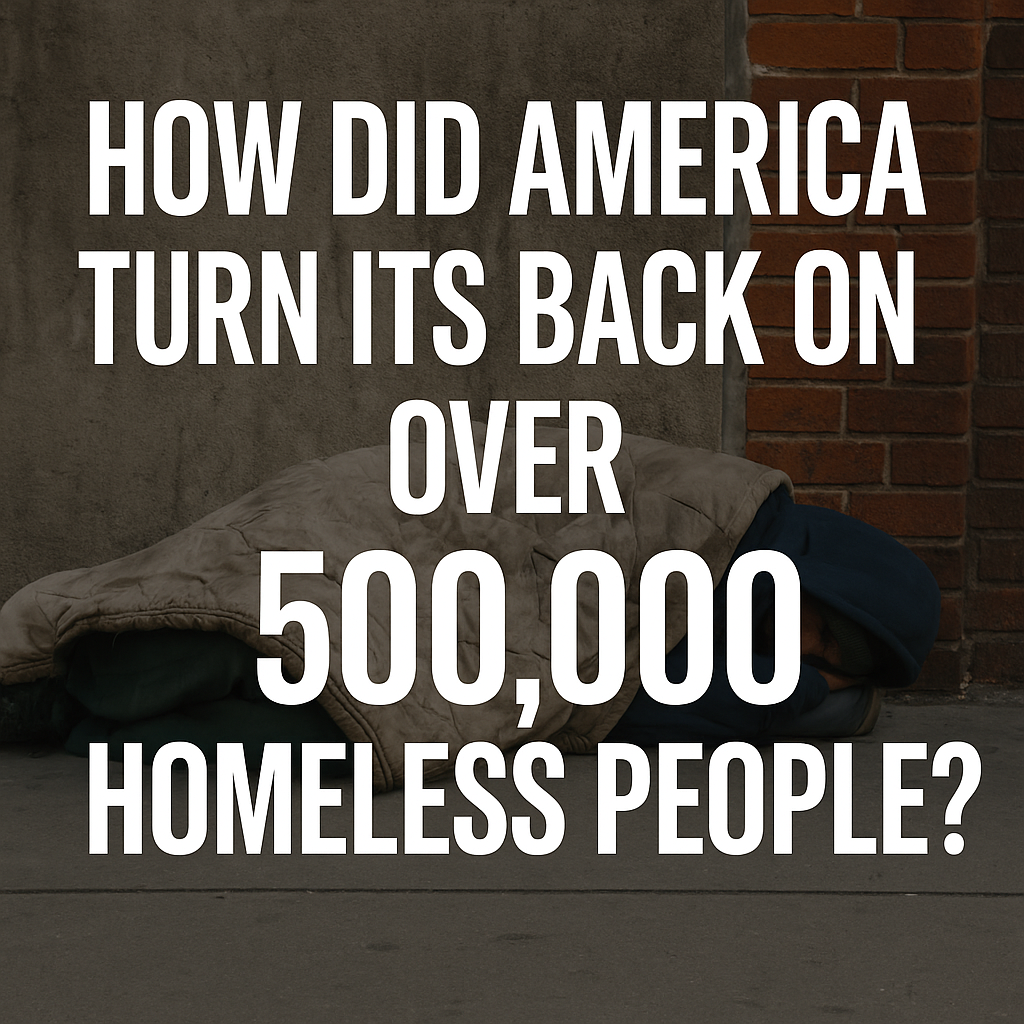
How Did America Turn Its Back on Over 771,480 Homeless People?
By Vincent Cordova · November 23, 2025
By Vincent Cordova · November 23, 2025
A society that walks past nearly 800,000 homeless people every day is a society that has been emotionally shut down.
There are more than 771,000 human beings living outside in America right now—in tents, in cars, behind buildings, in alleys, in parks, under bridges. This is the highest number in modern U.S. history.
And yet, the nation has normalized it. How did we allow this? How did we turn our backs on an entire population of people whose only crime is suffering?
Drugs are not the cause of homelessness; they are a symptom of abandonment. Addiction becomes the excuse to abandon them and the "reason" society allows itself to ignore them.
The system created the conditions that put them there. They are not the problem. They are the result of a system that stopped valuing human beings.
If the system can turn its back on the homeless, it can turn its back on anyone. You, your family, your children—no one is safe when society decides a group is no longer worth protecting.
We are supposed to take care of each other. We are supposed to see each other. We are supposed to lift each other—not step over each other. America forgot that.
And the first step toward change is simple: Start seeing them again. Start caring again. Start feeling again.
The Truth About Homelessness in America (With References)
According to the U.S. Department of Housing and Urban Development (HUD), the most recent point-in-time count shows:
- 771,480 Americans are homeless — the highest number ever recorded.
- Source: HUD, 2024 Annual Homeless Assessment Report (AHAR) — 2024-AHAR-Part-1.pdf
This number is not an estimate from years ago. This is the 2024 federal count, taken on a single night across the United States. But even this number is incomplete. A point-in-time count only captures people who can be located by volunteers on one night. It does not include:
- people sleeping in cars in remote areas
- people temporarily doubling up with strangers
- people who travel from location to location
- people staying in unsafe, unregistered shelters
- people deliberately hiding due to fear
Independent researchers estimate the true annual number is likely 1.2 to 1.5 million Americans experiencing homelessness at some point each year.
These are not statistics. These are people. Human beings with families, memories, dreams, and dignity.
And as the number climbs, something even darker rises with it: Society’s decision to look away. No nation can say it protects children while allowing foster youth to be thrown onto the streets at eighteen. Abandonment at birth should not be followed by abandonment at adulthood.
For certain groups, it is FAR worse:
- Veterans: 1 in 154 veterans experience homelessness in a given year.
- Former foster youth: 1 in 10 become homeless within 18 months of aging out.
- Unaccompanied homeless youth: About 1 in 30 American children ages 13–17 experience homelessness annually.
- People in poverty: Roughly 1 in 20 people below the poverty line experience homelessness.
The numbers show something we don’t want to admit: America has stopped caring for its own. Not because the people are bad, but because the system has taught us to look away.
When 771,480 human beings are homeless — the highest number ever recorded — and life goes on as if nothing is wrong, it tells us: compassion has been replaced with survival; community has been replaced with individualism; empathy has been replaced with numbness; caring has been replaced with distraction. This is not who Americans truly are. This is who the system trained them to become. And now, we have to unlearn that numbness together.
Community Comments
Community Comments
Share a public response to this post. Submissions are reviewed before they appear.
0 approved comments
Loading comments...