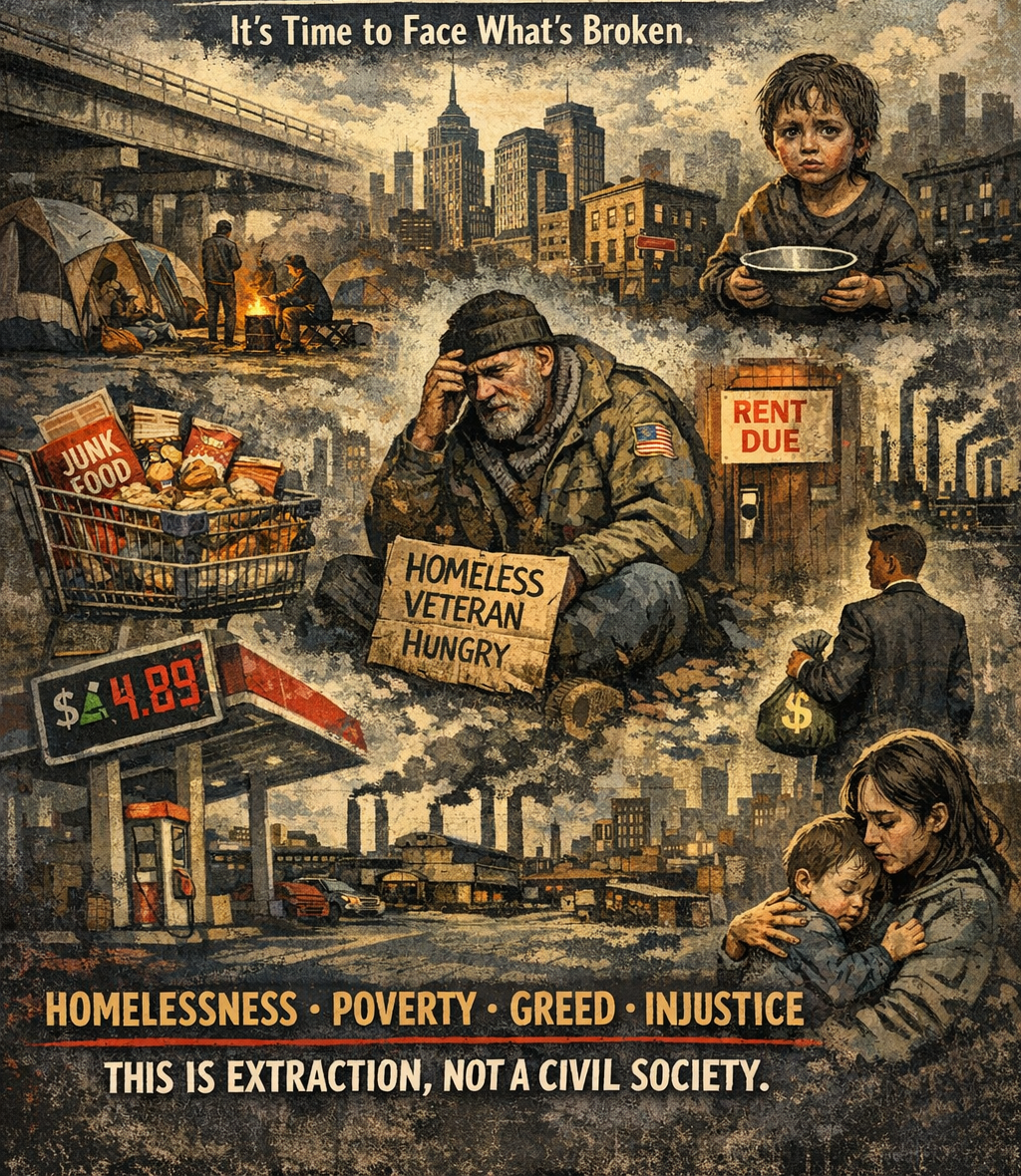
Campaign design team
Do You Think We Have a Civil Society?
By Vincent Cordova · 2-24-2026
Hello. :)
I need to talk about something that has been sitting heavy on my heart.
I want to start with a question—not an answer. Because I think some questions are more honest than declarations.
Do you think we have a civil society?
I've been trying to decide whether to write about this for a while. Not because I don't believe it matters—I believe it deeply—but because I don't want to hurt anyone. I don't want to point fingers at people who are just trying to live their lives, pay their bills, and take care of their families.
And I especially don't want to hurt people who have lived through things far worse than what I'm describing here. People who have survived war, genocide, state collapse—real uncivil chaos where the rules completely dissolved. If that's you, I see you. I honor you. And I'm not trying to compare. I'm just trying to ask a question about the society we're living in right now.
So here it is:
Can a society truly call itself civil when the basic systems we've built together—the policies, the laws, the economic structures—don't seem to serve so many of the people living within them?
When the collective agreements we've made don't seem to prioritize human dignity, safety, and well-being for everyone?
I don't know the answer. But I think we need to ask the question.
Let's Start with the Number We All Pretend Not to See
There are currently over 770,000 people experiencing homelessness in this country.
Let that number land for a moment. Say it out loud. Seven hundred and seventy thousand.
That is not a small population. That is a city. That is a massive, visible wound that we walk past every single day. And the fact that we have accepted this as normal—as just the way things are—tells me something is deeply broken.
How can we call ourselves civil when families sleep in tents under freeways? When children go to school from shelters? When veterans who served this country die on the streets?
We have the resources to house every single one of those 770,000 people. We have the money. We have the empty buildings. We have the construction workers and the materials and the knowledge. What we don't have is the collective will.
And that is not a failure of resources. That is a failure of spirit.
It's Not Just Housing. It's Everything.
The unhoused crisis is just the most visible symptom. If you look closer, you see the same pattern everywhere.
Our food systems are making us sick.
Walk through any grocery store and you'll see shelves lined with products designed to be cheap, shelf-stable, and addictive—but nutritionally empty. Ultra-processed foods loaded with ingredients our grandparents wouldn't recognize. Foods scientifically engineered to make us want more, eat more, and still never feel satisfied.
And the people most affected? The ones with the least money. The ones living in food deserts where fresh produce is a luxury and fast food is the only option within walking distance.
We have built a system where the cheapest calories are the ones that harm us most. And then we wonder why chronic disease rates keep climbing.
Our housing system extracts instead of shelters.
For those of us lucky enough to have roofs over our heads, the system is still often working against us. Rent consumes half or more of paychecks in so many cities. Homeownership feels like a distant dream for younger generations in a way it didn't for our parents.
Housing has been transformed from a basic human need into an investment vehicle. People buy second and third homes not because they need somewhere to live, but because they need somewhere to park their money. And every time that happens, the price goes up for everyone else.
This is not how a civil society treats shelter.
Our tax systems favor the ones who need help the least.
I'm not going to get into complicated economics here. I'll just say this: look at who pays what. Look at how wealth is taxed compared to work. Look at how corporations are treated compared to individuals.
We have created a system where the people with the most resources often pay the smallest percentage of their income. And the people working multiple jobs just to keep the lights on? They pay every single time they cash a paycheck.
Our fuel and energy systems trap people.
We've built communities where you cannot live without a car, and then made fuel prices volatile and unpredictable. We've tied our economy to energy sources that enrich a tiny few while the rest of us pay and pay and pay.
And when prices go up? The people at the bottom feel it first and feel it hardest. The commute to a job that barely pays enough suddenly costs more. The choice between heating the home and buying food becomes real.
What Is Being Extracted?
This is the word that keeps coming back to me: extraction.
We have built systems that extract. They extract money from the poor and give it to the rich. They extract health from bodies and replace it with chronic disease. They extract time from parents who work multiple jobs and never get to see their children. They extract hope from young people who look at the world and wonder if they'll ever be able to afford a home, a family, a stable life.
Extraction is the opposite of cultivation. Cultivation adds value, nurtures growth, builds something sustainable. Extraction takes and takes until there is nothing left.
And the people doing the extracting? They often don't even see themselves as villains. They're just playing the game. They're following the rules. They're maximizing returns, optimizing efficiency, growing shareholder value.
But the rules themselves are the problem.
This Could Never Be a Civil Society
If a society is civil, it should protect its most vulnerable. It should ensure that basic needs are met before luxuries are accumulated. It should value human beings over systems.
By that standard, we are not there.
We are not close.
And the hardest part? Most of us know this. Deep down, we know. We feel it in the pit of our stomachs when we walk past someone sleeping on a grate. We feel it when we read about another food recall, another price hike, another family evicted. We feel it when we look at our own bank accounts and wonder why working so hard leaves us with so little.
But we don't talk about it. We don't name it. We keep scrolling, keep moving, keep telling ourselves that this is just how things are.
But Here's the Harder Truth: The System Needs This
And this is where we have to go a little deeper. Because it's not just that the system is broken. It's that the system is working exactly as designed for the people at the top.
Think about it.
If everyone had stable housing, who would fill the low-wage jobs that require showing up at 5am via a two-hour bus ride? Who would rent the crumbling units that landlords don't want to repair? Who would be desperate enough to accept predatory loans, exploitative labor, wages that don't cover survival?
An underclass isn't just a group of people experiencing hardship. An underclass is a resource. It's a pool of desperation that can be extracted from.
- Desperate for housing? Here's an apartment with mold and no heat. Pay 80% of your income or live in your car.
- Desperate for work? Here's a shift that starts whenever we need you and ends whenever we don't. No benefits, no stability, no questions.
- Desperate for food? Here's the cheapest calories we can manufacture. They'll keep you alive enough to work tomorrow.
- Desperate for medicine? Here's a bill that will haunt you for years. Hope you get better fast.
Every single one of those scenarios benefits someone on the other side of the transaction.
The Roles We're Pushed Into
"roles" when we talked about this, and it's so accurate.
Because an underclass isn't just a condition. It's a position in a play. A function in a machine.
Some people get to be the extractors. Some people get to be the extracted. And the system works hard to make sure everyone stays in their role.
If you're born into poverty, the system has a role for you: flexible labor, perpetual consumer of last-resort products, someone who can be fined, jailed, or evicted when you can't pay. There's a whole infrastructure built around managing you—social services, policing, payday lenders, public hospitals, the carceral system.
If you're born into comfort, the system has a role for you too: investor, homeowner, consumer of premium products, someone whose wealth grows while others' labor creates it. There's an infrastructure for you too—tax breaks, financial advisors, gated communities, private schools, healthcare that actually works.
And the tragedy is, people in both roles often can't see the script they're reading from. The comfortable person thinks they earned it. The struggling person thinks they failed. Neither sees that the roles were written long before either of them arrived.
The Cruelest Trick
Here's what makes it so hard to talk about this.
The system doesn't have to be evil to function this way. It doesn't require a villain in a boardroom twirling a mustache and saying, "Excellent, the poors are suffering again."
It just requires enough people making rational decisions within a broken framework.
- A landlord raising rent to market rate isn't trying to create homelessness. They're just maximizing their asset.
- A corporation using temporary workers without benefits isn't trying to create a permanent underclass. They're just managing labor costs.
- A city zoning out affordable housing isn't trying to concentrate poverty. They're just protecting property values.
But the sum of all these "rational" decisions? A system that systematically pushes people down and keeps them there.
The cruelest trick is that most of the people benefiting from the system genuinely believe they're good people. And they are! They're just good people playing a bad game, following rules that were designed to produce exactly these outcomes.
So Why Write This?
Because naming things matters.
Because the first step toward change is saying out loud: This is not okay. This is not civil. We can do better.
I'm not writing this to make anyone feel guilty. I'm not writing this to shame individuals who are just trying to survive within a broken system. I'm writing this because we need to stop pretending.
We need to look at the 770,000+ unhoused and say: This is a policy failure, not an inevitability. And maybe—just maybe—it's also a sign that the system is getting exactly what it wants.
We need to look at our food and say: This is a system designed for profit, not for health.
We need to look at our housing, our taxes, our energy—and admit that they are extracting from us rather than serving us.
And then we need to start imagining something different.
What Would a Real Civil Society Look Like?
I don't have all the answers. I'm not a policy expert or an economist or a politician. I'm just someone who looks around and thinks: We can do better.
But I have some guesses.
A real civil society might treat housing as a human right, not a commodity. It might ensure that everyone has a safe, warm place to sleep before anyone gets a tax break on their third investment property.
A real civil society might design food systems that prioritize nutrition over shelf life. It might make sure that the cheapest options in the store are also the healthiest ones.
A real civil society might structure taxes so that those with the most contribute the most—not as punishment, but as participation in the shared project of keeping everyone alive and well.
A real civil society might build communities where people can live, work, and thrive without being dependent on systems that extract their last dollar.
A real civil society might measure success not by GDP or stock market highs, but by questions like: Are people housed? Are people healthy? Are people hopeful?
This Is Not About Blame
I want to be really clear about something.
This is not about blaming you. It's not about blaming your neighbor or your boss or the politician you didn't vote for. It's not even really about blaming the wealthy or the corporations, though they bear more responsibility than most.
This is about recognizing that we have built something together that isn't working the way it should. And if we built it, we can rebuild it.
But only if we're honest about what's broken.
A Small Invitation
If you've read this far, thank you. Really. I know this wasn't an easy read. It wasn't an easy write.
Here's what I'm asking:
Sit with it. Just for a few minutes.
Look at your own life and ask: Where do I see extraction? Where do I see systems that take more than they give? Where do I see people falling through holes that we could patch if we wanted to?
And then ask: What kind of society do I actually want to live in?
Because that second question—that's the important one. The critique matters, but only as a doorway to something better.
We don't have to accept this. We don't have to pretend this is civil. We can name what's broken and then start imagining, and building, something new.
Something truly civil.
Something worthy of all of us.
With hope, honesty, and love for every person reading this—especially the ones who disagree.
Community Comments
Community Comments
Share a public response to this post. Submissions are reviewed before they appear.
0 approved comments
Loading comments...