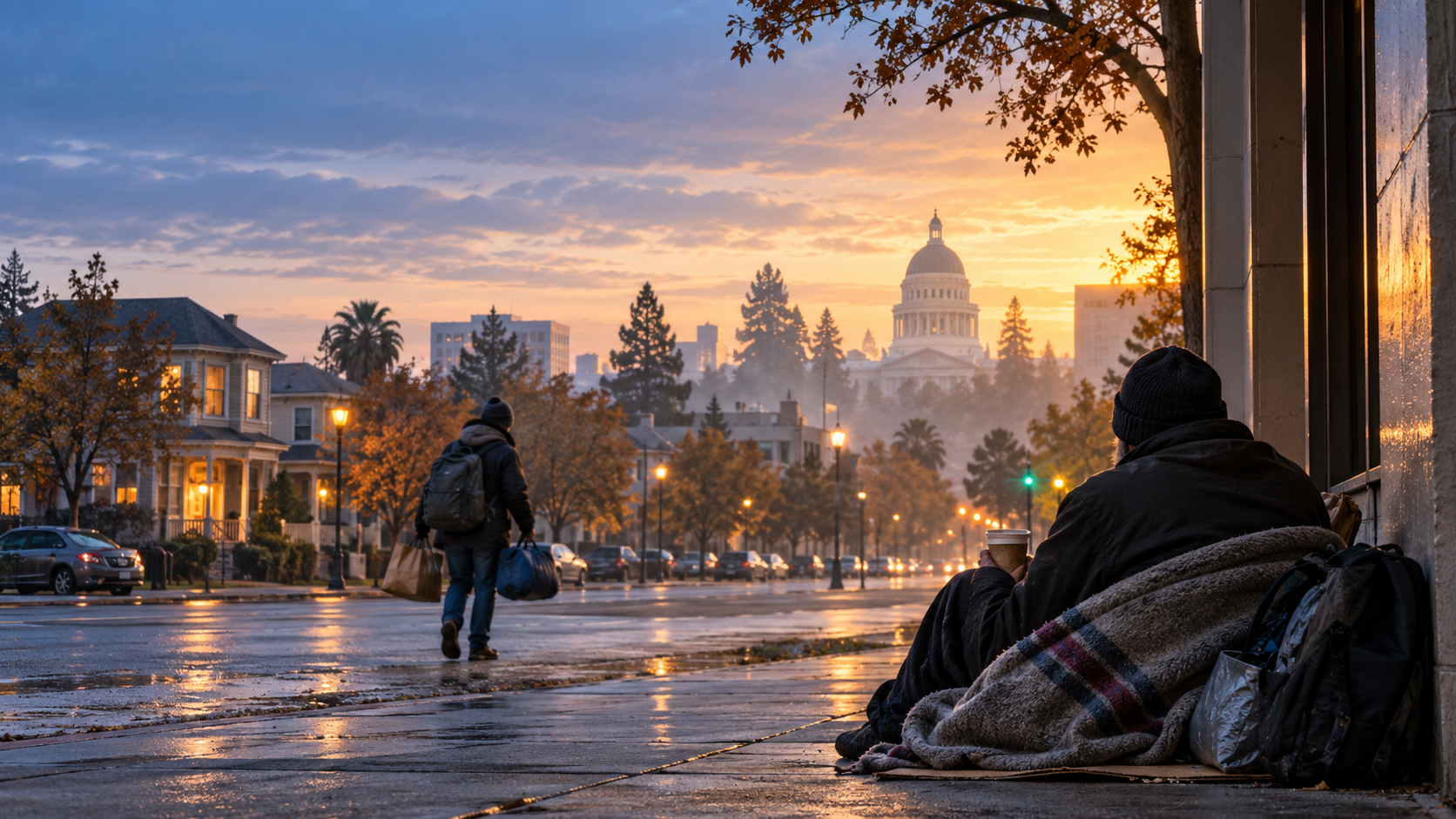
I'm in Sacramento this morning, and it's cold.
Not "grab a jacket" cold. The kind of cold that settles into your bones when you've spent the whole night outside with nowhere to go.
And everywhere I look, there are people doing exactly that. Sleeping in doorways. Wrapped in whatever they could find. Sitting on sidewalks a few blocks from the Capitol, where the people who are supposed to fix this go to work every day.
I want to say something plainly, before anything else:
No human being, no matter their condition, should be treated this way.
Not because of addiction. Not because of mental illness. Not because of bad luck or bad choices. None of it. A person is a person.
The Gift We're Robbing People Of
Every one of us is born with something extraordinary: the gift of life, and the free will to experience it on our own terms.
That's the promise. You get one life. You get to decide what to do with it. Build something. Create something. Chase the thing that lights you up.
But look around. For millions of Americans, that promise has been quietly taken away. Not by accident. By design.
When a system is built so that the people at the top keep winning and the people at the bottom keep sinking, that is not a flaw. That is the system working exactly as intended. And the people who designed it, and the people defending it today, are the same people collecting the benefits.
Do the Math on Survival
Let's talk about what it actually costs to be alive here right now.
$1,900
Average monthly rent for a Sacramento apartment
$2,930
Monthly pay at full-time minimum wage, before taxes
$285
Typical combined PG&E electric and gas bill
$36.50
Hourly wage needed to afford average rent at 30% of income
The average apartment in Sacramento rents for about $1,900 a month. A two-bedroom for a family runs closer to $2,000.
A typical PG&E electric bill is around $200 a month, and roughly $285 once you add gas. In a Central Valley summer with the air conditioning running, plenty of families blow past $300. More than 1 in 5 households served by California's big utilities are already behind on their energy bills.
Now look at the paycheck. California's minimum wage is $16.90 an hour. Work full time, every week of the year, and that's about $2,930 a month before taxes.
- Rent (~$1,900)
- Electricity (~$200)
- Food, gas, insurance, childcare, medicine, savings
Rent alone eats about 65% of that. Add electricity and you're past 70%, before food, gas, insurance, childcare, medicine, or a single dollar saved for tomorrow.
The standard rule is that housing should cost no more than 30% of your income. To afford an average Sacramento apartment by that rule, you'd need to earn about $36.50 an hour. More than double the minimum wage.
It doesn't add up. It was never meant to.
A wage you cannot survive on is not a safety net. It's a trap with a paycheck attached.
So people fall. One missed shift, one medical bill, one rent increase, and they're out.
2026 Point-in-Time Count · Sacramento County
7,458
people experiencing homelessness in Sacramento County
+13%
increase from two years ago
~4,000
sleeping outside
~1,200
people in families with children
This year's count found 7,458 people experiencing homelessness in Sacramento County, up 13% from two years ago. About 4,000 of them were sleeping outside. Nearly 1,200 were people in families with children.
And here's the part that should end the "they're all coming here from somewhere else" talking point for good: about 78% first became homeless while already living in Sacramento County.
These are our neighbors. They lived here, worked here, paid rent here, until they couldn't.
The Dreams We Never Get to See
Here's the part that doesn't get talked about enough.
Homelessness is the most visible damage. But there's a quieter kind of damage happening to almost everyone else.
How many people had a business idea they never started, because nearly $2,000 in rent meant they couldn't miss a single paycheck? How many artists, inventors, builders, and dreamers traded their ambitions for a time clock because there was nothing, no support, no floor, nothing to catch them if they took the leap?
We will never know their names. We will never see what they would have built. That's not just their loss. That's all of ours.
This system doesn't just push people onto the street. It takes the dreams of the majority and converts them into labor. It tells you: forget who you wanted to be, become a worker, and be grateful for it.
And if you do land a good-paying job right now? Enjoy it. Because this unhealthy version of capitalism is working hard to take that from you too.
"The Market Will Fix It"
Some will read this and say: be patient, the market will sort it out. Supply will catch up. Prices will settle.
We've been waiting for decades. The market hasn't fixed it, and it won't, because fixing it was never the market's job.
Markets designed to exploit have no inherent will to care.
They don't feel the cold. They don't see the family in the car or the man in the doorway. A market built to extract will keep extracting until someone builds something different.
And let's be clear about something else. Markets do not determine who we are, and they did not create our species. We existed long before any of them, and we took care of each other long before anyone put a price on a roof. A market is a tool. Nothing more.
The only tools that keep us apart are the tools of division. The ones that tell you your neighbor is your competition. The ones that tell you the person sleeping outside must have deserved it. Put those down, and what's left is people who need each other.
A Society That Favors the Highest Bidder Is Doomed to Fail
When the rules of a country are written for whoever pays the most, everyone else is just living in someone else's business model.
That can't last. A nation where the majority is struggling to survive, where people freeze on the sidewalk outside the seat of government, where dreams are a luxury, is not a nation that's moving forward. It's a nation coming apart.
Collectively, this system is wearing down the human race. And it will keep doing it until we build something better.
So What Do We Do?
We stop pretending this is normal.
We stop accepting that housing is an investment vehicle first and a home second. That's why I'm building the National Housing PBC: a mission-locked public benefit corporation designed to build and preserve affordable housing permanently, with protections written in so it can't be bought out, captured, or flipped.
But here's what I want every person reading this to understand: you don't have to wait for me, or for anyone, to do this.
The tools that built this extraction machine aren't secret. Corporations, trusts, investment structures, legal charters. They've been used for generations to pull wealth out of our communities. Those same tools can be used to put it back. A public benefit corporation isn't reserved for the powerful. Anyone can form one. A group of neighbors can. A church can. A handful of workers can. A town can.
So I'm asking you to do it. Start a housing PBC in your city. Build a business that's locked to serve its workers and its community instead of distant shareholders. Take whatever you know how to do and build it so it can never be turned against the people it's meant to serve.
Here's how to start
Start a housing PBC in your city
- 1In California, this kind of company is called a benefit corporation. File articles of incorporation with the California Secretary of State that state your public benefit purpose. Delaware and most other states offer the same structure.
- 2Talk to a business attorney about locking your mission in tight.
- 3Build alongside us, or share what you're working on.
Every time one of us takes a tool of extraction and points it at people instead of profit, the old system loses a little ground. And the more of us who do it, the faster we build something better, for each other.
We demand wages you can actually live on. We build a floor strong enough that a person can take a risk on their dreams without risking the street.
And we remember the people I saw this morning. Not as a problem to be cleared away, but as our neighbors, whose lives matter as much as anyone's.
Our Children Are Watching
There's one more number I can't stop thinking about.
1 in 5
high school students seriously considered suicide in the past year
4 in 10
felt persistently sad or hopeless
In the CDC's most recent national survey, 1 in 5 high school students said they had seriously considered suicide in the past year. 4 in 10 said they felt persistently sad or hopeless.
Every one of those numbers is a real kid. There are many reasons a young person can end up in that much pain, and no single cause explains it. But we have to be honest enough to point at our own society and admit that the world we are handing them is part of the weight they carry.
Think about what they see. Their parents working themselves to exhaustion and still falling behind, and knowing that's supposed to be their future too. People sleeping on the sidewalk on the way to school. Families torn apart over immigration. Our own species bombing itself on the evening news. They are growing up inside a system that tells them, every day, that their worth is whatever the market decides to pay them.
That is not working for them. It is not working for any of us.
So here's what I'd ask every parent, every teacher, every neighbor: talk to the young people in your life. Ask them how they're really doing, and listen to the answer. And to every young person reading this: this world is not finished. The system that makes you feel this way was built by people, and people can build something better. We need you here to help do it.
I am a piece of the collective essence of this world that never gives up and needs every other piece to be whole.
— Vinnie Cordova
Cordova 2028: Moving Forward Together
Sources
- Sacramento average rent: RentCafe, Sacramento rent trends (2026), Zillow Sacramento rental market
- California minimum wage: CalChamber, 2026 minimum wage increase to $16.90
- PG&E electric bills: PG&E rate advisory, March 2026, TURN on combined electric and gas bills
- Households behind on energy bills: CPUC Public Advocates Office, Q2 2026 electric rates report
- 2026 Point-in-Time Count: CapRadio, CBS Sacramento, Sacramento Bee via AOL
- Youth mental health: CDC Youth Risk Behavior Survey, 2023 Data Summary & Trends Report