Campaign design team
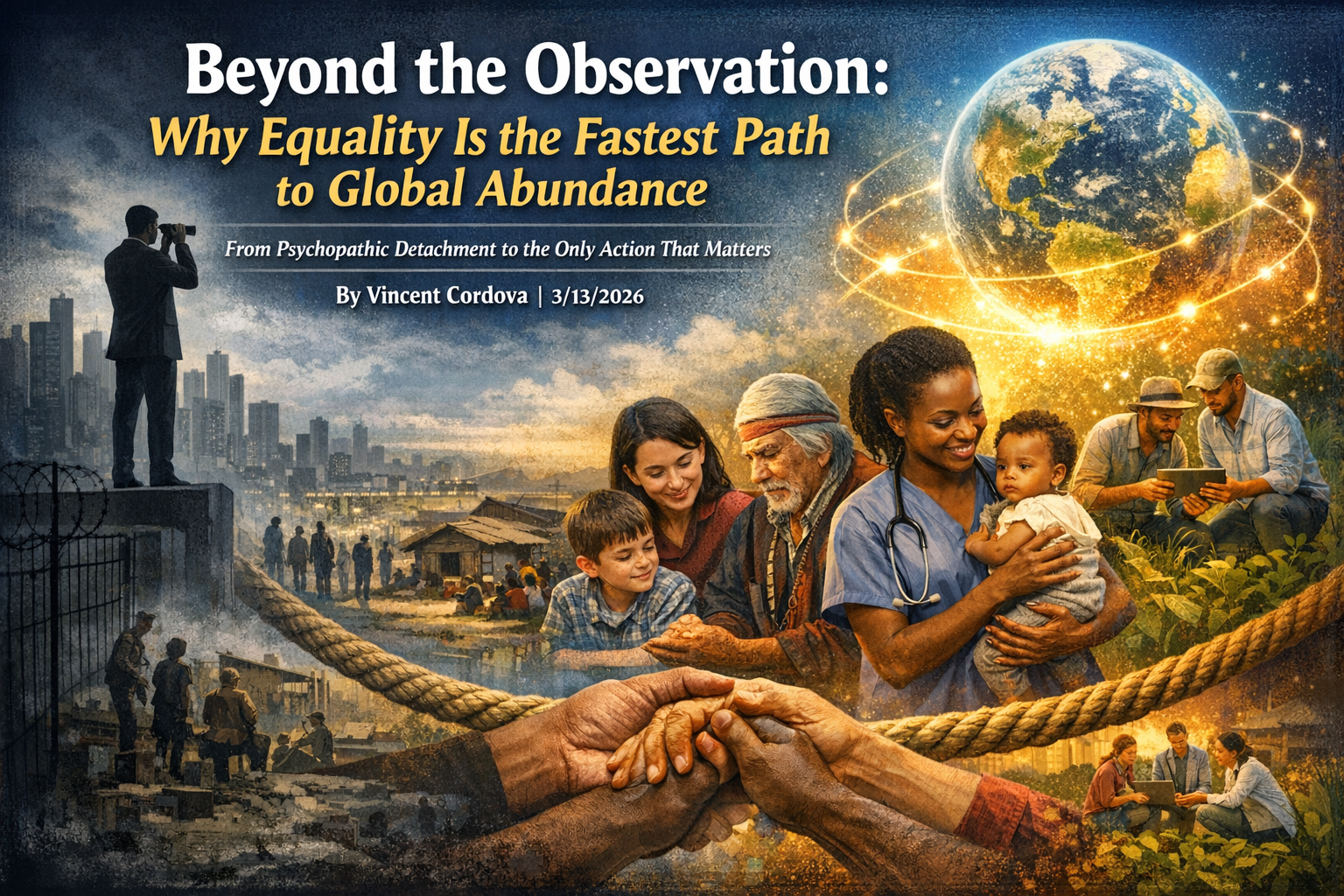
Beyond the Observation: Why Equality Is the Fastest Path to Global Abundance
By Vincent Cordova | 3/13/2026
From Psychopathic Detachment to the Only Action That Matters In my last letter, I named the pattern. I called out the institutions that observe suffering, document it with scholarly precision, and call it progress. I named the psychopathic observer—the entity that knows everything and does nothing, that profits from brokenness and calls it service. That letter was necessary. The truth must be spoken. But truth, without a path forward, is just another form of observation. Today, I am not here to name the problem. I am here to declare the alternative. I am here to define what comes after we stop observing. Because Love is action. Love is protecting each other. And any system that teaches you to feel above another—to observe their struggle from a detached height—is not normal in a medical, biological, or spiritual sense. We were created out of love. Our systems must be rebuilt with that same active, protective love at their core. The Lie of the "Higher Authority" The current educational model operates on a foundational lie: that there is an observer and an observed, a knower and a known, an expert and a subject. This is a false hierarchy. You, the institution, are not the creator of the life you study. You are an equal to the observed. When you forget this, you fall into a psychopathic mindset. You treat human suffering as data, children as statistics, and communities as case studies. Documentation without action is worthless. A legal filing, a scholarly paper, a policy recommendation—if these are not followed by the tangible act of throwing a rope, they are not just incomplete. They are a performance. They are a fake hierarchy built on the suffering of others. They are a betrayal of the love from which we are all born. The Evolution We Are Blocking: Why Equality Is the Fastest Path to Abundance Here is the truth the observer class refuses to see: When the observer steps down from the pedestal and becomes an equal partner, everything accelerates. Think about it. Right now, we have a tiny fraction of humanity—the "experts," the "researchers," the "policymakers"—sitting in rooms, analyzing problems, and generating reports. The vast majority of humanity—the parents, the local teachers, the community organizers, the elders who have raised children for generations—are treated as sources of data, not sources of wisdom. This is not just arrogant. It is inefficient. It is slow. What happens when the observer becomes a partner? The knowledge that has been sitting in academic journals for decades finally meets the ground. The wisdom that has been living in communities for centuries finally meets the funding. The hands that have been doing the work without recognition finally meet the resources. The children who have been waiting finally meet the help. This is not charity. This is not "helping the less fortunate." This is pooling the full intelligence of the species. The observer stance holds that the expert knows and the community needs to be taught. The partner stance knows that the community understands things the expert never will—and that the expert has resources the community needs. When they meet as equals, you get the best of both worlds. You get applied wisdom. You get abundance. The observer stance is holding up evolution itself. Evolution does not happen in isolation. It happens through connection, through exchange, through the merging of different knowledge streams into stronger wholes. When institutions wall themselves off as "higher authorities," they (切断 - cut) themselves off from the very evolutionary input they need to stay relevant. They become stagnant. They become museums of outdated ideas while the living world changes around them. The fastest way to global abundance is simple: Recognize that you are not above. You are alongside. Now, let's work together. When Dhaka learns from Detroit and Detroit learns from Dhaka, both are stronger. When a university in Lagos treats a village elder as a colleague, not a subject, the children of that village get a better education than either could provide alone. When a research foundation in London asks community members in Lagos to help design the study, the findings are actually useful. This is not a moral argument. It is a practical one. The observer model is too slow to solve the problems we face. The climate is changing. Conflicts are spreading. Children are falling. We do not have time for another decade of studies. We need every brain, every hand, every heart working together—right now. What Applied Love Looks Like: Evidence That Action Works Let us be clear: this is not abstract idealism. There are places where institutions have chosen action over observation. There is evidence that when love is applied, children thrive. The research already exists—not as theory, but as proof. The Community Schools Model When schools become hubs for wraparound services—health care, mental health counseling, nutrition programs, family support—the results are undeniable. A 2020 study of community schools in New York City found that students in these schools had significantly higher attendance, greater academic gains, and lower suspension rates than their peers in traditional schools. The graduation rate at community schools outpaced the city average by 10 percentage points.¹ The knowledge has been there for decades. The action is what makes the difference. Nurse-Family Partnership This program sends registered nurses to visit first-time, low-income mothers during pregnancy and through the child's second birthday. The outcomes, tracked for over 40 years, include an 81% reduction in child abuse and neglect, a 50% reduction in behavioral and intellectual problems in children by age six, and a 67% reduction in arrests among mothers.² The intervention is not a study. It is a relationship. It is love as action. The Finnish Paradox Finland's education system is often studied, but rarely replicated. What do they do differently? They act on what they know. Every school has access to a multi-disciplinary team—social workers, psychologists, special education teachers, health nurses—that intervenes the moment a child shows any sign of struggle. There are no standardized tests until the end of high school. There is no competition between schools. There is only the applied principle that every child matters.³ The result? Finland has consistently ranked among the top nations in reading, math, and science, with one of the smallest achievement gaps in the world.⁴ The BRICS Network University Challenge As noted in my previous letter, the BRICS+ nations are building parallel institutions, questioning who sets the global education agenda.⁵ But the question remains: will they replicate the observer model, or will they build something new? Early indicators from the BRICS Network University show an emphasis on applied research—solutions to food security, public health, and sustainable development that are tested in the communities that need them.⁶ This is a pattern worth watching. If they succeed, they will prove that the Global South does not need the West's observation. It needs its own action. Cuba's "Yes, I Can" Literacy Program Between 2001 and 2015, Cuba's "Yo, Sí Puedo" literacy program taught over 8 million people in 30 countries to read. The method is simple: trained volunteers go into communities, meet people where they are, and teach. The results are documented. Venezuela alone declared itself "illiteracy-free" after 1.5 million people learned to read through the program.⁷ No lengthy studies. No conferences. Just action. The Perry Preschool Project This landmark study followed 123 low-income African American children from the 1960s into adulthood. Half received a high-quality, active preschool program with weekly home visits. Half received nothing. By age 40, those who received the program had higher earnings, were more likely to hold a job, and had committed fewer crimes. The return on investment was $7.16 for every dollar spent.⁸ The knowledge has been public for over 50 years. The action has not followed. Indigenous-Led Education in Canada When British Columbia shifted control of Indigenous education to Indigenous communities in the 1970s, graduation rates for First Nations students rose from near zero to over 80% in participating schools.⁹ The key was not observation. The key was transferring authority to those who understood the children—and acting on that understanding. The Applied Direction: Education as an Act of Love These examples are not anomalies. They are proof that the knowledge is sufficient. The missing ingredient is will. So, what does it look like when education stops being an observer and becomes an applied direction to abundance? What does it mean to build a system rooted in love as action? It means we must fundamentally invert the priorities of every institution that touches a child's life. 1. From Research Subjects to Healed Communities An applied system does not just study the trauma of a community; it actively participates in its healing. Universities must measure their success not by the number of papers published about failing schools, but by the number of failing schools they have helped to thrive. The question is no longer "What did we discover?" but "Who did we help?" 2. From Detached Experts to Equal Partners We must dismantle the hierarchy of the "expert" who flies in, observes, prescribes, and leaves. In a system of applied love, the institution is a neighbor. It listens to the knowledge already present in a community—the parents, the local teachers, the elders—and offers its resources as a partner, not a savior. You are not above them; you are for them. 3. From Profiting from Crisis to Investing in Wholeness This is the hardest truth: our institutions are financially structured to need the crisis. We must redesign the funding model. Research grants should come with a mandate for action. Endowments should be released to fund community-led solutions. An institution's budget should reflect its love: the majority of its resources going directly to the act of healing, protecting, and elevating. If solving a problem makes you irrelevant, then you were never relevant to begin with. 4. From Training Observers to Raising Healers The curriculum itself must change. We must stop training generations of students to analyze the world from a safe distance. We must teach them how to enter it. A degree should certify your ability to act, to heal, to build, and to protect. It should certify your love. We do not need more graduates who can write a brilliant case study on the school-to-prison pipeline. We need graduates who are in the schools, actively dismantling that pipeline brick by brick. The Question of Will To the universities, the policy institutes, the international organizations: you have the resources. You have the brainpower. You have the platforms. You have the evidence. The community schools work. The nurse visits work. The literacy programs work. The Indigenous-led models work. The only question left is whether you have the will to stop being a "higher authority" and start being an equal partner. Do you have the will to trade your detached expertise for the messy, glorious work of applied love? Love is not a feeling you publish about. Love is a verb you embody. The children are not waiting for another study. They are waiting for a rope. They are waiting for an adult who remembers that they, too, were created out of love and are therefore an equal, not a subject. The unnatural order of the observer ends today. The natural order of applied love begins now. The sidelines are already full. The answers are already known. The proof is already published. The only thing missing is us—showing up, as equals, with our hands out and our hearts open. We were never meant to be fragmented. We were never meant to watch each other struggle from a distance. The separation is the illusion. The wholeness is what's real. Let's get to work. References 1. Community Schools in New York City: A Research Summary. (2020). RAND Corporation and NYC Department of Education. https://www.rand.org/pubs/research_reports/RRA324-1.html 2. Nurse-Family Partnership. (2021). Forty Years of Evidence: Proven Outcomes for Mothers and Children. https://www.nursefamilypartnership.org/wp-content/uploads/2021/02/NFP_Evidence_Summary.pdf 3. Sahlberg, P. (2021). Finnish Lessons 3.0: What Can the World Learn from Educational Change in Finland? Teachers College Press. 4. OECD. (2022). PISA 2022 Results: Finland Country Note. https://www.oecd.org/publication/pisa-2022-results/country-notes/finland-8a9c0e4b/ 5. BRICS Information Centre. (2023). BRICS Network University Framework Agreement Progress Report. University of Toronto. 6. BRICS Network University. (2024). Applied Research Initiatives in Food Security and Public Health. Moscow State Institute of International Relations. 7. UNESCO. (2016). "Yo, Sí Puedo": A Literacy Experience from the South. UNESCO Institute for Lifelong Learning. https://uil.unesco.org/case-study/effective-practices-database-litbase-0/yo-si-puedo-literacy-experience-south 8. Schweinhart, L. J. et al. (2005). Lifetime Effects: The High/Scope Perry Preschool Study Through Age 40. High/Scope Educational Research Foundation. 9. British Columbia Ministry of Education. (2022). Indigenous Education: Annual Report on First Nations Student Success. https://www2.gov.bc.ca/assets/gov/education/administration/kindergarten-to-grade-12/indigenous-education/ie-annual-report-2022.pdf
Community Comments
Community Comments
Share a public response to this post. Submissions are reviewed before they appear.
0 approved comments
Loading comments...