This site is under construction - will be ready soon.
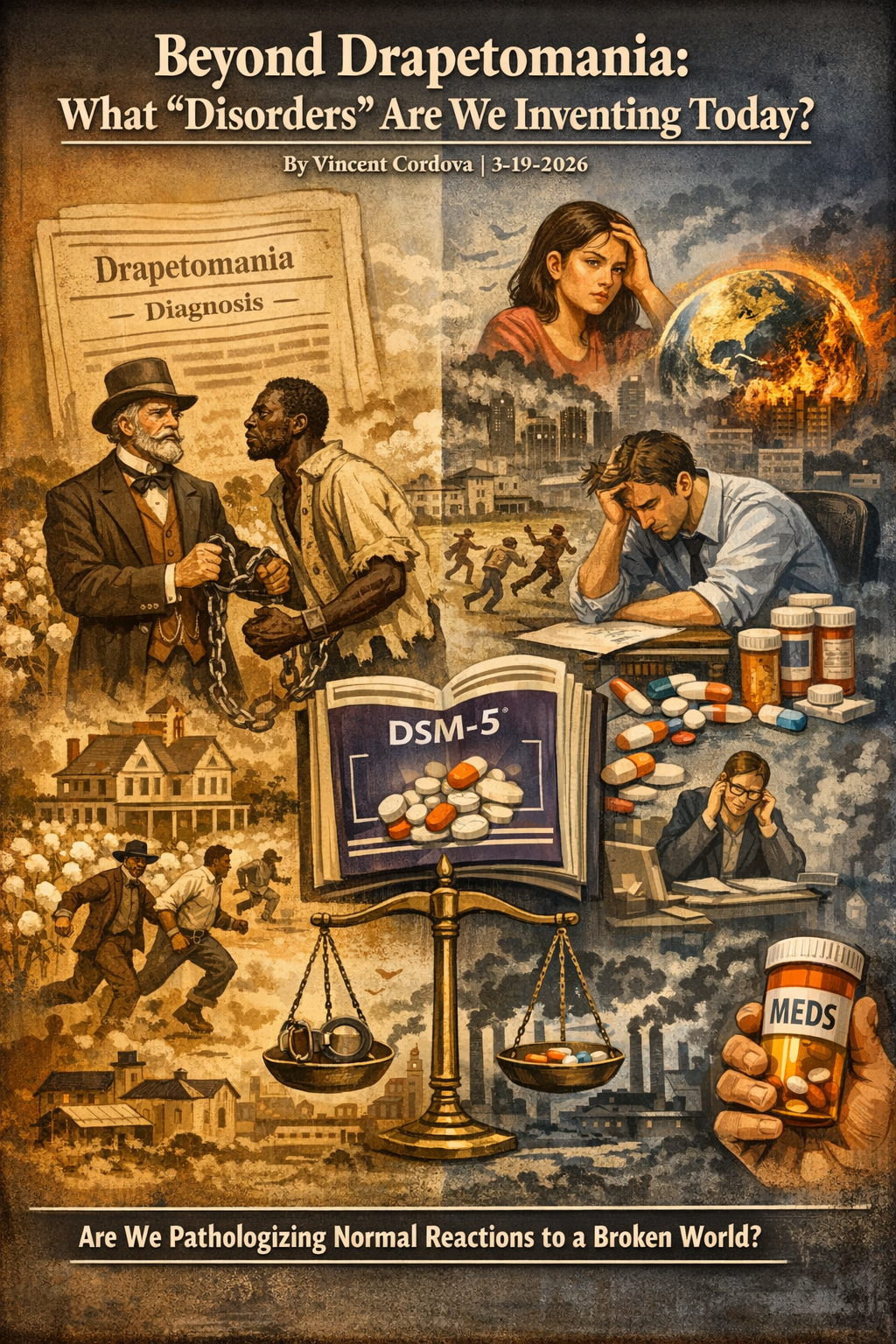
Symbolic illustration for Beyond Drapetomania

Campaign design team

Beyond Drapetomania: What "Disorders" Are We Inventing Today?

By Vincent Cordova · March 19, 2026

How modern psychology might be pathologizing perfectly normal reactions to a broken world—and why it needs us to stay sick.

How modern psychology might be pathologizing perfectly normal reactions to a broken world—and why it needs us to stay sick. Introductory Hook Imagine being told you have a mental illness because you want to be free. Sounds absurd, right? In the 1850s, a respected physician named Samuel Cartwright invented a condition called "drapetomania" to explain why enslaved people kept running away. His “scientific” conclusion was that the desire for freedom was a psychiatric disorder that needed to be cured. We look back on that now with horror. It's a glaring example of a culture using the “objective” language of science to enforce its power structures. But it forces us to ask an uncomfortable question: if we could be so blind then, what are we missing today? Are we, in the 21st century, unintentionally (or sometimes intentionally) creating new “drapetomanias”—diagnostic labels that pathologize normal, rational responses to stress, injustice, and an unhealthy society? And more disturbingly: do we need these disorders to keep ourselves relevant? The Old Blueprint — How Drapetomania Worked • The Mechanism: It took a social/political problem (the desire for freedom from chattel slavery) and redefined it as a medical/individual problem (a mental illness). • The Effect on Society: It reinforced the status quo. If a slave was unhappy, it wasn't because slavery was evil; it was because the slave was “sick.” This absolved the system and the oppressor of all blame. • The Effect on the Individual: It stripped the enslaved person of their agency and humanity. Their cry for justice was dismissed as a symptom. The Modern Parallels — Three Potential “Drapetomanias” of Today Here is where we need to be thoughtful. The goal isn't to dismiss real mental distress, but to question where we place the blame. Is the problem inside the person, or is it a reaction to a toxic environment? 1. The Pathologizing of Burnout and Disengagement • The "Old" View: A professional, burned out and cynical about their corporate job, is diagnosed with an adjustment disorder or depression. The prescribed "cure" is often cognitive-behavioral therapy to change their negative thoughts, mindfulness apps, or medication to help them cope. • The “Drapetomania” Parallel: Are we treating the symptom or the cause? What if the burnout is a rational response to an exploitative system of endless productivity, stagnant wages, and meaningless work? • How it Affects Us All: By individualizing burnout, we let corporations off the hook. We medicate people back into compliance rather than demanding better working conditions. We are all told to build “resilience” to a system that is, by design, overwhelming. 2. The Medicalization of Student Non-Compliance • The "Old" View: A child who won't sit still in class, questions the teacher, or refuses to do standardized test prep is screened for Oppositional Defiant Disorder (ODD), ADHD, or an anxiety disorder. • The “Drapetomania” Parallel: What if the child's “defiance” is a healthy response to an outdated, rigid, and often uninspiring educational system? What if they are bored, hungry, or traumatized by a world that feels like it's on fire? We call them “disordered” instead of asking, “Is this school failing this child?” • How it Affects Us All: It stifles creativity and critical thinking from a young age. We are training children to be compliant cogs, and medicating the ones who resist. This creates a generation that doubts their own instincts when a system feels wrong. 3. The “Climate Anxiety” Paradox • The "Old" View: A young person is consumed with dread about the future of the planet. They can't sleep, they struggle to focus, they feel hopeless. A clinician might diagnose Generalized Anxiety Disorder. • The “Drapetomania” Parallel: Is it irrational to be anxious about the collapse of an ecosystem? Is that a “disorder,” or is it a profoundly sane and empathetic response to an existential threat that older generations have largely ignored? • How it Affects Us All: By labeling climate distress as an “anxiety disorder,” we risk turning a collective political and survival crisis into a private mental health problem. We tell the young person to manage their symptoms with breathing exercises, rather than validating their fear and channeling it into collective action. Part 3: Why Does This Happen? This isn't usually a grand conspiracy. It's a product of several forces: • The Medical Model's Limits: Modern psychology is heavily influenced by medicine. It seeks to find a “fault” within the individual (a chemical imbalance, a cognitive distortion) because that's easier to treat than a “fault” in society. • The Insurance and Pharma Complex: To get paid, therapists need a diagnosis. To sell a drug, pharmaceutical companies need a disorder. This creates a powerful incentive to name and label, often in the simplest way possible. • Social Control: A society full of people who believe their suffering is their own fault is easier to manage than a society full of people who recognize their suffering is a symptom of a broken system. This is the most direct link to drapetomania. The Unspoken Layer — Why the System Needs the “Disordered” There's a deeper layer to this, and it's uncomfortable to name: what if the system doesn't just misdiagnose people—what if it needs them to be disordered? Think about it. If people stopped being burnouts who need resilience training... if children stopped being defiant kids who need behavioral intervention... if the anxious stopped needing diagnoses and medications... what happens to the industries built around managing them? • Material Dependency: Institutions, journals, conferences, pharmaceuticals, and careers are built on the existence of “disordered” people. The Diagnostic and Statistical Manual (DSM) grows with each edition, as categories expand. Each new diagnosis is a new market. • Moral Justification: There's comfort in this too. If the suffering of the underclass is their pathology—their bad brains, their poor resilience, their dysfunctional families—then the rest of us don't have to look at the system. We get to be helpers, not participants in the harm. • The Cruelest Cycle: The system often creates the very wounds it then diagnoses. Work people until they break → call it burnout and sell them mindfulness. Starve them of meaning and community → call it depression and sell them SSRIs. Expose them to a collapsing world → call it climate anxiety and sell them coping skills. It's not just that an underclass is needed. It's that the underclass is manufactured, then pathologized, then managed—sometimes by well-meaning people who genuinely believe they're helping. The ancients had a word for this: iatrogenesis—harm caused by the healer. Not malice, but a system so invested in its own role that it can no longer see how it perpetuates the suffering it treats. What Do We Do With This? If you've read this far, you've seen the pattern. You've watched how a society can take a sane response—the desire for freedom, the refusal of meaningless work, the grief for a dying world—and rename it as sickness. You've sat with the uncomfortable possibility that some of these “disorders” exist not because we're broken, but because something needs us to believe we are. So now the question becomes: what do we do? Not rhetorically. Practically. Collectively. Because this isn't just a diagnostic error. It's something closer to what one reader named an “essence killer” —a slow, quiet erasure of the human capacity to trust our own perceptions, to name our own suffering, to resist what harms us. When a child is medicated for questioning a broken classroom... When a worker is diagnosed for refusing endless productivity... When a young person is treated for grieving the future... Something essential is being lost. Not just health, but agency. Not just comfort, but the ability to say: This is wrong, and it's not me. So We're Asking To the therapists, the teachers, the parents, the workers, the ones who've been labeled and the ones who do the labeling: • How do we tell the difference between a wound that comes from within and a wound that is being inflicted from outside? • What would it look like to build a psychology that doesn't need an underclass to justify itself? • And if this really is an essence killer—if it really does strip away our ability to grow into full, responsive, resisting humans—then what do we protect? What do we restore? How do we begin? This isn't a rhetorical exercise. It's a door. If you have thoughts, if you've lived this, if you've found a way through—or if you're still trapped in it—your voice matters here. Because the people who built these categories are not the only experts. The people who've been categorized are experts too. We're listening. Reclaiming Sanity Psychology has the power to heal, but it also has the power to label and control. The legacy of drapetomania is a warning that lives on in the DSM. The next time you feel “disordered”—anxious, depressed, burned out, or defiant—ask yourself: Am I broken, or am I reacting to a world that is? And if I am reacting to a broken world, who benefits from calling me the problem?

References & Further Reading

On Drapetomania and Scientific Racism • Cartwright, Samuel A. (1851). "Report on the Diseases and Physical Peculiarities of the Negro Race." New Orleans Medical and Surgical Journal. • Washington, Harriet A. (2006). Medical Apartheid: The Dark History of Medical Experimentation on Black Americans from Colonial Times to the Present. Doubleday. • Byrd, W. Michael., & Clayton, Linda A. (2000). An American Health Dilemma: A Medical History of African Americans and the Problem of Race. Routledge. On the Medicalization of Deviance and Social Control • Foucault, Michel (1965). Madness and Civilization: A History of Insanity in the Age of Reason. Pantheon. • Szasz, Thomas (1961). The Myth of Mental Illness: Foundations of a Theory of Personal Conduct. Harper & Row. • Conrad, Peter, & Schneider, Joseph W. (1992). Deviance and Medicalization: From Badness to Sickness. Temple University Press. • Metzl, Jonathan M. (2009). The Protest Psychosis: How Schizophrenia Became a Black Disease. Beacon Press. On the DSM, Pharma, and the Construction of Disorder • Whitaker, Robert (2010). Anatomy of an Epidemic: Magic Bullets, Psychiatric Drugs, and the Astonishing Rise of Mental Illness in America. Crown Publishers. • Davies, James (2013). Cracked: Why Psychiatry is Doing More Harm Than Good. Icon Books. • Greenberg, Gary (2013). The Book of Woe: The DSM and the Unmaking of Psychiatry. Blue Rider Press. • Healy, David (2004). Let Them Eat Prozac: The Unhealthy Relationship Between the Pharmaceutical Industry and Depression. New York University Press. On Burnout as a Systemic, Not Individual, Problem • Cederström, Carl, & Fleming, Peter (2012). Dead Man Working. Zero Books. • Graeber, David (2018). Bullshit Jobs: A Theory. Simon & Schuster. • Ehrenreich, Barbara (2009). Bright-Sided: How the Relentless Promotion of Positive Thinking Has Undermined America. Metropolitan Books. On Children, Education, and the Pathologizing of Non-Compliance • Timimi, Sami (2005). Naughty Boys: Anti-Social Behaviour, ADHD and the Role of Culture. Palgrave Macmillan. • Gatto, John Taylor (1992). Dumbing Us Down: The Hidden Curriculum of Compulsory Schooling. New Society Publishers. • Boyle, David (2011). The Tyranny of Numbers: Why Counting Can't Make Us Happy. HarperCollins. On Climate Grief and the Sanity of Ecological Distress • Stoknes, Per Espen (2015). What We Think About When We Try Not To Think About Global Warming. Chelsea Green Publishing. • Doppelt, Bob (2016). Transformational Resilience: How Building Human Resilience to Climate Disruption Can Safeguard Society and Increase Wellbeing. Greenleaf Publishing. • Jem Bendell (2018). "Deep Adaptation: A Map for Navigating Climate Tragedy." Institute for Leadership and Sustainability (IFLAS) Occasional Papers. On Iatrogenesis and Systems That Create Harm • Illich, Ivan (1976). Limits to Medicine: Medical Nemesis: The Expropriation of Health. Marion Boyars. • McKnight, John (1995). The Careless Society: Community and Its Counterfeits. Basic Books. On Resistance, Agency, and Reclaiming Sanity • Levine, Bruce E. (2012). Get Up, Stand Up: Uniting Populists, Energizing the Disaffected, and Battling the Corporate Elite. Chelsea Green Publishing. • Hari, Johann (2018). Lost Connections: Uncovering the Real Causes of Depression—and the Unexpected Solutions. Bloomsbury. • Menakem, Resmaa (2017). My Grandmother's Hands: Racialized Trauma and the Pathway to Mending Our Hearts and Bodies. Central Recovery Press.
Vincent Cordova · Candidate for U.S. President 2028
📞 (350) 229-1046 · 📧 info@cordova2028.com · 🌐 www.vincentcordova.com