Campaign design team
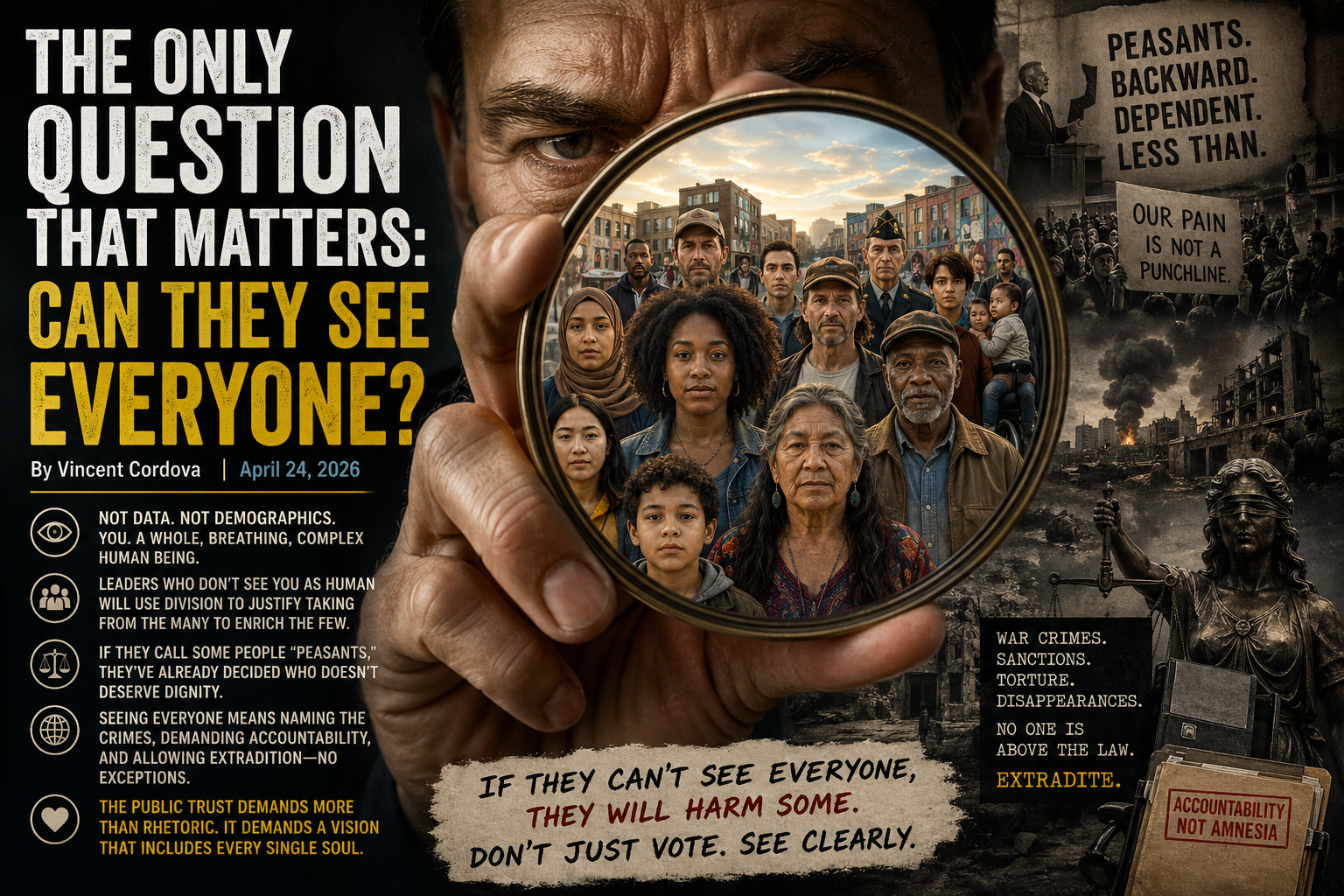
The Only Question That Matters: Can They See Everyone?
By Vincent Cordova | Candidate for U.S. President 2028
April 24, 2026
We have reached a point in our politics where the most urgent question we can ask of a candidate is no longer just about their stance on taxes or trade, but about the fundamental aperture of their humanity: Can they truly see you? Not your demographic data, not your consumer profile, not your utility as a voter or a laborer, but you-a whole, breathing, complex human being.
The importance of electing people who possess this basic vision cannot be overstated, because when we elevate leaders who can only see others as exploitable resources, as obstacles, or as something "less than" themselves, they do not simply govern poorly; they weaponize governance itself. They require division to function, needing an "us" and a "them" to justify the extraction of value from the latter for the benefit of the former. This is not a failure of policy, but a failure of perception.
When a public figure like J.D. Vance, to use a stark contemporary example, adopts rhetoric that dismisses vast swaths of the American populace as "peasants," he is not merely being provocative or folksy; he is performing a ritual of dehumanization. Because once you label a group of people as peasants-as backward, dependent, or culturally inferior-you have unlocked a moral permission structure. You have told your base, your bureaucrats, and your enforcers that these people are not worthy of the same dignity, that their pain is less acute, and that their lives are less legible. Policies that harm "peasants" are not seen as tragedies; they are seen as necessary corrections, or worse, as jokes.
History is cluttered with the wreckage of societies that allowed their leaders to draw these lines, from forced sterilizations of the "unfit" to the quiet defunding of schools in "those" neighborhoods. The harm is never abstract; it is a mother evicted, a child without healthcare, a worker exploited for tips without protection.
And so the non-negotiable standard for any elected official must be this: they must be incapable of looking at any person-regardless of class, origin, belief, or station-and seeing something less than a whole, worthy soul. No one should ever hold the public trust if they cannot see that a poor person's time is as valuable as a rich person's, that an immigrant's grief is as real as a native-born citizen's, that a homeless veteran's potential was once as bright as their own.
But let us push further. If a candidate claims to see every person as a whole human being, we must test that claim against the darkest corners of power. Ask them directly: Can you name the actors behind the war crimes-the ones committed in our name or with our silence? Do you know who ordered the bombings that leveled hospitals, who sanctioned torture, who looked away as civilians were disappeared? And here is the harder question: Will you allow extradition for those individuals, even if they once held titles like "president" or "secretary" or "ally"? Because we have learned, painfully, that every president is often just the mask-the public face for a congress and an institutional apparatus that shielded the same crimes across administrations. The people not seen are not only the victims abroad; they are also the perpetrators who walk free, who write memoirs, who appear at conferences. If a candidate cannot name them, or flinches at the word "extradition," then they are not truly seeing everyone. They are still protecting the few.
When we elect someone who lacks this vision, we are not just choosing a set of policies; we are choosing a lens through which our collective fate will be viewed. And if that lens is cracked, broken, or pointed only downward, it will not just distort reality-it will shatter the lives of those it refuses to truly see. That is a cost no policy win can ever justify.
Community Comments
Community Comments
Share a public response to this post. Submissions are reviewed before they appear.
0 approved comments
Loading comments...